




The 2026 Winter Olympics are an example of what well-thought-out technology can achieve when it is implemented consciously and with a clear and specific purpose.
Spanning multiple venues across the northern Italian landscape, these games show how innovation can enhance both athletic insight and spectator immersion in real time.
The tech evolution of modern sport
When the Winter Olympic Games first emerged around 100 years ago, they relied on manual stopwatches, loudspeakers, and rudimentary radio broadcasts to share results. Jump to the 1950s, where the Games were screened on televisions in groundbreaking venues that were specifically designed for TV cameras.
Now in 2026, the Winter Olympics have pushed the envelope once more by integrating artificial intelligence, sensors, drones, and Cloud computing in ways that were previously the domain of high-end simulation and analytics – not live sporting events. As a result, many people have noted that these games have now become as much a testbed for cutting-edge, real-time technology as they are about the sport.
This is a good example of technology, if it is used well, becoming a useful tool. It helps athletes to push further, understand their limits, and refine what they can achieve. On the flip side, it changes how the sport is consumed by viewers. Instead of watching without context, audiences can understand why decisions are made, what separates good from great, and how performance unfolds in split seconds. That real-time understanding not only encourages a deeper engagement with the sport itself – it also delivers some genuinely striking camera angles along the way.
Drones: seeing sport in a whole new way
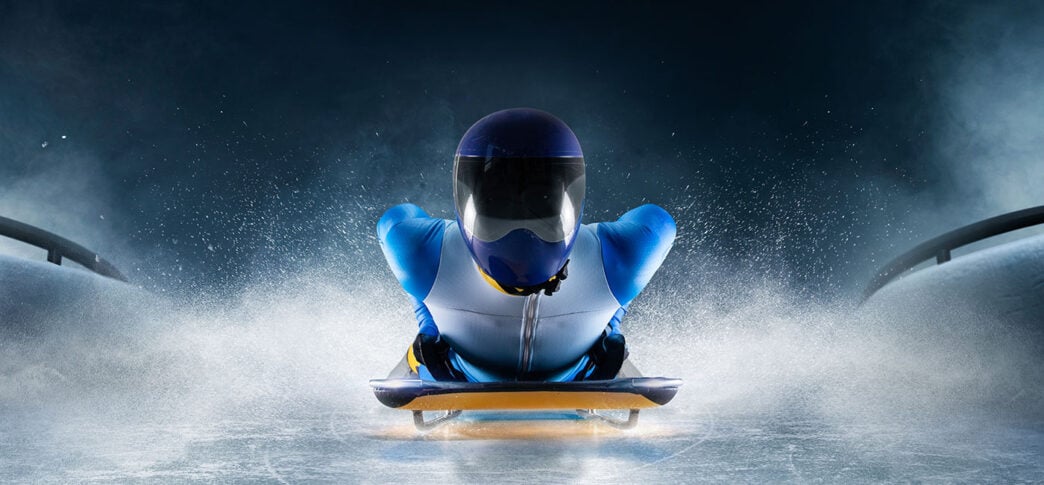
This year, 25 drones are being used at scale to capture dynamic, immersive footage of athletes in action. Of these, for the first time, 15 are custom-built first-person view (FPV) units designed to follow skiers, snowboarders, luge, and skeleton athletes from close angles, creating a visceral sense of speed and motion for the viewer.
Each drone weighs approx. 250g and can reach speeds of around 75mph. Skilled pilots see through onboard cameras via goggles and navigate precise flight paths to keep pace with high-speed competitors without interfering with performance. Usually, drones can only manage a couple of runs before returning to base to be charged. However, they can now be captured during flight, have the battery replaced, and then thrown back into the air in seconds.
Massive camera arrays and AI analytics
Alongside drones, an enormous array of fixed and robotic cameras forms a high-resolution capture network. More than 800 camera systems – including specialised 8K resolution rigs – are distributed across venues. Among these, a set of 14 8K cameras surrounds the figure skating rink, providing detailed data on jump height, airtime, and landing dynamics.
This array feeds into a proprietary AI system developed by Swiss Timing, a technology partner of the Games, which tracks athletes’ skeletal movement in three-dimensional space. The system extracts performance metrics and overlays data graphics almost instantly – a process that takes less than a tenth of a second.
Another innovation at these Games is an AI stone-tracking system in curling. Overhead camera arrays map each stone’s trajectory, speed, and rotation in real time and overlay graphics showing predicted paths and strategic options.
Sensors and precision feedback
Small, lightweight sensors embedded in equipment further extend the analytic capabilities on site. For sports such as ski jumping, sensors capture precise measurements of speed, acceleration, and body position during flight. Data from these sensors can be cross-referenced with external conditions such as wind, producing highly accurate performance metrics.
High-speed cameras augment this capability by providing slow-motion and stroboscopic footage, which helps to visualise movement nuances such as posture and timing at take-off and landing.
Cloud infrastructure and scalability
None of this would be possible without a powerful Cloud backbone. Olympic Broadcasting Services (OBS), the host broadcaster, has driven a significant shift towards Cloud-native workflows for capture, management, and distribution of content. The OBS Cloud – developed in partnership with Alibaba Cloud – supports virtualised production environments, scalable processing of ultra-high-definition feeds, and remote operation of broadcast infrastructure.
This Cloud strategy means that broadcast networks can work across geographically dispersed venues without relying solely on traditional hardware installations. Virtualised technical operations centres streamline live feed switching, camera control, and graphic overlay production.
In total, coverage is being delivered to 39 broadcasters with hundreds of simultaneous live and replay feeds.
Spectacular immersion
Technology at the 2026 Games also extends to interactive installations such as ‘Alibaba Wonder on Ice’ in Milan. Here, AI and Cloud computing are used to create personalised experiences for visitors. Attendees interact with AI agents that respond to preferences and generate tailored content such as avatars and visual journeys.
Humans and technology working together
By marrying technology and human judgement, real-time data and feedback can offer not just milliseconds of broadcast latency, but also an instantaneous comprehension of athletic performance. Human judgment is still key, but the technology ensures that speed, precision, and physical nuance are captured with a level of speed and depth that was not previously possible.
A global stage for technology
The Milano Cortina 2026 Winter Olympics feature 116 medal events across 16 sports, spread across multiple Italian venues from Milan to the Alpine mountains, covering 8,500 square miles (more than 22,000 square kilometres). The result is a far-reaching, global stage that is as much about the power of what well-orchestrated technology can do as it is about athletic excellence.
These games show us, in an age where every second counts, what is possible when technology is used in the right way – as a forward-thinking strategy, and not as a panic bolt-on.