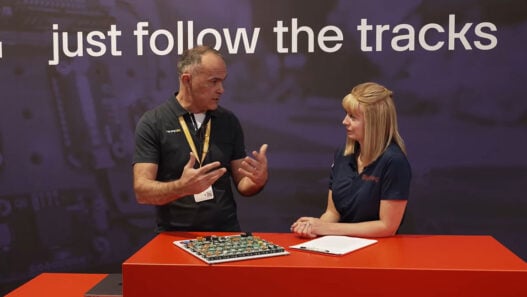





At embedded world 2026, Electronic Specifier’s Editor, Mick Elliott speaks to Coby Hanoch, CEO at Weebit Nano about the growing need for new non-volatile memory technologies and the company’s progress with resistive RAM (ReRAM).
Hanoch explained that traditional flash memory has been approaching its technological limits for more than two decades. While flash has been widely used for non-volatile storage, it struggles to scale below the 28nm manufacturing node and faces limitations in performance and efficiency. ReRAM, by comparison, offers significant advantages: it is much faster, consumes far less power, and provides much higher endurance. It is also cheaper to manufacture and can scale to smaller geometries, making it suitable for more advanced semiconductor nodes used in modern chips.
Weebit Nano operates with two types of customers. On one side, it works with semiconductor manufacturers such as foundries and integrated device manufacturers (IDMs), transferring its ReRAM technology so they can produce it in their fabrication facilities. On the other side, the company collaborates with fabless chip designers who integrate the memory into their system-on-chip (SoC) designs before sending them to those fabs for production. This model requires a detailed technology transfer process, where Weebit works closely with manufacturers to ensure the memory can be produced reliably within their existing manufacturing lines.
During the interview, Hanoch highlighted the advantages of the oxide-based ReRAM approach used by Weebit Nano. While several ReRAM architectures have been explored over the years, oxide-based implementations have proven to be among the most practical and production-ready, offering a simpler and more reliable technology path.
Artificial intelligence was another key topic. According to Hanoch, ReRAM is particularly well suited to AI workloads because it can scale to the advanced nodes required by modern AI processors. Today, many AI chips rely on an external flash chip to store neural network parameters. By integrating non-volatile ReRAM directly onto the chip, developers can eliminate the need for a second chip, reduce boot time, lower costs, and improve security. The approach also opens the door to in-memory computing architectures that are increasingly important for AI.
Hanoch also discussed the company’s growing list of partnerships, including a recent agreement with Texas Instruments and earlier deals with onsemi and DB HiTek. These collaborations mark important milestones as the technology moves toward mass production.
Looking ahead, Hanoch noted that the biggest challenge for emerging technologies like ReRAM is overcoming industry hesitation toward new solutions. However, as more major semiconductor companies adopt the technology and its reliability is proven, that perceived risk is steadily declining.