



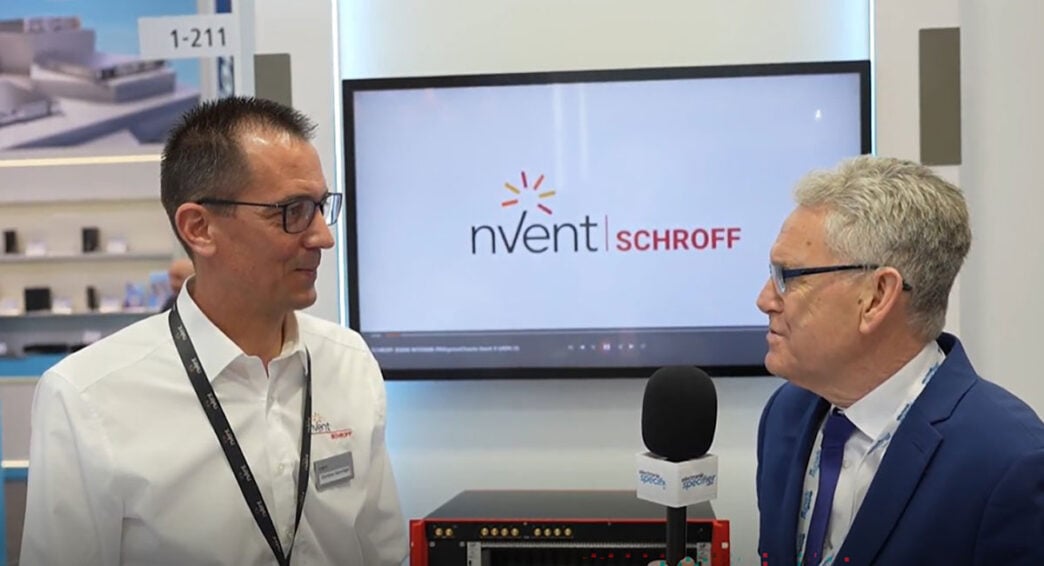
At embedded world 2026, Editor Mick Elliott spoke with Christian Ganninger, Global Product Manager, nVent SCHROFF Europe about how the company is combining thermal management, power distribution, and protection technologies to deliver more robust infrastructure for embedded applications.
Ganninger’s role at nVent focuses on managing the global lifecycle of products within the company’s SCHROFF-branded portfolio. His responsibilities span open standard systems, power distribution units, power supplies, and cooling technologies, as well as overseeing the development of new products from concept through to market deployment.
For Ganninger, embedded world remains one of the most valuable meeting points for the embedded community. The event brings together engineers, developers, and technology providers from across the industry, creating an environment where companies can showcase new technologies while engaging directly with the engineers designing next-generation systems.
A central theme on the nVent stand this year is its ‘Systems Enhanced – Cooled by Design – Protected by Default’ strategy. According to Ganninger, the concept reflects the company’s focus on addressing infrastructure challenges from a complete system perspective rather than concentrating on individual components in isolation.
One area where this approach is particularly important is thermal management. As embedded systems continue to increase in performance and power density, effectively managing heat is becoming a critical design challenge. To address this, nVent is showcasing several innovations aimed at improving cooling performance and expanding operating temperature ranges.
Among these is an “easy-swap” liquid flow-through cold plate designed for board-level cooling. The technology enables liquid cooling to be implemented directly within a card cage environment. A fixed cold plate is installed in an adjacent slot next to the board requiring additional cooling, where a specialised mechanism creates strong thermal contact between the board’s heat sink and the cold plate.
This design allows heat to be efficiently removed from high-power boards without requiring significant modifications to the existing system architecture. Importantly, the solution is retrofittable, meaning customers can integrate liquid cooling into existing platforms where power requirements have increased.
With the addition of the liquid cooling module and its associated recirculating circuitry, systems that previously supported around 80–100W per slot can be scaled up to approximately 200W per slot, enabling significantly higher performance while maintaining thermal stability.
Protection is another key pillar of the company’s strategy. In addition to thermal protection and electromagnetic compatibility (EMC), nVent is focusing on hardware-level management to improve system resilience.
One example highlighted by Ganninger is a new remotely manageable DC power distribution unit (PDU) designed for telecommunications infrastructure. Telecom equipment typically operates on 48V DC power and is often deployed in remote or difficult-to-access locations. Traditionally, these units offer limited management capabilities.
The new system introduces remote management functionality, allowing operators to monitor and control power distribution without requiring on-site intervention. If equipment becomes unresponsive, operators can remotely power-cycle devices to restore operation, reducing downtime and eliminating the need for service technicians to physically access remote installations.
As with many of the company’s developments, these solutions have been shaped through direct collaboration with customers. Ganninger explained that products such as the PXIe chassis and the liquid cooling system were developed through ongoing feedback from users during the design process. This iterative approach allows customers to contribute requirements and insights throughout development, ensuring the final products align closely with real-world applications.
Watch the full video below: