



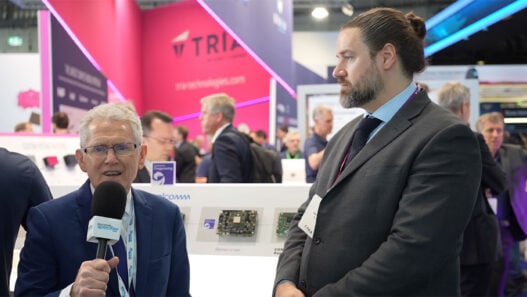


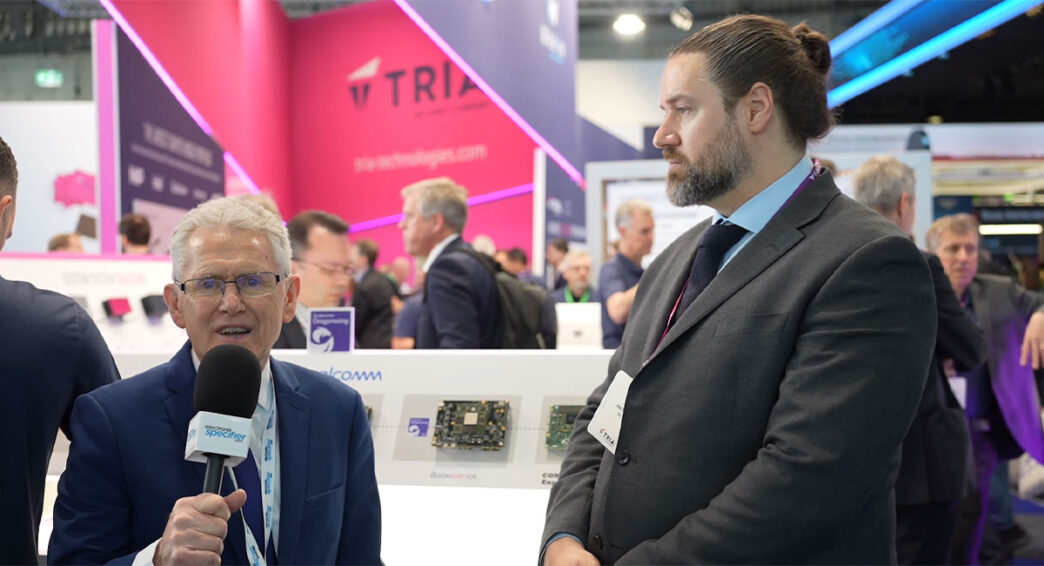
At embedded world 2026 Electronic Specifier Editor Mick Ellliott spoke with Alex Wood, Marketing Director at Tria Technologies about Edge AI demos and real life applications for Edge computing.
Wood explains how Tria has emerged as a standalone brand following the acquisition of MSE Technologies by Avnet. The company later operated as Avnet before launching the Tria brand to establish a distinct identity in the embedded computing sector.
He explained: “Tria launched as a brand a couple of years ago… we really wanted a standalone brand. We really wanted to stand out and be bold, hence the pink colour scheme.”
The company focused on designing and manufacturing embedded computing modules, systems, and full human-machine interfaces (HMIs), while also providing the software stack. This combination enabled customers to accelerate product development.
Wood said the goal was to help customers move “from idea to product as quickly as possible”.
A central theme of the discussion was Tria’s collaboration with Qualcomm. The semiconductor company had expanded its presence in embedded computing, building on its long-standing experience in wireless and communications technologies.
According to Wood, Qualcomm’s processors – including its DragonWing range – had proved well suited to Edge computing applications. These processors offer high performance while maintaining relatively low power consumption and heat output.
That combination allows advanced computing capability to be deployed in industrial environments without requiring large cooling systems or constant Cloud connectivity.
Wood explained: “The exciting thing about Qualcomm is that they have high performance for relatively low power draw and low heat, which means that we can take their more powerful Edge processors… and put them into more industrial computing.”
This enables Edge AI applications where processing takes place locally rather than in the Cloud.
One sector where this technology has gained traction is agriculture. Wood said the industry presented opportunities for automation and data-driven decision-making.
Tria has worked with customers developing AI-based vision systems that could operate directly in the field.
He said: “At the moment, agriculture is one of those most exciting spaces… we’re working with customers to develop vision-based AI systems where they can do things like object recognition in the field, crop monitoring, or automatic harvesting.”
Such systems often require ruggedised hardware capable of operating in demanding conditions. Equipment might need to withstand temperature fluctuations, moisture, and continuous operation throughout the year.
Tria’s embedded modules supported this type of deployment by combining computing performance with industrial reliability.
Another topic discussed was the choice between chip-down designs and modular computing solutions. While some manufacturers designed custom hardware at scale, Wood said many companies preferred modules because they reduced development complexity.
Using a module allowed customers to integrate processing capability more quickly by placing the module onto a carrier board, rather than designing a full processor implementation themselves.
Wood noted that this approach also helped companies keep pace with evolving processor and communications technologies.
The company primarily works with large OEMs producing equipment at global scale, including medical device manufacturers, agricultural machinery producers, and building automation companies.
Tria designed and manufactured its hardware in Europe, with engineering, research, and production teams operating within the same facility.
Wood said this integrated structure provided customers with transparency and confidence in the development process, as they could see both the design and manufacturing stages in operation.
Together with partners such as Qualcomm, Tria continued to focus on delivering embedded computing solutions that enabled Edge AI deployment across a range of industrial applications.
Find out more in the interview below.