







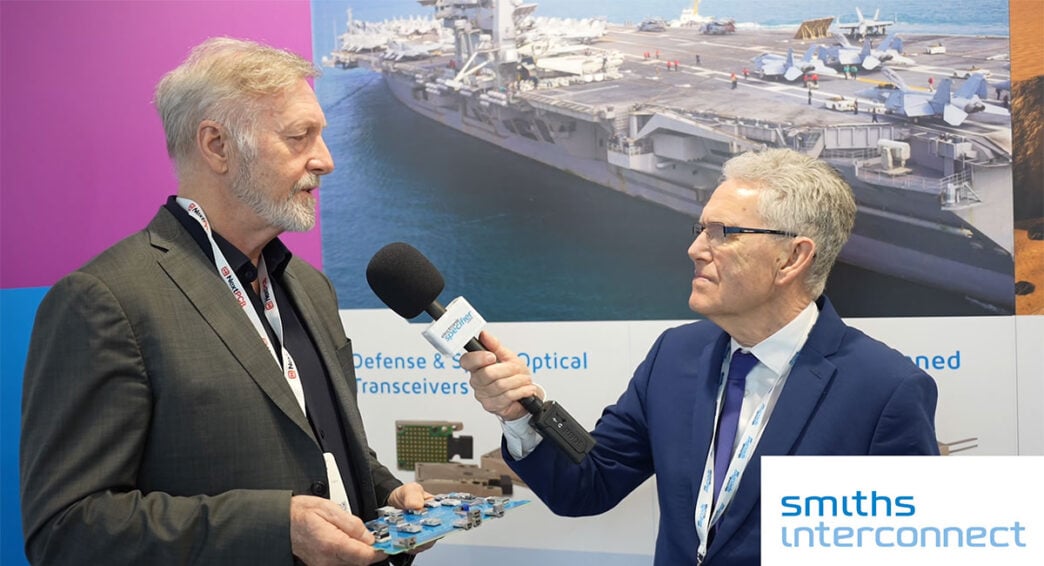
At embedded world 2026, Electronic Specifier Editor Mick Elliott speaks with Pierre Cardinal, Regional Sales Manager at Smiths Interconnect, to discuss the company’s latest developments in RF components and embedded fibre-optic technologies for high-reliability markets.
Cardinal outlines how the company was showcasing resistive attenuators, thermopads, filters, circulators, and waveguide products, alongside transceivers designed for industrial, defence, and space environments. The company focuses particularly on sectors where high reliability is required.
Smiths Interconnect’s primary markets include industrial, medical, defence, and space applications where components must operate in demanding environments. Space remains a significant focus for the business, particularly as satellite technology continues to evolve.
A major highlight at the stand is the company’s embedded fibre-optic transceiver technology, which is designed to optimise SWaP – size, weight, and power – for embedded systems. These compact transceivers support both 10G and 28G data rates and are available in several configurations, including duplex and multi-line formats that enable high-density electronic designs.
The technology has also been developed to meet space mission requirements. Smiths Interconnect produces radiation-resistant optical transceivers designed in line with standards set by the European Space Agency.
Cardinal notes that the technology has already been deployed in orbit. “We have the first satellite SCS 17A that’s using our transceiver for it throughout satellite so 25 years mission so we have done that with our partner Thales Alenia Space.”
The work with Thales Alenia Space marks a milestone for the technology, demonstrating its readiness for operational use. According to Cardinal, the company’s transceivers have now reached Technology Readiness Level nine, meaning they have been proven in real mission environments.
Smiths Interconnect also continues to develop new designs that support direct board-level integration. One example includes embedded surface-mount transceivers that connect directly into backplane connectors in accordance with the VITA open standard, which is commonly used in military and aerospace electronics.
These technologies support emerging satellite architectures that require increased processing capability and higher transmission throughput.
Cardinal also discusses the growing importance of direct-to-device satellite communication, often referred to as D2D. This technology enables devices such as IoT sensors and smartphones to communicate directly with satellites using existing cellular networks.
“It will allow all the devices to be tracked, follow, communicate whatever in the world without directly through a satellite.”
He explains that this approach could enable devices to remain connected even in locations without traditional network coverage, removing the need for dedicated ground stations or specialised terminals.
The development of these systems involves collaboration with aerospace partners and industry organisations. Smiths Interconnect works closely with companies such as Airbus as well as the European Space Agency to ensure the technology meets mission requirements.
According to Cardinal, producing radiation-hardened components capable of supporting long-duration missions requires extensive testing and validation.
He adds that the market for satellite communications continues to expand rapidly, particularly with the growth of high-throughput satellites and low Earth orbit constellations.
With certified, space-ready transceivers already deployed in orbit, Smiths Interconnect positions its technology to support both established space missions and emerging satellite communication applications.
Find out more in the interview below.