




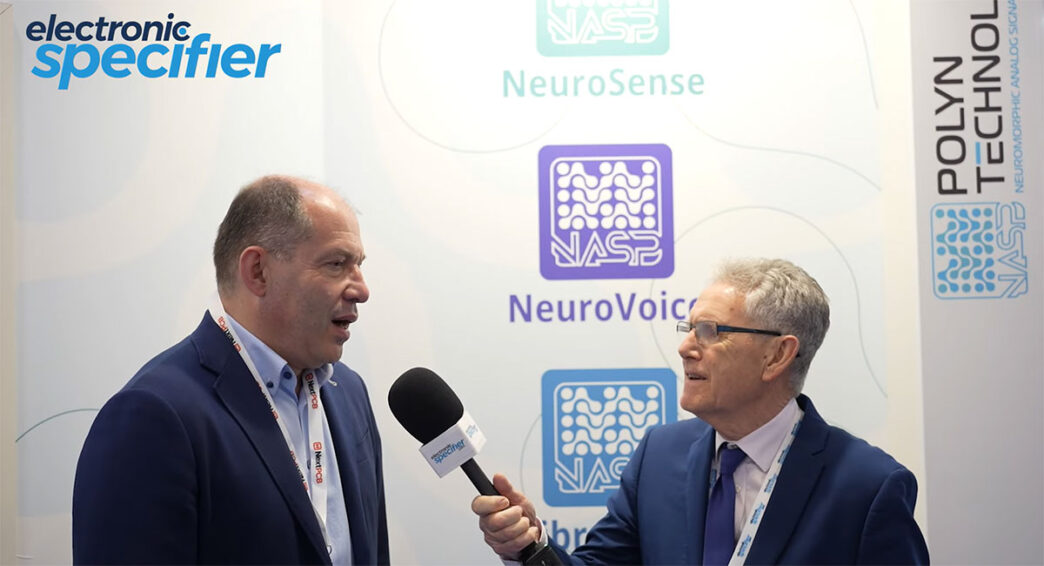
At embedded world 2026, Electronic Specifier Editor Mick Elliott speaks to Aleksandr Timofeev, CEO of POLYN Technology, about the company’s pioneering Neuromorphic Analog Signal Processing (NASP) technology and a live demonstration of its first silicon-proven chip.
Founded in 2020, POLYN Technology set out to address a long-standing tension in embedded computing: the trade-off between low latency and low power consumption. In conventional digital systems, achieving faster processing comes at the cost of higher energy use. POLYN’s answer was to rethink the architecture entirely. Rather than running neural networks on digital hardware, the company developed a method to translate digital neural network structures into physical analogue neuromorphic cores — silicon designs in which neurons and analogue data processing are realised physically, not simulated.
It took the team four years to build the compiler that makes this conversion possible. The result of that effort is POLYN’s first commercial chip: a voice activity detection (VAD) device that consumes power at the microwatt level, enabling always-on listening without draining a battery. A live demo at embedded world 2026 showcased this capability in action, showing what becomes possible when a chip can continuously monitor for audio events at negligible energy cost.
Full natural-language understanding — the kind needed to respond to complex, open-ended queries — still requires the Cloud, simply because the underlying models are too large to run locally. However, for the vast majority of everyday voice interactions — switching lights on and off, controlling a television, issuing simple home automation commands — the POLYN chip can handle these entirely offline. Timofeev describes a hybrid architecture in which simple commands are processed locally, and a specific trigger phrase can initiate a secure handoff to Cloud services for more complex requests. He says, for roughly 90% of daily interactions, users only need basic on/off-style commands, making the offline-first model both practical and privacy-preserving.
Because of this low-power profile, it opens up product categories that were previously impractical. Battery-powered voice-enabled devices — standalone room hubs, wireless remote controllers, compact smart-home nodes — become viable when the always-on listening component draws microwatts rather than milliwatts. POLYN’s vision is a smart home that functions fully offline, with cloud connectivity available on demand rather than by default.
On the manufacturing side, POLYN produces its chips at GlobalFoundries in Singapore using a 55-nanometre process node. Timofeev notes that the analogue nature of the NASP architecture means the company does not require cutting-edge process nodes — a significant cost advantage compared to digital AI chips competing for capacity on the most advanced fabs.
Looking ahead, POLYN has a clear product roadmap. The second-generation chip will combine voice activity detection with voice extraction, and the following generation will add speaker recognition — enabling the system to identify not just that a voice is present, but whose voice it is. These additions will progressively move more of the speech-processing pipeline onto the local device.
See the full conversation below.