





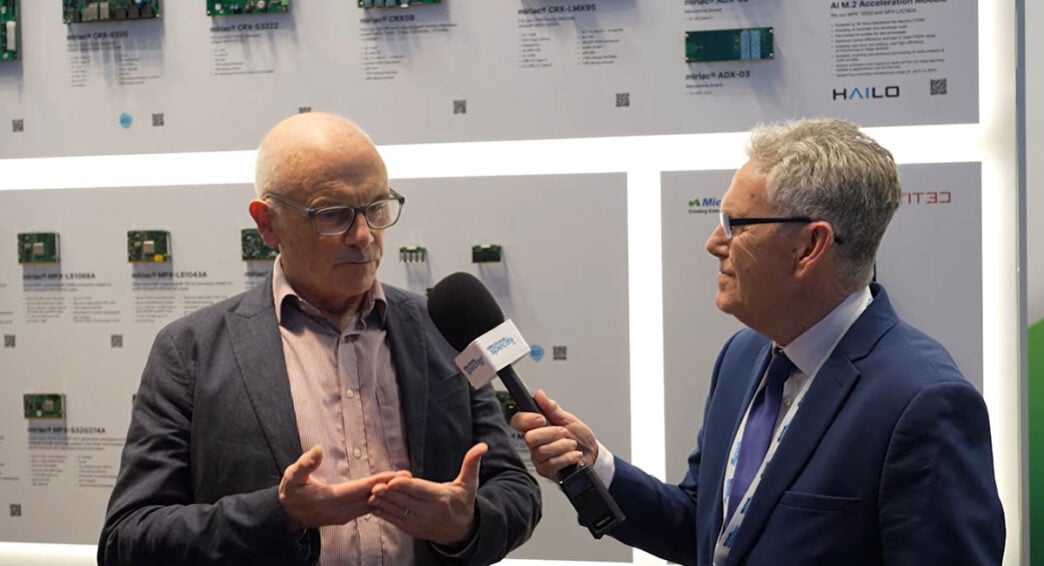
At embedded world 2026, Editor Mick Elliott spoke to David Pashley, MD at Direct Insight, on the Microsys booth, about the growing demand for functionally safe platforms, and how evolving regulations are shaping embedded system development.
Direct Insight has been working closely with Microsys for several years, helping bring advanced system-on-module (SoM) solutions to market. According to Pashley, Microsys stands out because of its focus on high-end processors from NXP Semiconductors, particularly the increasingly talked-about NXP i.MX95. While many vendors are now developing platforms based on the i.MX95, Microsys has taken a distinct approach by targeting demanding sectors such as automotive and autonomous robotics.
These industries require not only high levels of computing sophistication but also strict adherence to functional safety standards. To address this, Microsys has developed a new i.MX95-based module designed with safety-critical applications in mind. While the processor itself is capable of supporting functional safety, Pashley explained that achieving this in practice requires careful system design – particularly around power management and redundancy.
Microsys’ solution involves a 314-pin connector that exposes power supply lines externally, enabling system designers to implement redundant power strategies necessary for functional safety compliance. The module connects to a feature-rich baseboard that offers a wide array of interfaces, making it suitable for complex embedded applications.
For Direct Insight, the platform opens new opportunities in areas such as autonomous robotics and medical technology – two sectors where reliability and safety are paramount. By combining the Microsys hardware with QNX, Direct Insight can deliver a complete functional safety environment tailored to mission-critical applications.
The baseboard itself provides extensive connectivity, with additional flexibility available through expansion options. These include support for high-performance interfaces such as Power over Ethernet and 10-Gigabit Ethernet, which are increasingly required in advanced robotics and industrial automation systems.
The new development kit is expected to become available imminently, with production modules scheduled for release later in the year once customers have completed their development cycles. Microsys also plans to offer multiple memory configurations to address current market challenges around memory pricing.
Pashley noted that the industry is experiencing significant pressure on DDR5 supply, leading to higher costs. To accommodate different budgets and use cases, Microsys will provide modules ranging from 2 up to 16GB of RAM. This reflects a shift in design philosophy, where engineers are once again focusing on optimising memory usage rather than assuming abundant and inexpensive memory resources.
Beyond hardware platforms, Direct Insight is increasingly supporting customers with regulatory compliance, particularly in response to new cybersecurity requirements. Two major frameworks are currently shaping product development: the Cyber Resilience Act and the EU Medical Device Regulation. As these regulations converge, manufacturers must implement features such as secure boot, over-the-air updates, software bills of materials, and hardened system images with minimised vulnerabilities.
Direct Insight is already integrating these capabilities into customer projects, helping companies ensure their products meet upcoming compliance requirements.