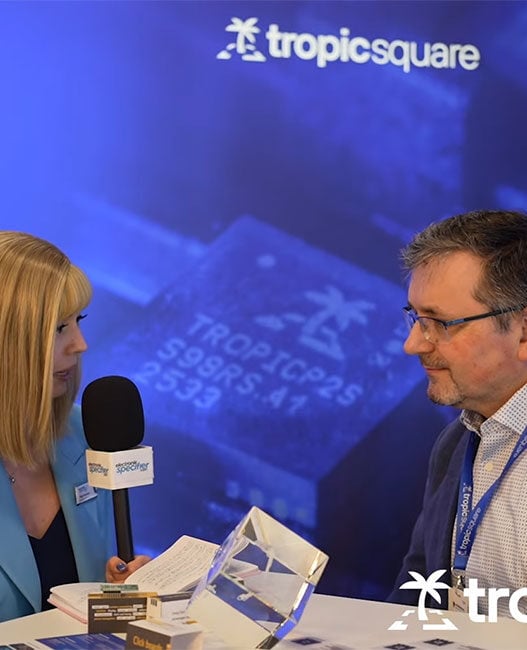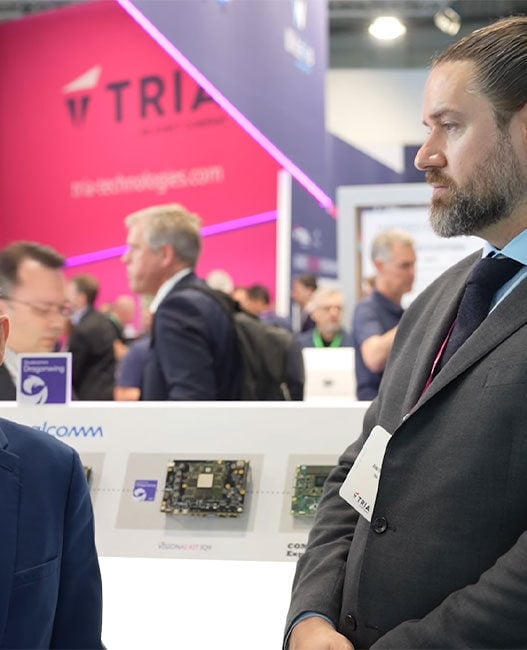








At embedded world 2026 on the DigiKey booth, Lucy Barnard spoke with Ravindra Singh, Product Manager for Radio Modules and Ninad Mehta, Product Manager for MEMS Sensors at Würth Elektronik, to discuss the latest innovations from Würth Elektronik designed to help engineers build smaller, more connected, and energy-efficient devices.
At the event, Würth Elektronik introduced new connectivity modules and sensing technology designed to help engineers develop compact, energy-efficient connected devices.
Speaking at the event, the pair outlined how the new products addressed common design challenges in IoT systems, including power consumption, connectivity reliability, and system integration.
The company described itself as a manufacturer of both passive and active electronic components, spanning capacitors, inductors, connectors, power modules, wireless connectivity solutions, and sensors. The company aims to provide engineers with a consolidated development ecosystem.
Singh said: “From passive components we have capacitor, inductors, connectors, and on the active side we have DC/DC modules, power modules and sensors. We also have the wireless solutions including Bluetooth, Wi-Fi, LoRa, cellular products and antennas, so it is kind of a one-stop shop for connectivity.”
New compact wireless modules
At the centre of the announcement were two wireless modules – Proteus-IV and Ophelia-IV – designed for space-constrained and battery-powered devices.
Both modules measured 12mm × 8mm and were built around the nRF54L15 chipset from Nordic Semiconductor. According to Singh, the platform combined processing capability, integrated memory, and security features intended to support future regulatory requirements.
Singh said: “This is the latest release from Nordic Semiconductor. It is based on a 128MHz ARM Cortex-M33 processor, with 1.5MB of non-volatile memory and 256KB of RAM, and it supports advanced security features.”
The modules also include dual antenna options, allowing engineers to use an integrated PCB antenna or connect an external antenna depending on the application’s coverage requirements.
Another design priority was energy efficiency. Singh explained that the modules consumed approximately 6 microamp in deep sleep mode, enabling devices to remain operational for extended periods on battery power.
Singh said: “Most IoT devices are battery powered.” So the device sleeps most of the time, wakes up occasionally to send the data, and then goes back into sleep state.
The Proteus-IV module shipped with pre-certified Bluetooth 6.0 firmware, enabling faster deployment for developers. The Ophelia-IV version used the same hardware but targeted developers that required greater flexibility to build their own firmware or protocols.
Expanding the sensor portfolio
Alongside connectivity products, Würth Elektronik also introduced a new MEMS-based differential pressure sensor.
Mehta explained that sensors formed a critical part of the data pipeline in connected systems.
Mehta said: “You need the data to send from point A to point B, and that is why we have these sensors.”
The new component forms part of the company’s growing MEMS sensor portfolio and incorporated multiple interface options including I²C, SPI, and analogue output. The device also operated across a supply range from 3.3V to 5V, allowing integration into a variety of systems.
Typical applications included HVAC filter monitoring, portable medical devices such as blood pressure monitors, and industrial pneumatic control systems.
The sensors were delivered fully calibrated and temperature-compensated, enabling rapid deployment into production designs.
Mehta said: “The sensors are fully calibrated and fully compensated. We do the factory calibration in production, so they are ready to be deployed in the end application.”
Addressing engineering challenges
Both product managers emphasised that the new technologies were developed in response to feedback from engineers facing increasing system complexity.
Wireless device design often involved antenna integration, regulatory certification, and technology selection. Singh explained that pre-certified modules helped shorten development cycles by reducing compliance requirements.
The company’s modules were already certified for CE in Europe and FCC in the United States, allowing manufacturers to incorporate the components while accelerating time-to-market.
For sensor applications, flexibility was a key requirement. Meta said the differential pressure sensor family could be customised for different pressure ranges and connection methods depending on the end use.
As device connectivity expanded across industries, the company expected demand to grow for compact modules and sensors that simplified integration while maintaining reliability and energy efficiency.
Find out more in the interview below.