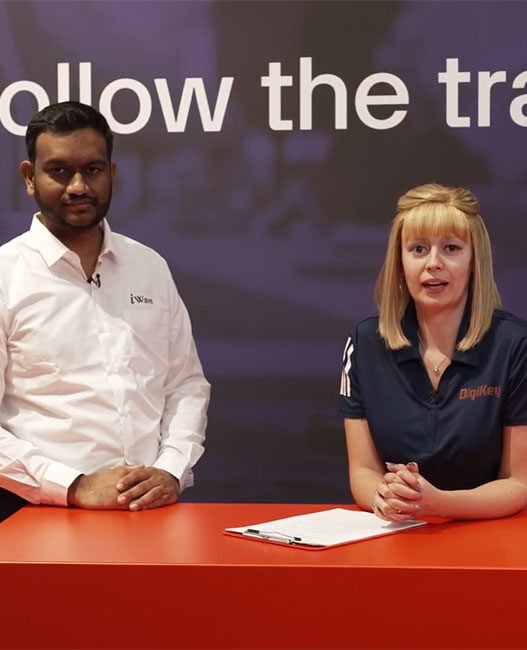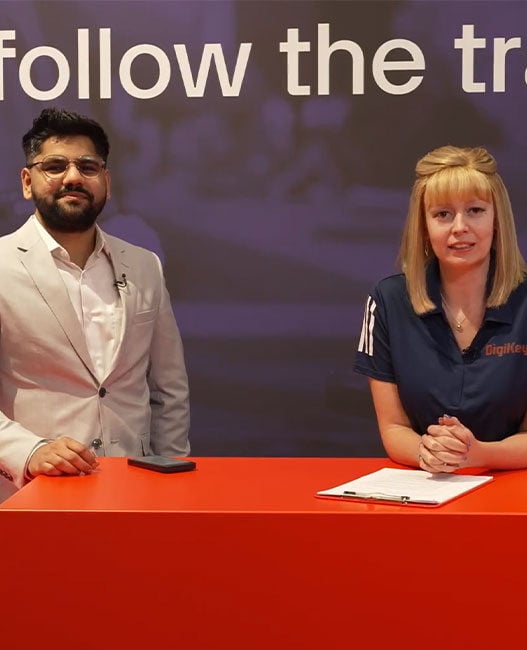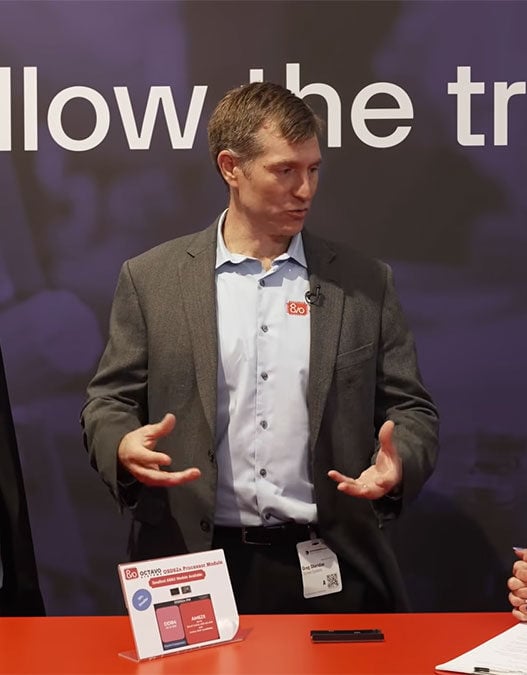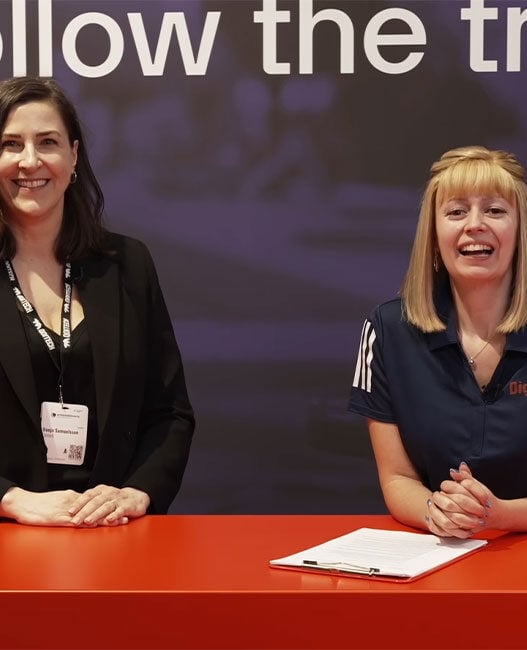


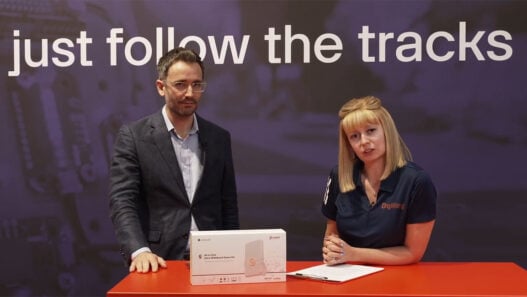

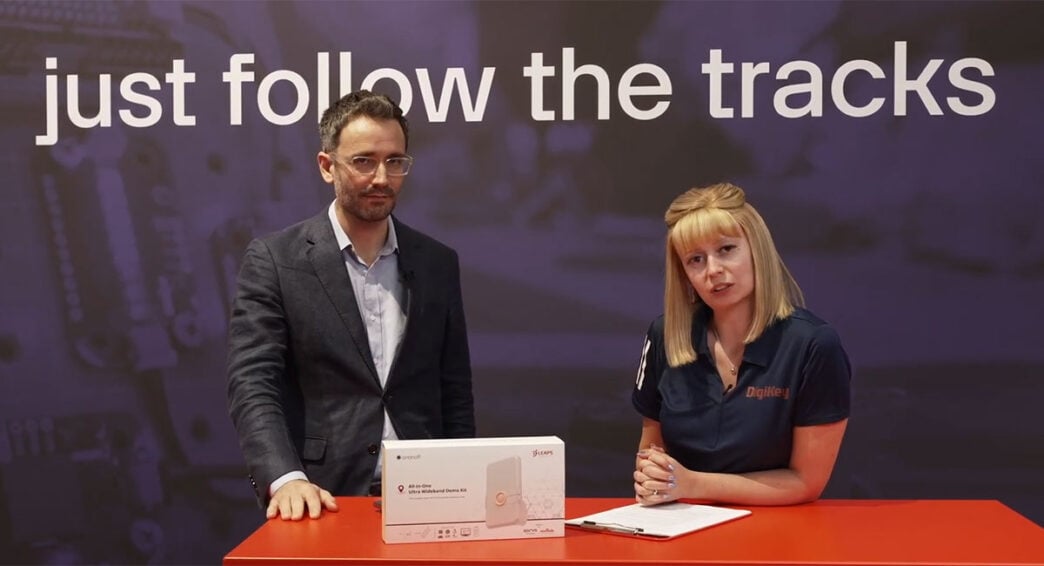
At embedded world 2026 on the DigiKey booth, Paige Hookway spoke with Alexis Bizalion, Director of Product Marketing and Strategy, at Qorvo, to explore how ultra-wideband (UWB) is redefining real-time location systems (RTLS) in industrial and enterprise environments.
Qorvo’s approach, Bizalion explained, is fundamentally system-level: “It’s the chips, it’s the software, it’s the standards, it’s going to be the modules, the reference design that goes around it,” with close collaboration on schematics, antenna design, and full solution development alongside ecosystem partners.
When asked what differentiates UWB from other wireless technologies that claim positioning capabilities, Bizalion was clear: UWB’s physics gives it a unique edge. With 500MHz of bandwidth, UWB can achieve a time resolution of about two nanoseconds, enabling highly precise time-of-flight measurements between devices. “You know precisely how far a device is at the centimetre level,” he noted.
This precision also underpins UWB’s security advantages. Unlike technologies that rely on signal strength (RSSI), UWB’s distance measurement is far harder to spoof. That makes it particularly effective for mitigating relay attacks and securing applications that depend on trustworthy proximity, such as access control or industrial identification. Built on the IEEE 802.15.4z standard, Qorvo’s UWB solutions support major ecosystems including CCC for automotive, FIRA for consumer and industrial, and NXP’s N-Blocks for industrial ranging.
In real deployments today, Bizalion sees UWB used across a spectrum of applications: asset tracking (e.g., locating crash carts in hospitals or tools on the factory floor), worker safety (knowing where people are in case of fire or mining accidents), and robot safety and navigation. Robots on the factory floor increasingly rely on UWB to understand where people and other machines are, enabling safe coexistence in crowded and complex environments.
One misconception that slows adoption is treating UWB “like Wi-Fi or Bluetooth.” In reality, it’s a more complex infrastructure technology that demands careful planning – especially around anchor density and antenna design. But with proper planning, UWB becomes “a very secure and scalable technology once the infrastructure is in place.”
Scalability is a central strength. Through tight synchronisation between anchors and techniques such as uplink time difference of arrival (TDoA), UWB systems can track tens of thousands of devices simultaneously – for example, an event where every attendee wears a UWB-enabled badge, or a factory where every tool, pallet, and worker is tagged and locatable in real time.
To help engineering teams get started, Qorvo offers a development kit aimed at rapidly prototyping UWB solutions. Bizalion explained that engineers need to quickly understand anchor density, system latency, and especially power–update-rate trade-offs for battery-powered tags in asset tracking scenarios: “Do you need to know if the tag is moving all the time? Or can you just make a system where you need to know where the tag is moving at all, when it’s not moving you’re not tracking it?”
The kit allows teams to evaluate RTLS, point-to-point, and one-to-many use cases and, he said, can cut evaluation times from months to weeks or even days – and is available through DigiKey.
Looking forward, Bizalion emphasised that UWB is evolving from a positioning technology into a broader spatial awareness platform. With newer chips, UWB can not only locate but also sense through analysis of the channel impulse response. This enables detection of very small motions, such as heart rate, and makes it possible to distinguish humans from machines – critical for robot safety, presence detection around moving mechanical arms, and even child presence detection in cars, ensuring that a person hasn’t been left behind.
In short, UWB is becoming a foundational technology for safer, smarter, and more autonomous industrial and automotive environments, moving beyond “where is it?” to “what is it, and is it safe to act?”
Watch the full interview below.