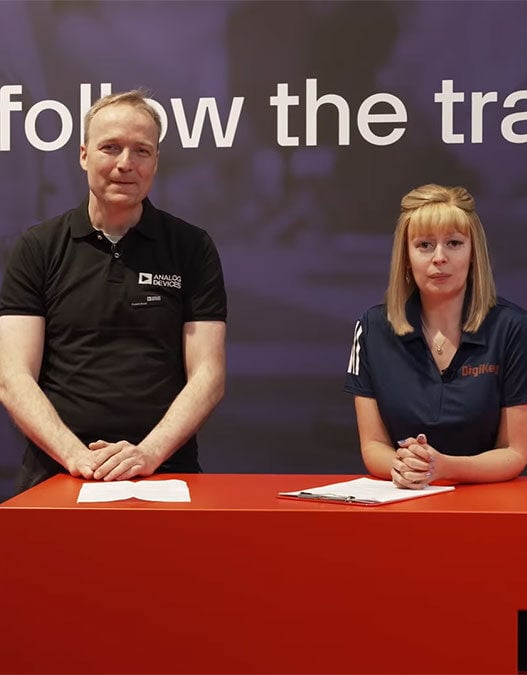






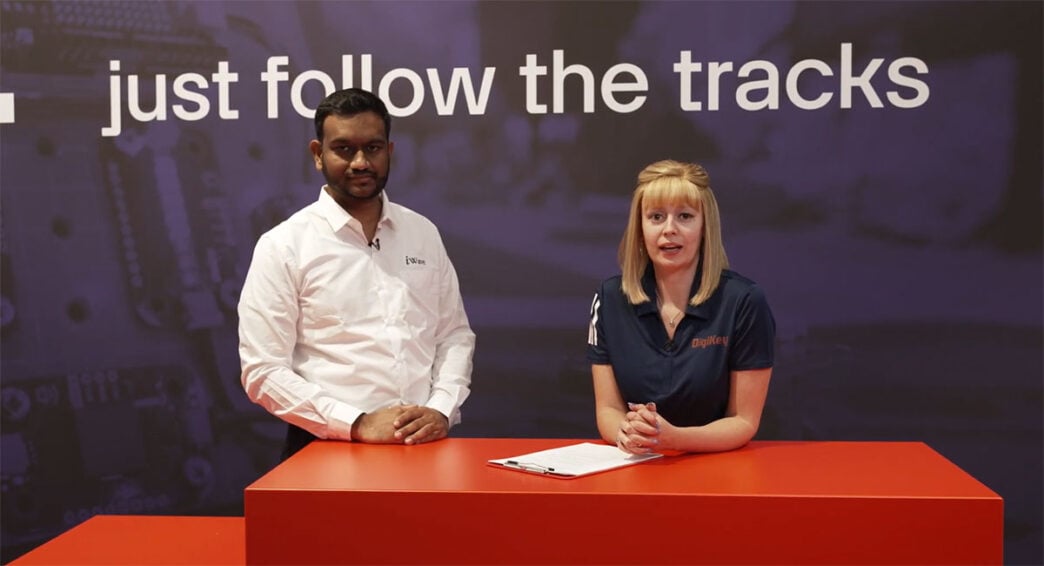
At embedded world 2026, on the DigiKey booth, Paige Hookway speaks with Tawfeeq Ahmad, Associate Director, Product Marketing at iWave, about Advancing RF Innovation with FPGA System on Modules.
The world of RF design is evolving rapidly, and iWave’s Tawfeeq Ahmad gave a clear picture of how FPGA-based System on Modules (SOMs) are helping engineers meet increasingly demanding requirements — faster, and with less risk.
Ahmad explains that customers today are grappling with a familiar but persistent set of challenges: “Customers are facing challenges in terms of design, such as timing matching, power integrity, signal integrity, and different types of clocking – that is usually a challenging concept in RF design.”
iWave’s answer is to absorb that complexity into the SOM itself, handling power, RF length matching, and timing at the module level so that customers can focus on differentiation rather than infrastructure.
The FPGA landscape itself is shifting in ways that make these modules increasingly powerful. Ahmad pointed to the integration of direct RF ADC and DAC blocks directly onto modern FPGAs as a defining trend. Sampling speeds have reached up to 32GSPS, with frequencies extending to 18GHz and up to 16ADC and DAC channels available on-chip.
“Previously, we used to have standalone FPGAs and different external ADC DAC,” Ahmad notes. “But today we see a lot of direct RF ADC and DAC integrated on the FPGA.”
That integration, combined with expanded AI engines and DSP compute on the fabric, means a single device can now handle workloads that once required multiple discrete components.
For applications requiring ultra-low latency and real-time processing – increasingly common requirements across sectors like radar and software-defined radio – iWave’s SOMs address synchronisation at the design level.
“We take care of a lot of timing requirements in terms of the clock and in terms of the latency requirements across the different RF channels,” Ahmad explains, adding that multi-board synchronisation is also handled within the SOM architecture itself.
When it comes to wideband signal acquisition, iWave brings out all RF ADC and DAC channels through external connectors, provisioning for different channel configurations, timing, and frequency ranges. This gives customers a flexible foundation to build across a wide range of wireless architectures without starting from scratch.
In terms of market traction, Ahmad identified aerospace and defence as the standout vertical, driven by growing demand for software-defined radios and radar systems. 5G wireless infrastructure rounds out the picture as another key application area where RF SoCs are seeing accelerating adoption.
Looking ahead, Ahmad sees the trajectory continuing in a clear direction: more channels, higher frequencies, and greater bandwidth – all within tighter constraints on size, weight, and power.
“Increasing channel length, increasing frequency, increasing bandwidth with reduced size, weight, and power – that is what we are taking care of on the system on module,” he says. For engineers navigating the next generation of RF system design, that promise of managed complexity in a compact, proven module may prove to be the critical enabler.
Watch the full conversation here.