




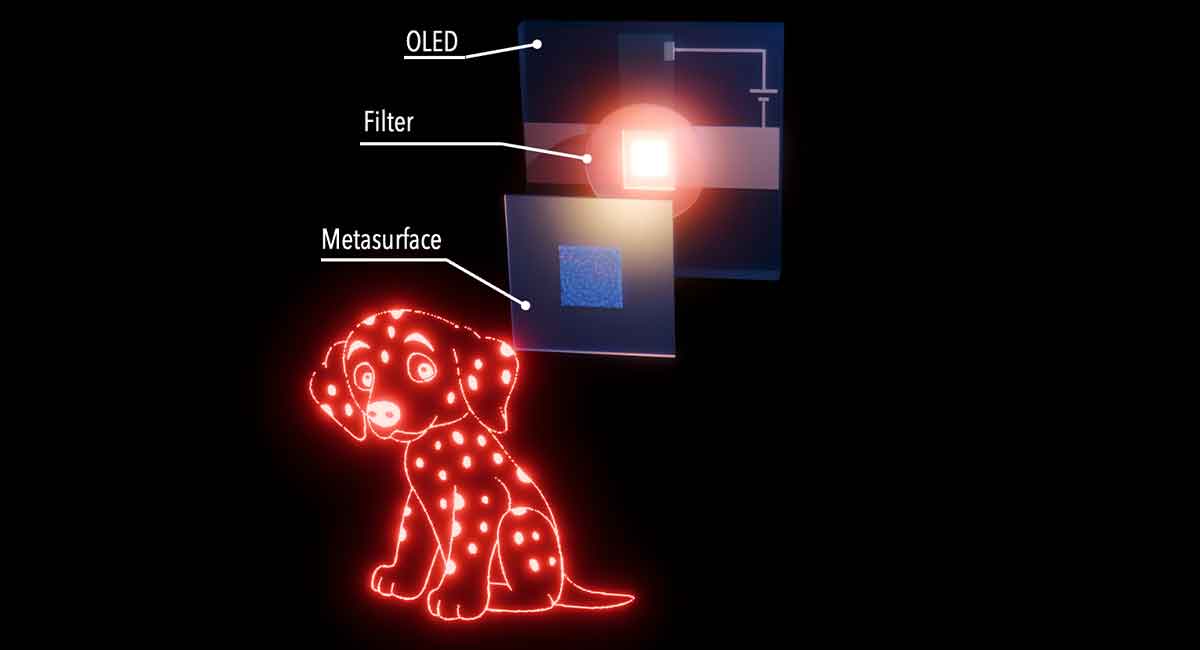
New research from the University of St Andrews paves the way for holographic technology, with the potential to transform smart devices, communication, gaming, and entertainment.
In a study published in Light, Science and Application, researchers from the school of Physics and Astronomy created a new optoelectronic device from the combined use of Holographic Metasurfaces (HMs) and Organic Light Emmitting Diodes (OLEDs).
Until now, holograms have are created using lasers, however researchers have found that using OLEDs and HMs gives a simpler and more compact approach that is potentially cheaper and easier to apply, overcoming the main barriers to hologram technology being used more widely.
OLEDs are thin film devices widely used to make the coloured pixels in mobile phone displays and some TVs. As a flat and surface-emitting light source, OLEDs are also used in emerging applications such as optical wireless communications, biophotonics, and sensing, where the ability to integrate with other technologies makes them good candidates to realise miniaturised light-based platforms.
A holographic metasurface is a thin, flat array of tiny structures called meta-atoms – the size of roughly a thousand of the width of a strand of hair – they are designed to manipulate light’s properties. They can make holograms and their uses span diverse fields, such as data storage, anti-counterfeiting, optical displays, high numerical aperture lenses – for example optical microscopy, and sensing.
This, however, is the first time both have been used together to produce the basic building block of a holographic display.
Researchers found that when each meta-atom is carefully shaped to control the properties of the beam of light that goes through it, it behaves as a pixel of the HM. When light goes through the HM, at each pixel, the properties of the light are slightly modified.
Thanks to these modifications, it is possible to create a pre-designed image on the other side, exploiting the principle of light interference, whereby light waves create complicated patterns when they interact with each other.
Professor Ifor Samuel, from the School of Physics and Astronomy, said: “We are excited to demonstrate this new direction for OLEDs. By combining OLEDs with metasurfaces, we also open a new way of generating holograms and shaping light.”
Andrea Di Falco, professor in nano-photonics at the School of Physics and Astronomy, said: “Holographic metasurfaces are one of the most versatile material platforms to control light. With this work, we have removed one of the technological barriers that prevent the adoption of metamaterials in everyday applications. This breakthrough will enable a step change in the architecture of holographic displays for emerging applications, for example, in virtual and augmented reality.”
Professor Graham Turnbull, from the School of Physics and Astronomy, said: “OLED displays normally need thousands of pixels to create a simple picture. This new approach allows a complete image to be projected from a single OLED pixel!”
Until now, researchers could only make very simple shapes with OLEDs, which limited their usability in some applications. However, this breakthrough provides a path toward a miniaturised and highly integrated metasurface display.