


For decades, out-of-home advertising has followed a familiar pattern: static posters, backlit billboards, and, more recently, large-format LED screens. Impressive as those mediums are, they share one limitation – they’re bound to physical surfaces.
Drone shows break that constraint.
In a presentation at ISE 2026, Mark Moosmayer, Sales Director at Lang, made a compelling case that drone shows are rapidly evolving from pure entertainment into a powerful new pillar of digital signage. The story here isn’t just “cool lights in the sky” – it’s about a programmable, networked, high-impact display medium that lives in 3D space.
Below are the key takeaways on why drone shows matter for digital signage, how they work, and where the technology is heading.
From novelty to high-scale platform
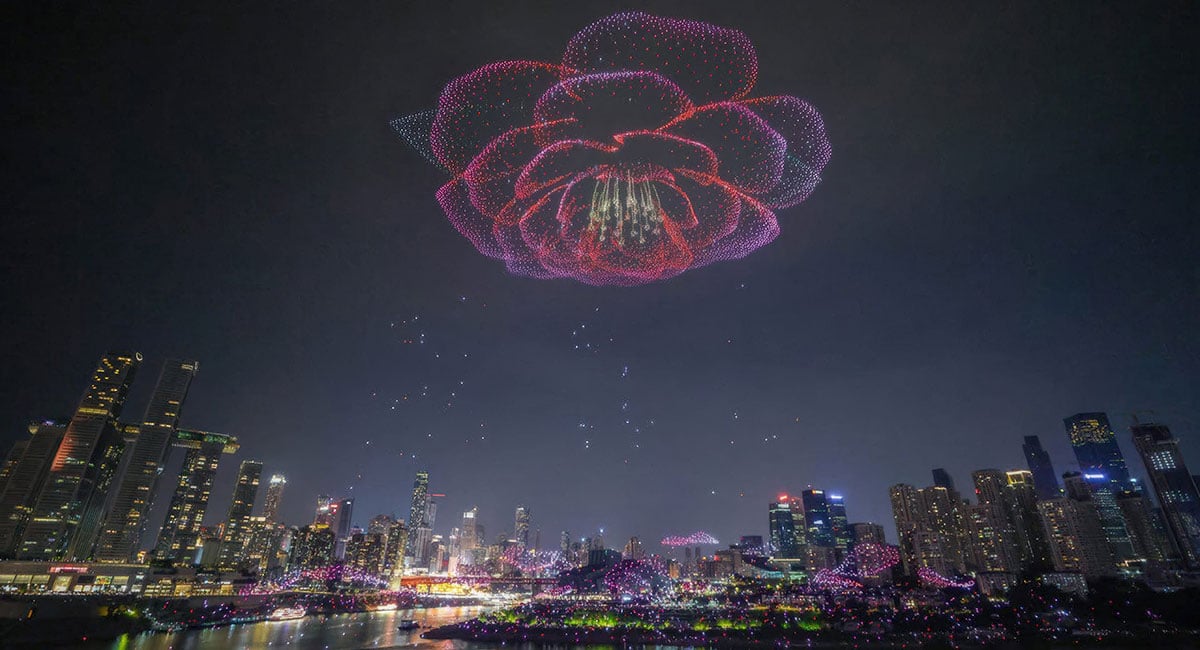
Moosmayer reminisced about seeing a 50-drone show in Lindla about three and a half years ago, and being impressed, to today’s mega-displays involving thousands of drones. A recent example being the 9,000-drone show for the opening of Disneyland Abu Dhabi. That exponential growth in scale signals that drone shows are transitioning from an experimental spectacle to a mature medium.
What’s important for digital signage is not just scale but predictability and repeatability. The shows are precomputed, not manually flown. Software controls flight paths, timing, and formations; the ‘pilot’ is essentially triggering an orchestrated, deterministic program. That’s exactly the kind of reliability digital signage networks demand.
Why drone shows belong in digital signage
Traditional digital signage revolves around fixed displays – LED walls, LCD networks, projections. Drone shows redefine what a ‘display surface’ can be:
360° visibility and massive reach
A drone show is inherently:
- Elevated: content is “up in the sky,” not at eye level
- Omnidirectional: visible 360 degrees around the display volume
- Long-range: content can be seen from hundreds of metres to kilometres away
This gives drone-based signage a coverage pattern that no single LED installation can match. A single show in a dense urban environment can reach both people on-site and viewers from a wide radius, without needing multiple physical placements.
Memorability and “non-skippable” presence
Moosmayer contrasts drone shows with the daily noise of posters and LED boards. In a typical city walk, you might pass hundreds of analog posters and dozens of LED screens, most of which you forget almost immediately. A drone show, by contrast, is:
- Time-bound (limited duration)
- Spatially dominant (above everything else)
- Visually novel (3D formations, animated graphics, logos, characters)
In practice, “nobody just passes by a drone show without noticing the message”. That makes it less like a banner ad and more like a live event – high-intent attention rather than peripheral exposure.
Rich visual language: 2D, 3D, and interaction
Drone formations can represent:
- 2D logos and graphics, rotated in space so they remain visible from multiple angles
- 3D objects – characters, symbols, branded shapes
- Dynamic sequences that tell short visual stories
One example Moosmayer cited involved a Penny supermarket show in Cologne that not only entertained but converted viewers using a QR code formed in the sky, scannable from up to a kilometre away. That QR example is crucial: it shows drone shows aren’t just visual; they can be entry points into digital funnels – app downloads, campaign microsites, or AR experiences.
Addressing constraints: space, setup, and continuity
Drone shows do come with constraints. Historically, a 600-drone show required around 500 square metres of staging area, which is not trivial to secure in dense urban centres. The setup process – aligning and arming hundreds of units – also demanded substantial time and staffing.
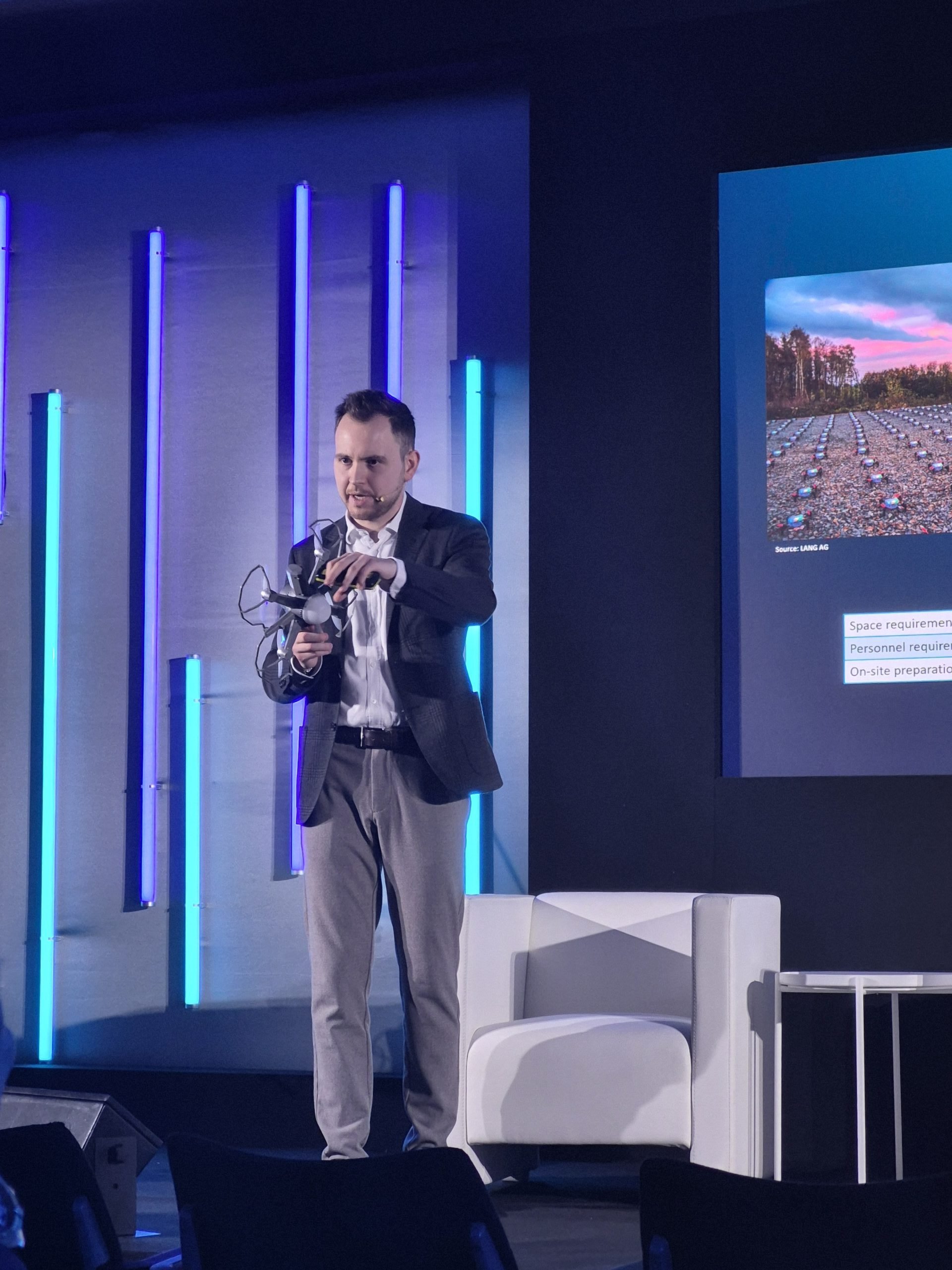
However, a new generation of drones is targeting these bottlenecks. Batteries are now built into the drones rather than manually inserted. Drones can automatically land and dock in dedicated charging fields or boxes. Each box can house multiple units, so operators deploy boxes instead of handling individual drones one by one. As a result, a 600-drone show can be staged on roughly 150 square metres instead of 500, and staffing needs can be cut roughly in half. Setup and turnaround times are also significantly reduced. This evolution moves drone shows closer to a modular, quickly deployable display system rather than a labour-heavy production.
Rethinking sustainability metrics
On paper, the power consumption of a drone show can appear high. A standard LED screen might draw about 1.5kW per hour, while a 200-drone show might consume around 10kW per hour. Moosmayer argues that this comparison is misleading if taken at face value. The more meaningful question is: how many LED screens, in how many locations, would you need to generate the same level of attention and engagement as a single drone show in a city centre?
Once you factor in the spatial coverage, memorability, and viral spillover of drone shows, the relevant metric becomes energy per unit of attention, not energy per device. From that perspective, drone shows can be surprisingly competitive and, in some contexts, more efficient than a distributed network of conventional displays.
A new pillar, not a replacement
Ultimately, Moosmayer is clear that drone shows should not be seen as a direct competitor to LED screens or existing digital signage technologies. They are an addition to the ecosystem, a new medium that excels at certain types of campaigns: highly visible, time-specific, shareable, and experiential. For brands and operators willing to think beyond the two-dimensional screen, drone shows offer a powerful new canvas in the sky – fully programmable, deeply engaging, and increasingly practical to deploy at scale.
Moosmayer also outlines a forward-looking vision of drone shows as fixed installations. In this model, drones are stored in enclosed bays under a roof that opens at scheduled times. Every evening at a set hour, they would launch, perform a show, and land again automatically. Brands could rent advertising time slots much like they do with LED networks today.
To approximate continuous operation, fleets can be split into groups. For example, a 600-drone fleet might be divided into three groups of 200. Each group flies a 15-minute show, then lands to recharge. With recharge times of around 45 minutes under normal conditions (and about 60 in freezing weather), the groups can rotate sequentially, effectively providing multi-hour or even near-24/7 coverage, not from a single continuous performance, but from cyclical waves of shows.