



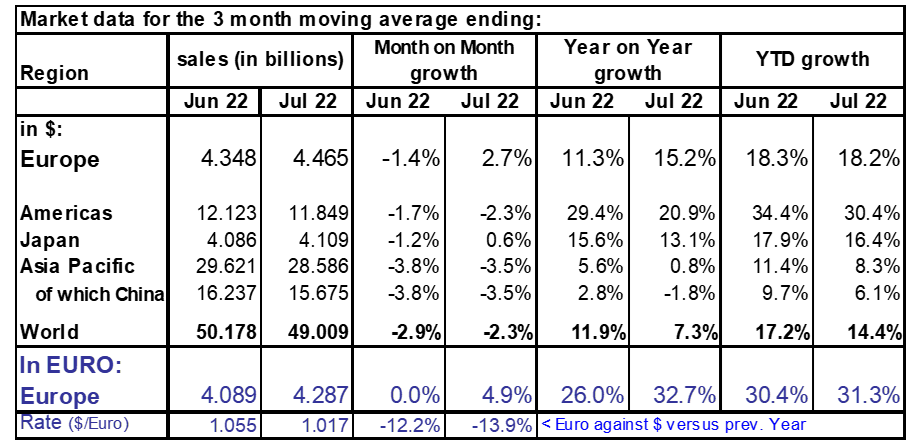
European sales were up 15.2% versus the same month in 2021. Europe and Japan were the two regions exhibiting growth in July.
Global semiconductor sales in July 2022 were $49.009bn, down 2.3% versus the previous month and up 7.3% versus the same month in 2021. All growth figures represent a three-month rolling average.
The main drivers of July’s sales in Europe as compared to April were diodes and discretes (up 9.3% and 7.3% respectively), total analogue devices (up 4.8%), and memory devices (up 2.5%).
The sales of application-specific chips decreased slightly in July (-0.3%) with the exception of wired communication and automotive, up 5% and 3% respectively.
In July, the exchange rate effect significantly increased when comparing market growth in Euros and in Dollars and came close to parity. Measured in Euro, semiconductor sales were €4.287bn in July 2022, up 4.9% versus the previous month and an increase of 32.7% versus the same month a year ago. On a year-to-date (YTD) basis, semiconductor sales increased by 31.3%.
Monthly European semiconductor sales
(3-month-average data, except YTD growth which is calculated based on current month data)
Semiconductor sales worldwide and in Europe
(in US Dollars)
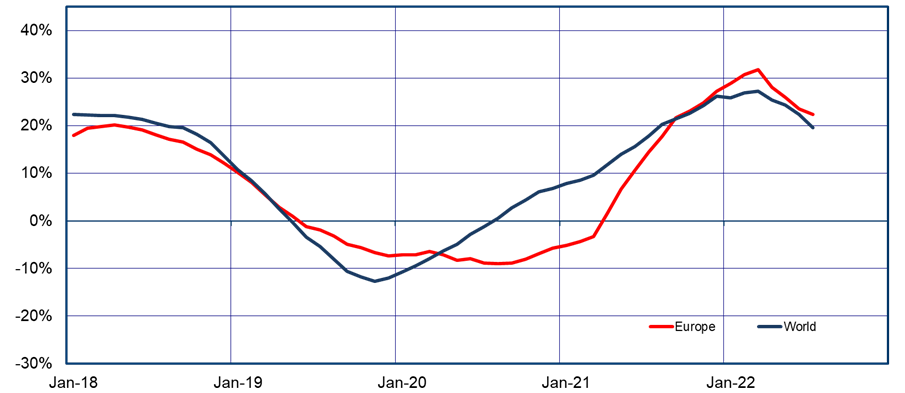
Note:
On a 12/12 basis, i.e., on the basis of the percent change of a 12-month period compared to a similar period twelve months before)
Monthly European semiconductor sales development
(in Euros)
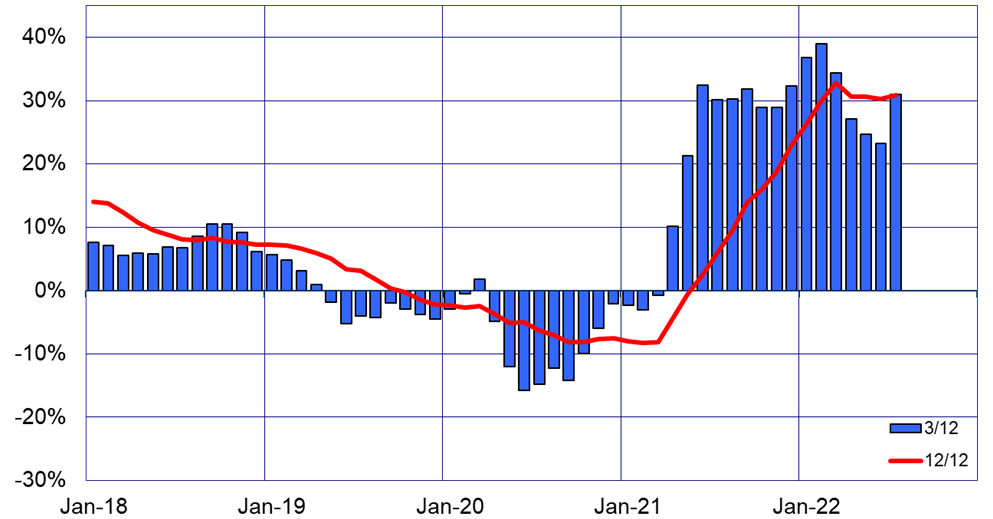
Note:
3/12 = Percent change of a three-month period compared to a similar period twelve months before
12/12 = Percent change of a twelve-month period compared to a similar period twelve months before