



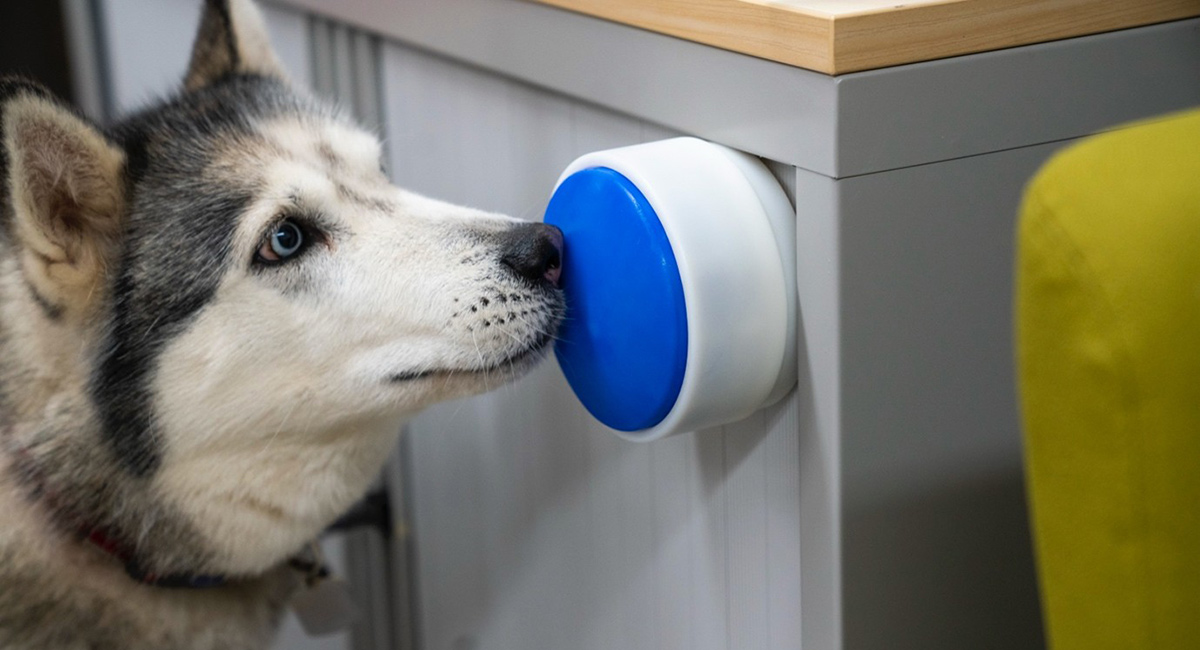
The Open University (OU) has developed a wireless control designed specifically for dogs, allowing them to switch household appliances on and off with a simple nudge. Originally created for service dogs, the Dogosophy Button is now available for all dogs and their families to enjoy.
A powerful bond
Dogs are often described as man’s best friend, and it’s easy to see why. They offer companionship, loyalty, and unconditional affection. As pack animals, they naturally see their human family as part of their group, and their instinct to please reassures owners in their day-to-day life.
But if we look beyond companionship and cuddles, many dogs take on roles that require an incredible amount of intelligence and focus. They search for missing people, detect diseases or illegal substances, and guide people with visual impairments. In return, they receive care, affection, and stability, creating a partnership built on trust.
The Dogosophy Button strengthens this bond by giving dogs a tool that increases their independence at home. Developed at the OU’s Animal-Computer Interaction Laboratory by Professor Clara Mancini and her team, the button is the result of years of research into how animals engage with technology. While it was first designed to support assistance dogs, it is now available to any dog that could benefit from greater autonomy.
Technology designed for dogs
The Dogosophy Button has been carefully shaped around the sensory, physical, and cognitive abilities of dogs. Collaboration with Dogs for Good and the Petplan Charitable Trust provided valuable insights from trainers, behaviourists, and assistance-dog teams, helping researchers understand how dogs approach, touch, and interpret objects.
The button’s tactile push-pad is bright blue, a colour dogs can see clearly, set against a white background for strong contrast. Its convex shape and textured surface provide grip and comfort, allowing dogs to press it from different angles. It responds equally well to nose nudges or paw presses, making it suitable for dogs with varying preferences or mobility needs.
When activated, a soft internal light flashes to confirm the action has worked. The light is gentle enough not to overwhelm a dog’s vision but clear enough to provide feedback.
Because the button is fully wireless, it can be placed wherever the dog finds it most accessible. It works within a forty-metre range of the appliance receiver, offering flexibility in how it is used around the home.
How it works
Each Dogosophy Button package includes a battery-powered wireless button, a receiver that plugs into a household appliance, and fittings to secure the button if needed. Once the receiver is connected to a UK mains socket and paired with the button, the dog can operate any appliance up to 13A (2,200-3,000W).
This could mean turning on a fan during a hot day, switching on a light in a dark room, or activating another small device that supports comfort and independence.
The casing is built to withstand regular use. Its lightly textured surface makes it easy to clean, and its size suits dogs across a wide range of breeds. Rechargeable AA batteries keep it running while reducing environmental impact.
Supporting working dogs, enriching family pets
For assistance dogs, the Dogosophy Button can make everyday tasks easier by reducing the number of actions that require human involvement. For example, it may help someone with limited mobility by giving their dog a clear and reliable way to carry out a household request.
For companion dogs, the button offers enrichment. Teaching a dog to use it can be a rewarding training activity that encourages problem-solving, confidence, and communication. It gives dogs a sense of control over their environment, which can support their wellbeing.
Training centres, behaviourists, and therapists may also find it useful for developing advanced interaction techniques. Pet owners, meanwhile, might simply appreciate its straightforward design and reliability.
A design grounded in science
The Dogosophy Button reflects the Open University’s wider commitment to animal-centred technology. By considering how dogs perceive the world, how they solve tasks, and how they physically interact with devices, the team has created a tool that is practical, gentle, and easy to learn.
It offers dogs a way to participate more actively in the home, building on the trust and cooperation that already define the human-dog relationship.