




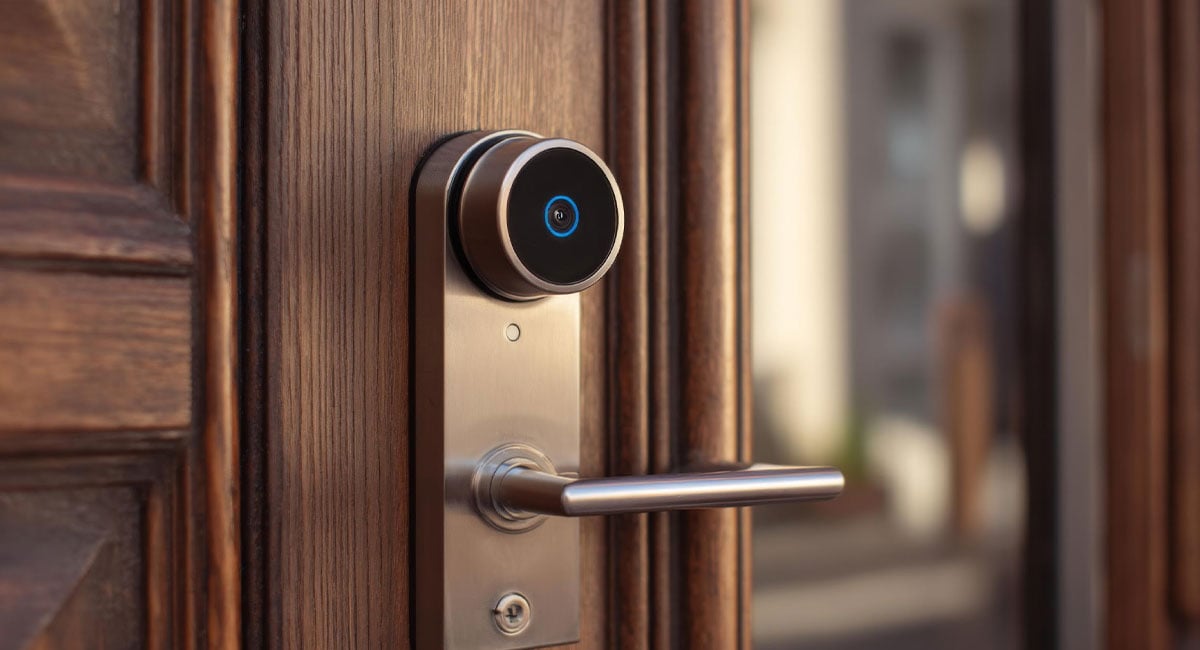
In an era where security and convenience are paramount, smart locks have emerged as a cutting-edge alternative for access control, offering features that go far beyond the limitations of physical keys. New generation of smart locks integrate advanced biometric technologies such as facial recognition and fingerprint scanning, allowing users to unlock doors with a simple glance or touch. Some high-end models even incorporate iris detection for an added layer of security. These innovations not only eliminate the need for carrying keys but also significantly reduce the risk of lock-picking and unauthorised access.
Beyond biometrics, smart locks often connect to mobile apps, enabling remote access, real-time alerts, and the ability to issue temporary access codes for guests, ideal for managing home deliveries or short-term rentals. This combination of convenience and control makes smart locks a cornerstone of next-generation security infrastructure. While traditional locks remain valued for their simplicity and affordability, they lack the flexibility, monitoring capabilities, and enhanced protection that smart locks provide, making the latter an increasingly popular choice for modern homes and businesses.
Benefits to users: accessibility, convenience, and safety
Accessibility: users can unlock doors effortlessly using their fingerprint, face, or even voice, ensuring quick and reliable access for authorised individuals
Convenience: integration with IoT ecosystems allows remote access, voice control via virtual assistants, and automated locking schedules. Temporary digital keys can be shared with guests or service providers, adding flexibility without compromising security
Safety: advanced encryption protocols, tamper detection, and multi-factor authentication provide robust protection against both physical and cyber threats. Features like geofencing and real-time alerts further enhance safety by ensuring users are always informed and in control
Authentication and security protocols in biometric smart locks
Biometric smart locks rely on advanced authentication mechanisms to deliver secure and reliable access control. At the core of these systems are strong encryption standards such as AES-256 and RSA, which safeguard biometric data during both transmission and storage. Many models incorporate multi-factor authentication (MFA), combining biometric verification with PIN (personal identification numbers) or mobile app confirmations to strengthen security. Depending on the design, biometric data may be stored locally on the device minimising exposure to cyber threats or in encrypted Cloud environments to enable remote access and centralised management. To further mitigate risks, some systems employ dynamic token generation and time-based access codes, reducing the likelihood of replay attacks or credential duplication. These layered security measures make biometric smart locks a robust solution for both residential and commercial environments.
Key considerations for selecting image sensors for smart locks
When selecting image sensors for smart locks, especially those using facial recognition, there are several key technical and practical considerations to ensure optimal performance, reliability, and security. Here’s a breakdown of the most important factors:
Low-light and NIR performance – smart locks often operate in varied lighting conditions, including complete darkness. Sensors must have strong near-infrared (NIR) sensitivity (typically at 850 or 940nm) to enable accurate facial recognition using IR illumination. A back-side illuminated (BSI) sensor like AR0830 8.3 MP image sensor from onsemi is ideal for increasing light capture, hence improving low-light performance.
Resolution and frame rate – higher resolution ensures more detailed facial feature capture, which improves recognition accuracy. A decent frame rate (30fps or higher) is also important for smooth motion detection and fast response times.
Power efficiency – smart locks are often battery-powered, so the image sensor must support ultra-low power modes, such as Wake-on-Motion (WoM) or context-aware operation, to extend battery life without compromising responsiveness. Low power consuming devices/systems are highly desirable for longest battery charge cycles and reliable operation without any downtime.
Size and integration – smart locks have very defined and limited real estate to fit in the intended functionalities. Compact sensor modules are preferred for sleek lock designs. The sensor should be compatible with small form-factor lenses and support integration with embedded processors or AI accelerators for on-device facial recognition.
Environmental robustness – smart locks are exposed to outdoor conditions. Sensors must be temperature-resistant, dustproof, and moisture-tolerant to maintain performance over time.
Enhancing smart locks with Hyperlux LP image sensors
The AR0830 image sensor from onsemi’s Hyperlux LP family is a powerful enabler of next-generation smart locks, particularly those utilising facial recognition for secure access. This 8.3MP back-side illuminated (BSI) CMOS sensor features a high-resolution 3840 x 2160-pixel array and excels in low-light and near-infrared (NIR) conditions critical for reliable facial scanning in varied lighting environments.
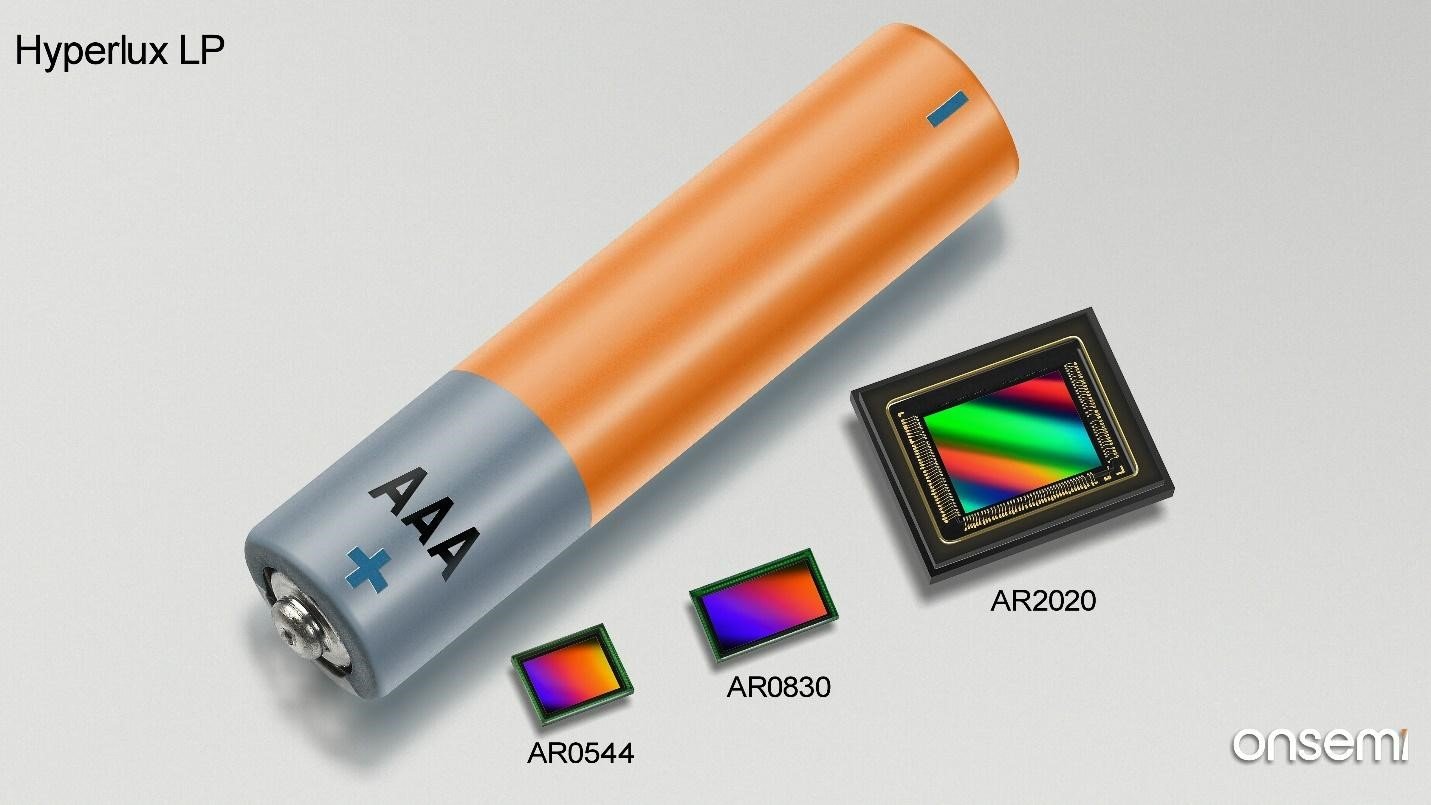
One of the advantages that stands out is its compact size. With an optical format of 1/2.9’ and a tiny 1.4μm pixel size, the AR0830 achieves high performance in a small footprint, making it ideal for space-constrained smart lock designs. Despite its size, it delivers enhanced NIR response at 850 and 940nm wavelengths, ensuring accurate detection even in complete darkness. Its ultra-low power consumption supports battery-operated systems, while advanced features like Wake-on-Motion (WOM), context switching, and multiple subsampling modes optimise performance without draining power.
The AR0830 enables fast, secure, and privacy-conscious facial recognition with sub-0.5 second recognition times and extremely low false acceptance rates. This makes it a key component in building smart lock systems that are both intelligent and trustworthy.
For smart lock manufacturers seeking a balance between performance and affordability, the AR0544 image sensor in the Hyperlux LP family offers an excellent alternative. This 5 MP BSI CMOS sensor delivers sharp image quality and strong low-light performance, making it well-suited for facial recognition and other vision-based authentication features without the added cost of ultra-high resolution. Its compact 1/4′ optical format and low power consumption make it ideal for battery-operated smart locks, while maintaining reliable NIR sensitivity for accurate recognition in dim or nighttime conditions. By providing essential imaging capabilities at a lower price point, the AR0544 enables manufacturers to design secure, feature-rich smart locks that remain accessible to cost-sensitive markets without compromising on core functionality.
Technical reasoning for selecting Hyperlux LP image sensors for smart lock application
The Hyperlux LP image sensors are engineered to meet the stringent requirements of biometric access systems, particularly those utilising 2D and 3D facial recognition. These sensors feature RGB-IR pixel architectures, enabling simultaneous acquisition of visible (RGB) and infrared (IR) data. This dual-channel capability supports 2D facial recognition using RGB data and depth-enhanced 3D recognition via IR illumination, improving accuracy and spoof resistance.
An additional benefit of such an RGB-IR sensor is the availability of the IR data during normal operation that can be used to remove the IR bleed that inevitably happens as the smart locks face the outdoor environment. This provides a high-fidelity image and a true representation of the scene.
From a system integration perspective, these sensors simplify design by requiring only a single camera module to capture both RGB and IR data, reducing component count and calibration complexity. They also offer flexible calibration and correction pipelines, allowing developers to fine-tune sensor output for varying environmental conditions and facial geometries.
A key advantage of Hyperlux LP image sensors is their multi-mode low-power operation, including an integrated Wake-on-Motion (WoM) feature that allows the sensor to remain in an ultra-low power state until motion is detected. This significantly reduces energy consumption, making them ideal for battery-powered smart locks. Their power efficiency also frees up system-level power budget for additional processing tasks, such as real-time AI inference or secure data transmission.
Conclusion
As biometric authentication becomes more accurate and accessible, smart locks are rapidly becoming a cornerstone of next-generation security infrastructure. Future innovations may include AI-driven behavioral recognition, which analyses movement patterns for identity verification, and blockchain-based credential management for decentralised, tamper-proof access control. With sustainability in mind, manufacturers are also exploring energy-efficient designs and solar-powered options to reduce environmental impact.
Ultimately, smart locks represent more than just convenience, they are a critical component of the evolving smart ecosystem, blending security, technology, and user experience into a single, intelligent solution.