





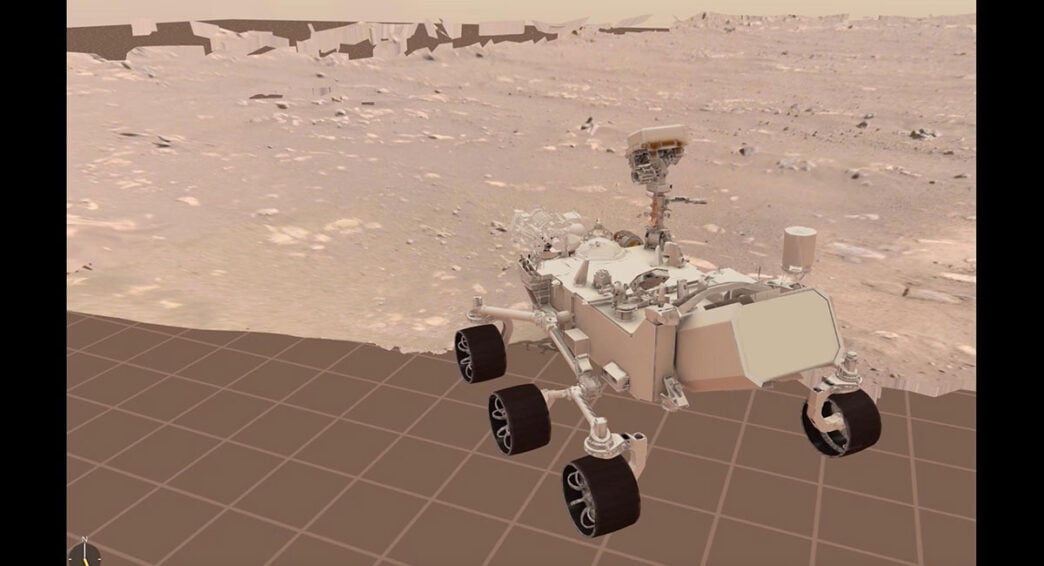
NASA’s Perseverance Rover has taken a drive around Mars that was entirely mapped out by AI.
On 8th and 10th December 2025, Generative AI was used by the Jet Propulsion Laboratory in Southern California to create waypoints for Perseverance – a complex decision-making task typically performed manually by the mission’s human rover planners.
“This demonstration shows how far our capabilities have advanced and broadens how we will explore other worlds,” said NASA Administrator Jared Isaacman. “Autonomous technologies like this can help missions to operate more efficiently, respond to challenging terrain, and increase science return as distance from Earth grows. It’s a strong example of teams applying new technology carefully and responsibly in real operations.”
The AI used the same imagery and data that a human would have used to map out a safe route across the planet’s unfamiliar terrain. Using high-resolution images from the camera aboard NASA’s Mars Reconnaissance Orbiter and terrain-slope data from digital elevation models, the Generative AI model identified potential hazards – bedrock, outcrops, hazardous boulder fields, sand ripples, and the like – and planned the route accordingly.
To ensure the AI’s instructions were fully compatible with the rover’s flight software, the engineering team also processed the drive commands through JPL’s digital twin, verifying over 500,000 telemetry variables before sending commands to Mars.
On 8th December, Perseverance drove 689 feet (210 metres). Two days later, it drove 807 feet (246 metres).
“The fundamental elements of Generative AI are showing a lot of promise in streamlining the pillars of autonomous navigation for off-planet driving: perception (seeing the rocks and ripples), localisation (knowing where we are), and planning and control (deciding and executing the safest path),” said Vandi Verma, a space roboticist at JPL and a member of the Perseverance engineering team. “We are moving towards a day where Generative AI and other smart tools will help our surface rovers handle kilometre-scale drives while minimising operator workload, and flag interesting surface features for our science team by scouring huge volumes of rover images.”
“Imagine intelligent systems not only on the ground at Earth, but also in Edge applications in our rovers, helicopters, drones, and other surface elements trained with the collective wisdom of our NASA engineers, scientists, and astronauts,” said Matt Wallace, Manager of JPL’s Exploration Systems Office. “That is the game-changing technology we need to establish the infrastructure and systems required for a permanent human presence on the Moon and take the US to Mars and beyond.”
Mars is the fourth planet from the Sun. Often called the Red Planet because its surface is rich in iron oxide (rust), giving it a reddish appearance, its thin atmosphere is 95% carbon dioxide, with almost no breathable oxygen. The planet experiences massive dust storms, sometimes covering the entire surface.
One day on Mars is about 24 hours 37 minutes – very close to an Earth day. A year on Mars is 687 Earth days, nearly twice as long as ours.
Mars is on average about 140 million miles (225 million kilometres) away from Earth which creates a serious communication lag making real-time operation of a rover impossible. This is why, for the last several missions, human route planners have been used to analyse the terrain before any “driving” is carried out.