







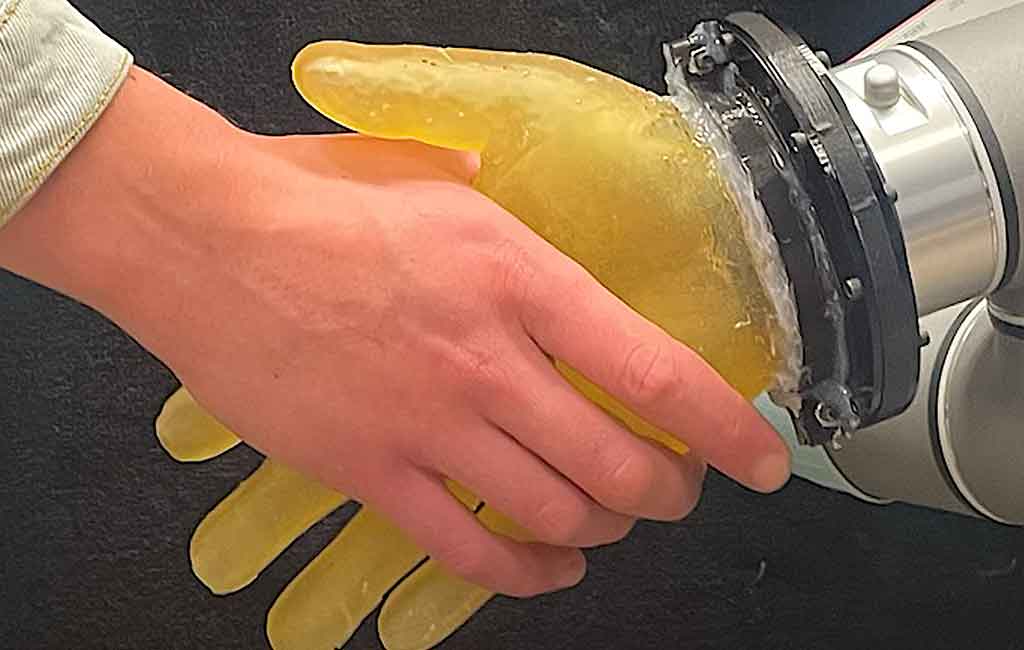
The skin, flexible and highly conductive, could be slipped over robotic hands like a glove, offering enhanced tactile perception at a significantly lower cost.
Made from a gelatine-based hydrogel, the material can be melted down and reshaped into complex forms, giving it an adaptable edge. Once in place, it responded to touch across its entire surface, a key departure from conventional robotic sensing systems that relied on separate sensors for different types of input.
“Having different sensors for different types of touch leads to materials that are complex to make,” explained Dr David Hardman from Cambridge’s Department of Engineering. “We wanted to develop a solution that can detect multiple types of touch at once, but in a single material.”
The innovation lay in what is known as multi-modal sensing. Rather than layering pressure, temperature, and pain sensors into a composite skin, the team used a single material that reacted differently depending on the nature of the contact. That approach simplified the fabrication process while improving durability.
“At the same time, we need something that’s cheap and durable, so that it’s suitable for widespread use,” added Dr Thomas George Thuruthel from UCL.
The researchers embedded just 32 electrodes at the wrist of a robotic hand. Despite the small number, they were able to extract over 1.7 million data points from the surface of the skin, thanks to more than 860,000 microscopic conductive pathways in the hydrogel.
They then subjected the artificial skin to a battery of tests: exposure to heat via a hot air gun, soft and hard finger taps, pressure from robotic arms, and even incisions made with a scalpel. The data gathered was used to train machine learning models that helped the robotic system interpret different types of contact.
“We’re able to squeeze a lot of information from these materials – they can take thousands of measurements very quickly,” said Dr Hardman, who worked in the lab of Professor Fumiya Iida. “They’re measuring lots of different things at once, over a large surface area.”
While the robotic skin has not yet reached the sensitivity of human skin, the researchers believed it has surpassed existing technologies in performance and practicality.
“We’re not quite at the level where the robotic skin is as good as human skin, but we think it’s better than anything else out there at the moment,” said Thuruthel. “Our method is flexible and easier to build than traditional sensors, and we’re able to calibrate it using human touch for a range of tasks.”
The team envision future applications ranging from advanced prosthetics to disaster relief and automotive systems, where a more human-like touch could enhance safety and performance. Further improvements to the material’s durability and real-world testing are already under consideration.
The research was published in Science Robotics and received support from the Samsung Global Research Outreach Program, the Royal Society, and the Engineering and Physical Sciences Research Council (EPSRC), part of UK Research and Innovation (UKRI). Professor Fumiya Iida is a Fellow of Corpus Christi College, Cambridge.


