



The University of Dundee advanced its role in stroke treatment and training after participating in the world’s first robotic transatlantic thrombectomy, which took place only hours after Professor Iris Grunwald, Director of the Image Guided Therapy Research Facility (IGTRF), performed the first-ever remote thrombectomy on a human cadaver.
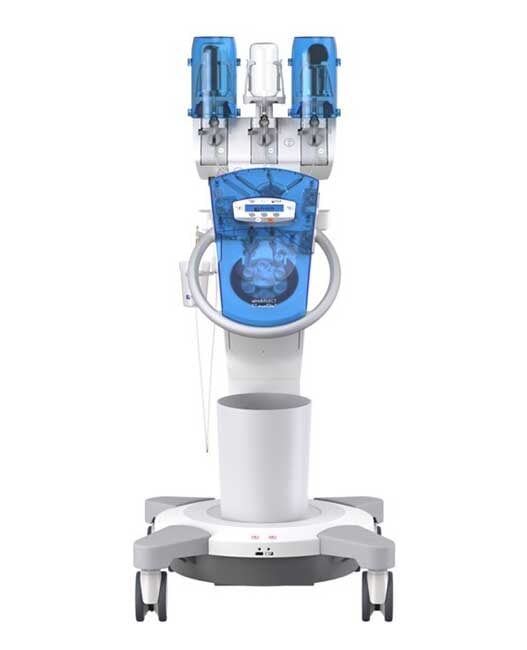
Using a robot developed by Lithuanian MedTech company Sentante, Professor Grunwald demonstrated that a blood clot could be removed from the brain without a specialist being physically present. Operating from within the School of Medicine at Ninewells Hospital, she successfully carried out the procedure remotely.
That was followed by the groundbreaking moment when Ricardo Hanel MD, PhD – in conjunction with Professor Grunwald – used Sentante’s device to perform the first transatlantic thrombectomy on a human cadaveric model located at the IGTRF from Baptist Medical Centre in Jacksonville, Florida.
Sentante’s system uses standard guidewires and catheters linked to a device with a high-resolution sensory system that captures a specialist’s hand movements. The robot at the patient’s bedside replicates these in real time. Unlike joystick-controlled surgical robots, Sentante provides direct force feedback to the surgeon’s fingertips, replicating the tactile experience of manual surgery. The procedure requires only a trained medical professional to gain arterial access before a remote expert, such as Professor Grunwald or Dr Hanel, performs the thrombectomy.
“For an ischaemic stroke, the difference between walking out of hospital and a lifetime of disability can be just two to three hours,” said Edvardas Satkauskas, Co-Founder and CEO of Sentante. “Today, patients are often transported long distances to reach one of a limited number of thrombectomy centres. With Sentante, the specialist comes to the patient over a secure network, and performs the entire procedure remotely – with the same tactile feel and control they have at the bedside.”
Professor Grunwald said: “As a neurointerventionist, it is remarkable to feel the same fine control and resistance through a robotic interface as during a live procedure. Sentante’s technology truly bridges the gap between operator and patient, no matter the distance. Sentante’s robotic platform redefines what is possible in endovascular treatment today. It is precision, safety and access to treatment – all in one innovation.”
Globally, around 15 million people suffer a stroke each year, with the UK’s total societal cost estimated at £26 billion annually, including £8.6 billion for NHS and social care. Thrombectomy remains the most effective treatment for strokes caused by large vessel blockages, yet in many regions, fewer than 1% of patients receive it. In 2024, only 212 patients in Scotland underwent thrombectomy, representing 2.2% of those with ischaemic stroke.
A shortage of interventional neuroradiologists continues to limit access to this treatment. Professor Grunwald explained: “By the time patients reach a specialist centre, there’s often no brain left to save. Every six minutes delay in receiving treatment equates to a 1% lesser chance of a good outcome. For example, here in Dundee we’re covering the north of Scotland – so a patient coming from Inverness or one of the islands would have a long distance to travel. The answer lies in expanding expertise locally through cross-specialty training, or by using robotic technology, such as Sentante, that lets experts operate remotely.”
Dr Hanel added: “Tele neurointervention will allow us to decrease the gap and further our reach to provide one of the most impactful procedures in humankind – the thrombectomy – to more people. To operate from the US to Scotland with a 120 millisecond (blink of an eye) lag is truly remarkable.”
The IGTRF serves as the official global training centre for the World Federation for Interventional Stroke Treatment, welcoming medical teams from around the world. The facility works closely with Dundee’s Centre for Anatomy and Human Identification (CAHID) to deliver interventional training, medical device testing, and research. One of its strengths lies in the development of a perfused whole-body human stroke model that closely replicates a ‘life-like’ patient scenario.
Edvardas Satkauskas, Co-Founder and CEO of Sentante, said: “The human cadaveric models at Dundee are fantastic. This is the reason we have worked with them – this is probably the only site in the world that can do this type of research.
“For an ischaemic stroke, the difference between walking out of hospital and a lifetime of disability can be just two to three hours. Today, patients are often transported long distances to reach one of a limited number of thrombectomy centres. With Sentante, the specialist comes to the patient over a secure network and performs the entire procedure remotely – with the same tactile feel and control they have at the bedside.”
Sentante’s robotic platform continues to advance through regulatory approval for peripheral vascular interventions, with the FDA granting Breakthrough Device Designation for its stroke system. The collaboration with Dundee marked another milestone in demonstrating how robotic technology could remove distance as a barrier to life-saving care.