



AI workloads are pushing the power demands of server racks beyond the practical limits of 48VDC distribution. With current levels reaching several MW, data centres using traditional architectures face insurmountable power losses, making the shift toward HVDC distribution a necessity.
The rapid growth of AI workloads is driving a dramatic increase in power consumption in data centres. Modern AI server racks already require close to 1MW of power, and this figure is expected to rise significantly in the coming years. Traditional 48VDC power distribution is reaching its physical limits, as the extremely high currents involved cause major copper losses and demand bulky, costly busbars.
To overcome these limitations, data centre operators are shifting toward High Voltage Direct Current (HVDC) architectures, mainly 800VDC/±400 VDC systems. By increasing the distribution voltage, current is reduced dramatically, which lowers resistive losses and enables more efficient and compact power delivery. However, simply raising the voltage is not sufficient. High overall system efficiency and power density require advanced power semiconductor technologies and optimised circuit topologies.
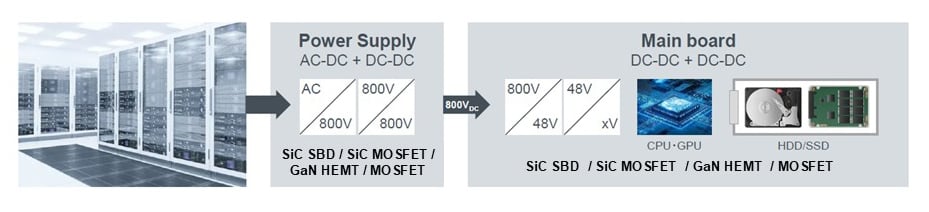
Comprehensive power semiconductor portfolio for HVDC systems
ROHM addresses these challenges with a comprehensive portfolio of power devices and control ICs designed specifically for next-generation HVDC power systems. The company offers a comprehensive line-up that includes power semiconductors, analog ICs such as power supply control ICs and DrMOS (Driver + MOSFET), and passive components like resistors and optical semiconductors. This enables efficient optimisation of power supply circuits. In practice, prototypes of power supply circuits required for 800VDC and ±400VDC have already been developed, achieving high efficiency and miniaturisation.
ROHM has also established a strategic partnership with Infineon Technologies. Both companies provide SiC power MOSFETs housed in identical, standardised packages. By leading the effort to standardise power semiconductor packaging, ROHM ensures a more stable supply chain. This allows users, such as power supply manufacturers, to easily secure reliable second-source products.
For high-power front-end stages in 800VDC or ±400VDC systems, ROHM provides advanced SiC devices well suited for high voltage and high switching frequency operation. In Vienna rectifier circuits, ROHM’s 3rd-generation SiC Schottky barrier diodes (SCS240KE2) are used as boost diodes, while 4th-generation SiC power MOSFETs (SCT4013 series/SCZ4008DTB) serve as switching devices. These same 4th-generation SiC MOSFETs are also applied in isolated three-phase LLC resonant converters. This combination enables power conversion efficiencies of up to approximately 99%, significantly reducing system losses in megawatt-class racks.
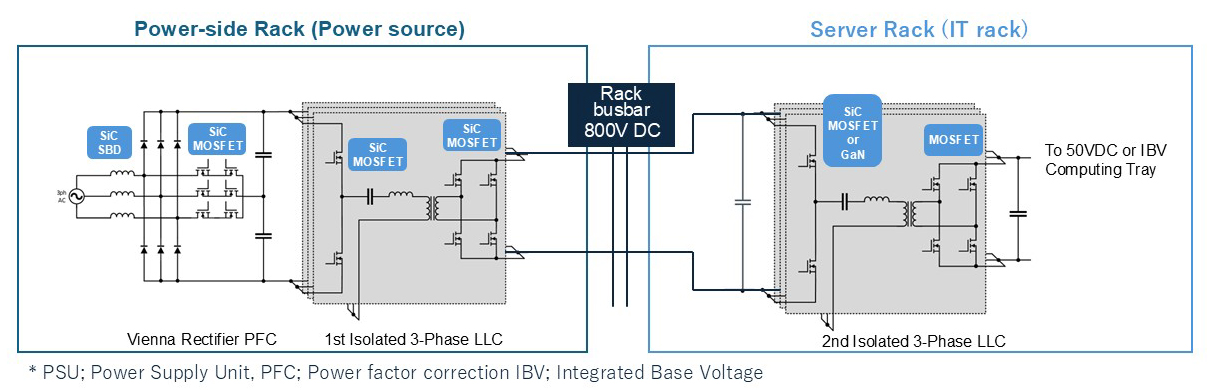
On the IT server rack side, where space constraints demand extremely high-power density, ROHM offers optimised solutions for converting 800VDC down to 50VDC. One approach uses isolated three-phase LLC resonant converters with 4th-generation SiC MOSFETs (SCT4018 series/SCZ4006KTA/SCZ4011KTA) on the primary side and Si power MOSFETs (RS7N200BH) on the secondary side, achieving power densities around 7.8W/cc at switching frequencies of 100kHz.
For even higher performance, ROHM proposes an architecture that splits the 800VDC input and uses series-connected isolated three-phase LLC resonant converters with GaN HEMTs (GNP2025TD) on the primary side. By increasing the switching frequency to 500kHz, this configuration doubles the achievable power density to approximately 15W/cc while maintaining conversion efficiency close to 99%. GaN devices are particularly effective in this role due to their low switching losses and suitability
As AI continues to drive exponential growth in computing power and energy consumption, HVDC distribution using 800VDC and ±400VDC is becoming the standard architecture for future data centres. Thanks to advancements in next-generation power semiconductors like SiC and GaN, alongside innovative control technologies, architectures that achieve both high efficiency and high-power density are becoming a reality. HVDC and advanced circuit technologies are now the two essential pillars supporting the next generation of data centres.
Visit ROHM’s Servers and Data Centres page to learn how ROHM is shaping the future of efficient, scalable data centre infrastructure.