






Vishay has introduced a new series of automotive grade AC line rated ceramic disc safety capacitors that are the industry’s first with a Y1 rating to be offered in a surface-mount casing.
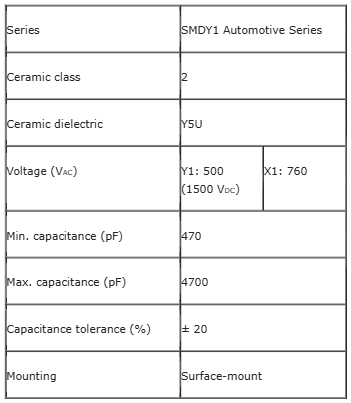
Combining their Y1 rating of 500VAC and 1500VDC with high capacitance to 4.7nF, the Vishay BCcomponents SMDY1 automotive series devices are designed to provide EMI/RFI suppression and filtering in harsh, high humidity environments.
AEC-Q200 qualified with PPAP available, the newly released capacitors will be used in on-board chargers (OBC), traction inverters, battery management systems (BMS), e-compressors, and AC/DC converters in electric (EV), hybrid electric (HEV), and plug-in hybrid electric (PHEV) vehicles. For these applications, the devices offer high humidity resistance with a Class IIB humidity grade (in accordance with IEC60384-14 annex I) and can withstand the 85 / 85 / 1,000h test.
Allowing for surface-mount assembly with a reflow soldering process, SMDY1 automotive series capacitors reduce production costs. Unlike leaded components, the devices offer a low, flat profile on the PCB to enable flat casings or backside PCB mounting without the clearance space required by through-hole capacitors.
RoHS-compliant and halogen-free, the components consist of a copper-plated ceramic disc and feature encapsulation made of flame-resistant epoxy resin in accordance with UL 94V-0. The devices are available in two case sizes: the C case with a creepage distance of 10mm and the D case with a creepage distance of 14.5mm.
Device specification table:
Samples and production quantities of the SMDY1 automotive series are available now, with lead times of 12 weeks.