



As vehicles become more electrified, connected and autonomous, the demands placed on their power electronics are rising sharply. In a recent webinar hosted by Electronic Specifier, Managing Editor Paige Hookway led a panel of experts from Vicor, Texas Instruments, Microchip, and Ansys (now part of Synopsys) to explore how engineers can maximise power in minimal space while maintaining reliability, safety, and cost-effectiveness.
What’s driving the shift in power density?
From the system to the subsystem level, all panellists agreed: power demand is rising everywhere in the vehicle.
Greg Green, Director of Automotive Marketing at Vicor Corporation, pointed to the ongoing replacement of mechanical systems with electrical ones: “Things that used to be mechanical are now electrical, like steering, braking, suspension, and now even the HVAC functions. And so that has been leading everyone to try and consolidate and improve the architecture of the vehicle.”
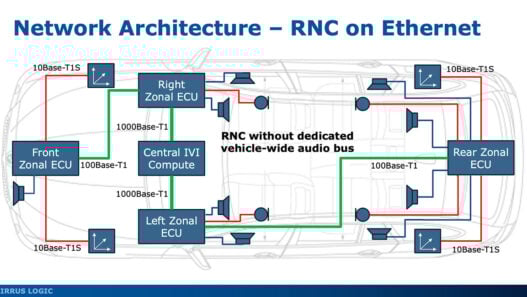
This is accelerating moves toward zonal architectures and higher power networks.
From the subsystem perspective, Darwin Fernandez, Systems Manager for Automotive Power Design Services at Texas Instruments, highlighted the impact of ADAS and infotainment: “When I look at ADAS … and the increasing number of sensors and SoC power and being able to process all that data, power goes up. When you look at infotainment, there’s more displays in cars now … more USB ports … so again, the power goes up.”
Vijay Bapu, Senior Manager Product Marketing at Microchip, stressed how this turns the car into “a full-fledged computer on wheels”: “We are expecting the car to essentially be a full-fledged computer on wheels, and the demand for additional features and cooler things inside the car is only increasing.”
In Europe, end-user expectations add another layer. Günther Hasna, Senior Director in the Synopsys Innovation Group at Ansys, noted: “The end users … want to have the same range and coverage they have with combustion cars, with electric cars, and if not, they want shorter load cycles. This means very high peaks or very high power densities … and it’s making it really very difficult.”
48V, 800V, and zonal architectures: the new sweet spots
One clear architectural trend is the migration to 48V low-voltage systems and 400/800V high-voltage systems.
Green described 48V as the emerging “sweet spot”: “The 48 volt low voltage architecture is the sweet spot that everyone’s trying to move to … it optimises the low voltage wiring system and greatly downsizes those wires, which makes everyone’s job assembling the vehicle easier.”
At the high-voltage level, he added, the industry is consolidating around 400V and 800V platforms, with 800V offering faster charging. However, legacy 12V devices remain entrenched, pushing demand for compact, efficient 48-to-12V and high-voltage-to-48V DC-DC conversion, an area where Vicor is positioning its high-frequency, high-efficiency topologies.
Design trade-offs: cost, complexity, and wide bandgap
Higher power density rarely comes for free. Fernandez boiled the trade-offs down succinctly: “Usually, the trade-off for power density or smaller size is either cost or complexity.”
He cited the example of multi-phase silicon solutions being replaced by GaN-based designs with fewer phases but higher device costs, and single-stage OBCs that remove bulky components but dramatically increase control complexity.
Wide bandgap devices, especially silicon carbide (SiC), are central to balancing these trade-offs. Bapu explained: “When you increase the switching frequency, you can have smaller magnetics, smaller inductors, smaller capacitors and basically increase the power density. You can do that by using wide bandgap devices. Silicon carbide devices … can switch much, much faster… [and] they have much better thermal conductivity than standard silicon or IGBTs.”
He also highlighted SiC’s excellent reverse recovery performance for topologies like totem-pole PFC, enabling high efficiency in onboard chargers and DC-DC converters.
Hasna added that new switching strategies and higher efficiency are inseparable from more complex control: “If you have high power in smaller spaces, it means higher temperatures … new switching strategies [make] systems more efficient … but it gets much more complex on the controlling side, which also means we need a lot more digitalisation into the power electronics.”
Thermal management: the ultimate limiter
Across industries, not just automotive, thermal management emerged as the primary limiter of power density.
Green was unequivocal: “In all electronics, thermal control is the limiting factor. Even when we’re at 98–99% efficiency … that’s still a lot of heat you have to deal with, in a very small spot.”
As high-density converters shrink, they concentrate heat into tiny footprints – “a 61 x 35mm area” instead of spread-out boards – making early system-level thermal planning essential.
Hasna argued that thermal must be addressed as early as possible via simulation: “Our standpoint is as early as possible to go into simulations and using virtual prototypes … to do a lot of ‘what if’ scenarios virtually already before going into the hardware.”
He also pointed to the emerging role of AI in using historical experience to guide thermal design and system-level temperature distribution.
Fernandez reinforced that cooling solutions – cold plates, liquid cooling, topside cooling packages – must be defined “in the definition stage,” because they immediately tie into mechanical design and packaging, not just electronics.
Reliability, functional safety, and system thinking
As integration and power density rise, reliability and safety grow more complex.
Bapu stressed that higher integration introduces new coupling effects and that safety must be addressed at both component and system levels: “You’re looking at thermal coupling, EMI, crosstalk … and you have to look at safety from silicon standpoint and from an overall system standpoint.”
He noted that systems like onboard chargers may target ASIL B, whereas traction inverters can demand ASIL D, requiring robust design flows, FMEDAs, and safety manuals.
Hasna argued for breaking down organisational and engineering silos: “Today it’s very difficult to see only one aspect separated from the other … There’s a lot of silo thinking, but you need to break the silos. You need to see everything together.”
For him, the future lies in digital twins, derived from detailed physics-of-failure understanding and compact models: “With this digital twin, especially having some sensors in power electronics devices, we can do predictive maintenance or remaining useful lifetime estimation.”
Fernandez connected functional safety back to integration, pointing to power-management ICs (PMICs) that integrate multiple bucks, LDOs, watchdogs, and supervisors designed under ISO 26262 to simplify system-level compliance.
Advice for automotive power engineers
The panel closed by offering guidance to engineers working in this field.
Fernandez urged them to focus on meaningful innovation: “Don’t try to innovate just to be different. You want to make something very impactful and meaningful … make something that’s useful for the world.”
Bapu highlighted two essential skill sets: “It is important for all engineers to understand digital control and magnetics … Digital control gives you a lot of flexibility … and magnetics is a key part of the whole power conversion system.”
Hasna’s advice was to stay out of silos: “Try to exchange ideas with other experts … If you have this overall system view, really very good ideas can be born.”
Green encouraged engineers to challenge constraints and ask “why not?”: “In innovation, turn [the five whys] on its head. It’s the five why nots that will help break the silos … And don’t be afraid to ask experts if you’re crazy or not … People are willing to help you.”
Collectively, the panel painted a picture of an automotive landscape in rapid transition: toward higher voltages, zonal architectures, wide bandgap devices, heavy use of simulation and AI, and deep cross-disciplinary collaboration. The central challenge remains constant: delivering more power and functionality in less space, without compromising reliability or safety – and doing it on ever shorter design cycles.
Watch the webinar on demand below: