


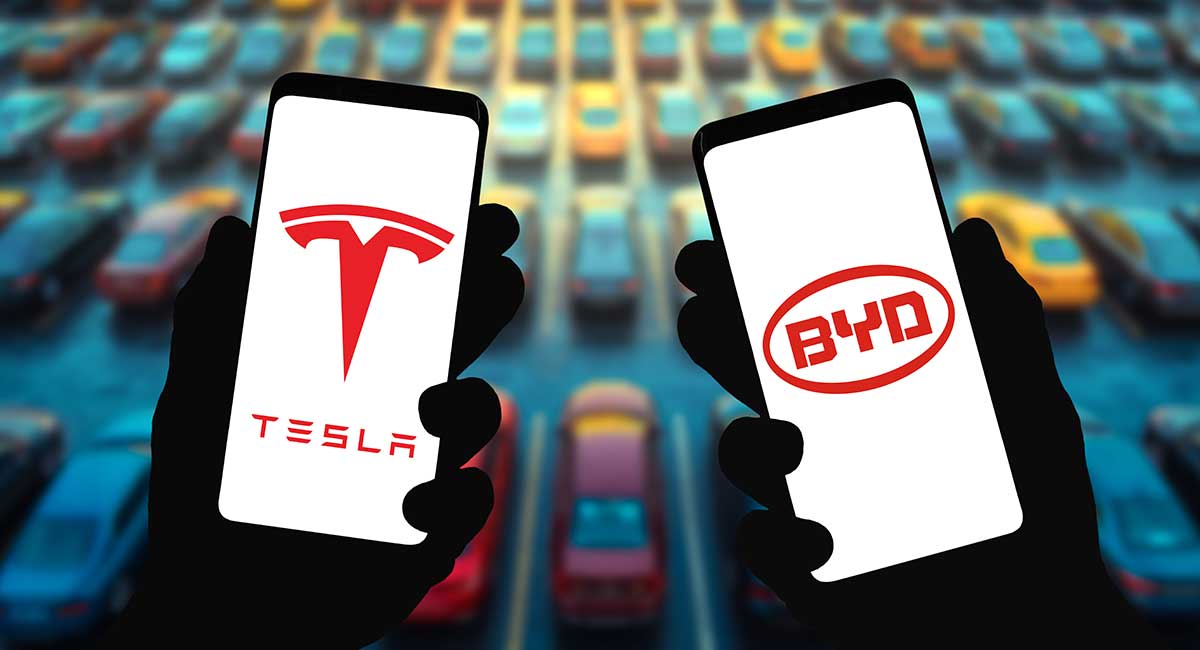
Tesla has been overtaken as the world’s leading electric vehicle (EV) maker by Chinese rival BYD. In 2025, BYD sold more battery-electric vehicles (BEVs) than Tesla, marking the first full year it has claimed the global BEV crown. In 2025, BYD sold about 2.26 million battery-electric vehicles, while Tesla delivered approximately 1.64 million cars.
But, could this shift in position tell us something about how each manufacturer operates, the support it receives from domestic markets, and the engineering decisions made that shape their products and production.
Divergent beginnings, evolving priorities
Tesla was formed in the early 2000s and began vehicle production with the Roadster in 2008. From the very beginning the company was focused on battery-electric vehicles and it built a reputation on high-efficiency powertrains, advanced vehicle electronics, and extensive software controls.
BYD was founded in 1995 as a rechargeable battery maker. It later expanded into automotive manufacturing, initially making conventional vehicles before moving towards electrification. However, its expertise in battery design and production has been a mainstay of its strategy.
Sales and market
Tesla’s annual deliveries in 2025 were down compared with 2024, marking at the second consecutive year of lower volumes reported. BYD’s BEV deliveries, by contrast, grew by around 28% year on year, helping it to overtake Tesla in pure electric vehicle sales.
The broader EV market in 2024/25 shows that EV sales increased. However, this is due to China’s robust sales that saw an almost 40% increase year-on-year, compare to the EU and North America which saw slower growth than it had in previous years. This was due to factors such as reduced government incentives in key regions and global economic headwinds which contributed to a more competitive environment.
Vertical integration
A major difference between the two companies is their approach to manufacturing.
BYD’s engineering strategy encompasses vertical integration: it produces core components such as batteries, electric motors, power electronics, and some semiconductors in-house. This reduces its dependency on external suppliers and helps control materials and production costs.
Tesla also pursues integration, with several Gigafactories around the world designed to bring key processes under its control. However, it still relies on external partners for significant volumes of battery cells and specialised components, and its model range is limited compared with many competitors.
Battery strategy
BYD’s battery portfolio includes lithium iron phosphate chemistries, which are recognised for their safety, lower cost, and thermal stability.
Tesla uses a mix of battery chemistries across regions and models to balance energy density, cost, and supply risk.
Both companies continue to refine cell formats and pack designs to improve performance and manufacturability.
Product portfolio and market coverage
Tesla’s global line-up is concentrated on a small number of core models, with the Model 3 and Model Y representing the vast majority of its sales. This strategy simplifies manufacturing and software standardisation, but it also limits options for buyers.
BYD offers a broader range of both fully electric and plug-in hybrid vehicles across multiple price points and body styles. This gives it flexibility in markets where charging infrastructure and incentives differ.
Cost structures and pricing
In many regions, BYD’s vehicles are typically priced lower than Tesla equivalents. This is driven in part by its integrated supply chain and localised production bases. BYD has also expanded its international footprint with facilities aimed at reducing import tariffs and logistics costs.
Tesla’s manufacturing footprint includes factories in the US, China, and Europe, but its reliance on exports from major plants exposes it to tariff and supply-chain risks that can influence pricing and delivery timelines.
Government policy and industrial support
China’s government initiatives has supported domestic EV makers through targeted incentives, favourable procurement rules, and coordinated infrastructure growth. This has created a large home market that has helped brands such as BYD build scale.
In the US and Europe, incentives are more variable and have adjusted with political changes. This has affected demand for EVs and complicated long-range production planning for companies like Tesla.
Differentiated strategies shape market outcomes
BYD operates in a manufacturing-focused, deeply integrated strategy that is supported by a strong domestic market and export growth. Tesla’s model of high automation, centralised design, and software-driven vehicle platforms delivered early success, but it now faces competition as the EV market matures and diversifies.
More than simple sales rivalry, the current landscape shows how engineering decisions, supply-chain design, and policy environments can influence the ability of manufacturers to be able to scale and succeed in a more competitive global EV market.