



A research team led by Dr Dong-Soo Han at the Korea Institute of Science and Technology (KIST) Semiconductor Technology Research Centre, in collaboration with Professor Jung-Il Hong of DGIST and Professor Kyung-Hwan Kim of Yonsei University, developed a new device principle that transforms ‘spin loss’ – previously regarded as a form of energy waste – into a power source for magnetic control.
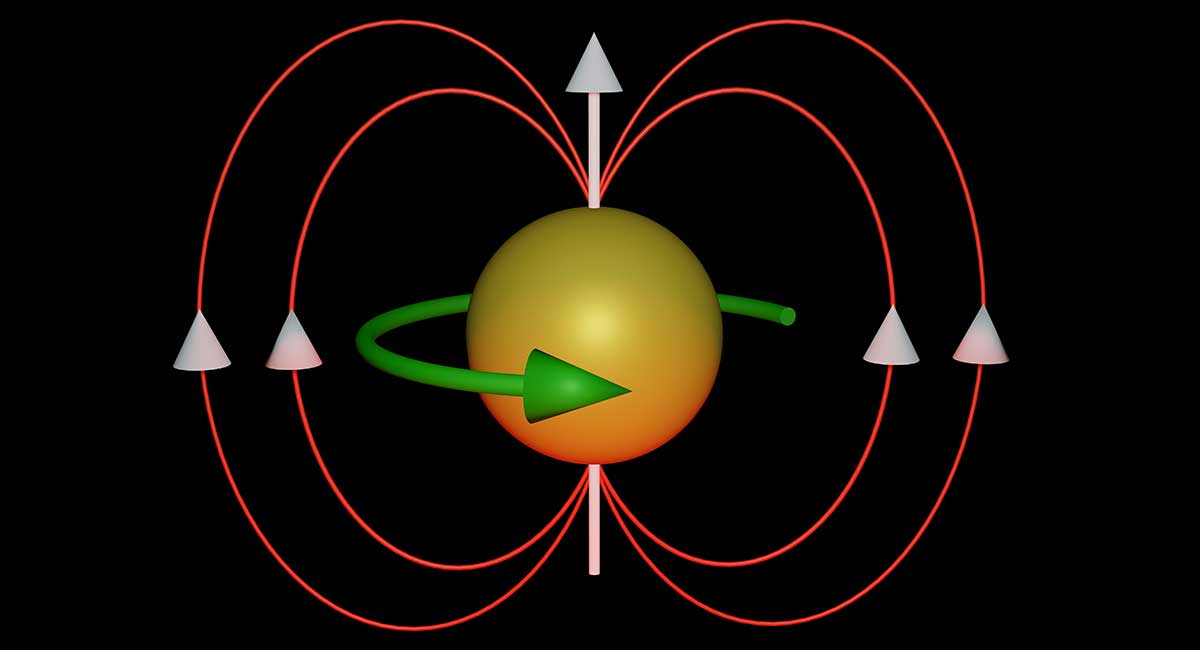
Spintronics, which exploits the spin property of electrons to process and store data, has long been viewed as a key enabler for next-generation information technologies. These include ultra-low-power memory, neuromorphic chips, and stochastic computing devices that operate with greater efficiency and non-volatility than conventional semiconductors. The recent discovery by the KIST-led team introduced a new concept that could significantly enhance the performance and energy efficiency of spintronic devices.
The researchers identified a previously unknown physical phenomenon that allows magnetic materials to spontaneously switch their internal magnetisation direction without external stimuli. Such materials are central to modern data processing: information is represented by the orientation of magnetisation – upward for ‘1’ and downward for ‘0’. Traditionally, reversing this direction required applying a strong current to align electron spins within the material.
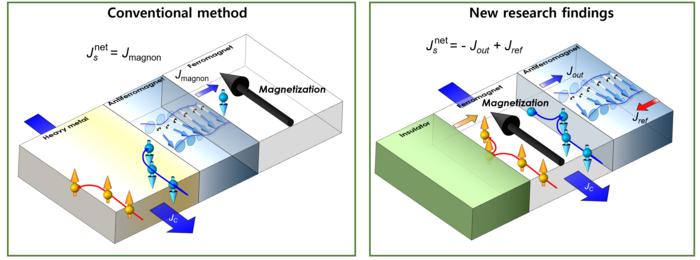
However, this process has long been hindered by spin loss – the dissipation of electron spin before it reaches the magnet – resulting in wasted energy and inefficiency. Efforts across the field have focused on minimising this loss through material and process innovations.
Dr Han’s team, however, turned this principle on its head. They discovered that spin loss could, paradoxically, drive magnetisation switching. The researchers likened the effect to a balloon moving in reaction to escaping air – a counterintuitive mechanism in which what was once considered wasted energy now fuels the desired magnetic transformation.
Experimental results demonstrated that the greater the spin loss, the less external power was needed to induce magnetisation switching. This discovery yielded energy efficiencies up to three times higher than conventional techniques, without requiring exotic materials or complex architectures. The simplicity of the device structure ensures compatibility with standard semiconductor manufacturing processes, paving the way for industrial-scale production and device miniaturisation.
The implications extend across multiple domains, including AI semiconductors, ultra-low-power memory, neuromorphic computing, and probabilistic computing systems. The ability to harness spin loss for efficient magnetic control could accelerate the development of compact, energy-efficient computing hardware, particularly for AI and Edge applications.
“Until now, the field of spintronics has focused only on reducing spin losses, but we have presented a new direction by using the losses as energy to induce magnetisation switching,” said Dr. Dong-Soo Han, a senior researcher at KIST. “We plan to actively develop ultra-small and low-power AI semiconductor devices, as they can serve as the basis for ultra-low-power computing technologies that are essential in the AI era.”