







Supersonic flight refers to aircraft travelling faster than the speed of sound, approximately Mach one at sea level, or around 1,236km/h (750mph) under standard conditions.
Supersonic flight began in the mid-20th century, driven largely by military research. In October 1947, US test pilot Chuck Yeager flew the Bell X-1 to Mach 1.06, becoming the first person to break the sound barrier in controlled, level flight. This achievement demonstrated that stable supersonic flight was possible and dispelled concerns about a so-called “sound barrier”.

During the 1950s and 1960s, supersonic capability expanded rapidly in military aviation. Fighter aircraft such as the North American F-100 Super Sabre, the English Electric Lightning, and later the McDonnell Douglas F-4 Phantom II routinely operated at supersonic speeds, driven by advances in jet engine design, swept wings, and high-temperature materials.
Civil supersonic flight emerged in the late 1960s. The Anglo-French Concorde and the Soviet Tu-144 both entered service in the 1970s. Concorde first flew in 1969 and entered commercial operation in 1976, cruising at around Mach two and reducing transatlantic flight times to just over three hours. However, high operating costs, limited routes due to sonic boom restrictions, and environmental concerns constrained wider adoption.

Following Concorde’s retirement in 2003, supersonic flight largely returned to the military domain. In recent years, research programmes and private companies have revisited supersonic concepts, focusing on reduced sonic booms, improved fuel efficiency, and new materials.
NASA’s X-59
NASA’s X-59 is an experimental aircraft developed under the agency’s Quesst mission, which aims to demonstrate “quiet” supersonic flight by significantly reducing the disruptive sonic boom associated with breaking the sound barrier.
Designed and built by Lockheed Martin’s Skunk Works, it features a highly elongated nose, measuring around 9m in length, which accounts for roughly one-third of the aircraft’s total length. This distinctive shape redistributes shockwaves generated during supersonic flight, turning a traditional sonic boom into a much quieter “sonic thump” perceived on the ground.
The aircraft is designed to cruise at around Mach 1.4 at an altitude of approximately 16,800m. Unlike conventional supersonic aircraft, the X-59 does not include a forward-facing cockpit window. Instead, the Test Pilot relies on an external vision system, combining cameras and a high-resolution display, to provide forward visibility during flight.
“The X-59 is the first major, piloted X-plane NASA has built and flown in over 20 years – a unique, purpose-built aircraft,” said Bob Pearce, NASA Associate Administrator for the Aeronautics Research Mission Directorate. “This aircraft represents a validation of what NASA Aeronautics exists to do, which is to envision the future of flight and deliver it in ways that serve US aviation and the public.”
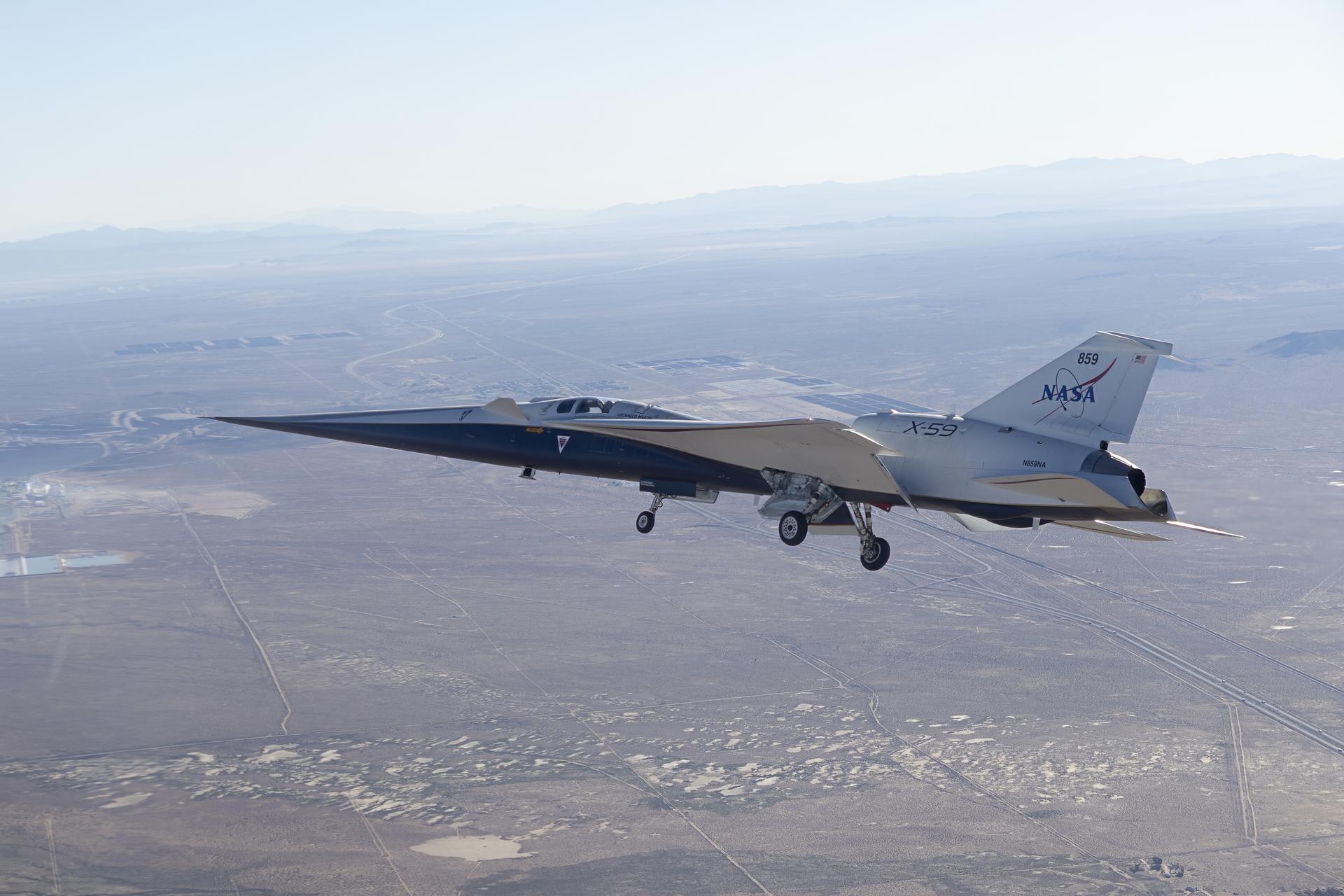
In November 2025, NASA completed the aircraft’s first flight test. All went as planned, with the aircraft operating slower than the speed of sound at 230mph and a maximum altitude of about 12,000 feet. It flew for 67 minutes during which the team conducted in-flight system and performance checks.
“In this industry, there’s nothing like a first flight,” said Brad Flick, Centre Director of NASA Armstrong. “But there’s no recipe for how to fly an X-plane. You’ve got to figure it out, and adapt, and do the right thing, and make the right decisions.”
The team is now preparing for full flight testing, evaluating how it will handle and, eventually, how its design will shape shock waves. The X-59 will eventually reach its target cruising speed of about 925mph (Mach 1.4) at 55,000 feet.
Boom Supersonic XB-1
Boom Supersonic is a US aerospace company founded in 2014, focused on reviving commercial supersonic travel. It aims to develop a new generation of supersonic aircraft that are faster, economically viable, and more sustainable than earlier designs.
Its flagship project is Overture, a supersonic airliner designed to carry 64-80 passengers at a cruise speed of around Mach 1.7. It’s optimised to run on up to 100% sustainable aviation fuel (SAF).
Symphony is the company’s purpose-built turbofan engine that will enable supersonic flight. Developed as a twin-spool, medium-bypass turbofan without an afterburner, it is designed to balance efficient supersonic operation with lower noise and emissions, while supporting net zero-carbon goals.
XB-1 is Boom’s technology demonstrator aircraft and, in January 2025 during a test flight, it broke the sound barrier at Mach 1.122 over the Mojave Desert, marking the first privately developed civil jet to do so since Concorde’s retirement.
“XB-1’s supersonic flight demonstrates that the technology for passenger supersonic flight has arrived,” said Boom Supersonic Founder and CEO Blake Scholl. “A small band of talented and dedicated engineers has accomplished what previously took governments and billions of dollars. Next, we are scaling up the technology on XB-1 for the Overture supersonic airliner. Our ultimate goal is to bring the benefits of supersonic flight to everyone.”

Interestingly, XB-1’s supersonic flight took place in the same historic airspace where Chuck Yeager broke the sound barrier for the first time in 1947.
Currently, Overture’s order book stands at 130 aircraft, including orders and pre-orders from American Airlines, United Airlines, and Japan Airlines.
Boom is also working with Northrop Grumman for government and defence applications of Overture.
Progress in 2026
Looking ahead to 2026, supersonic travel appears poised to move from concept to reality once more.
With NASA’s X-59 demonstrating that sonic booms can be tamed and Boom Supersonic proving that civil jets can break the sound barrier again, the foundation has been laid for a new era of faster, more sustainable flight.
While widespread commercial adoption may still take years, the combination of quieter supersonic technology, more efficient engines, and sustainable fuels suggests that passengers could soon experience travel at speeds previously reserved for military jets and the Concorde.
For aviation, 2026 may mark the year when supersonic flight shifts from the fringes of experimentation toward tangible progress in everyday air travel.