




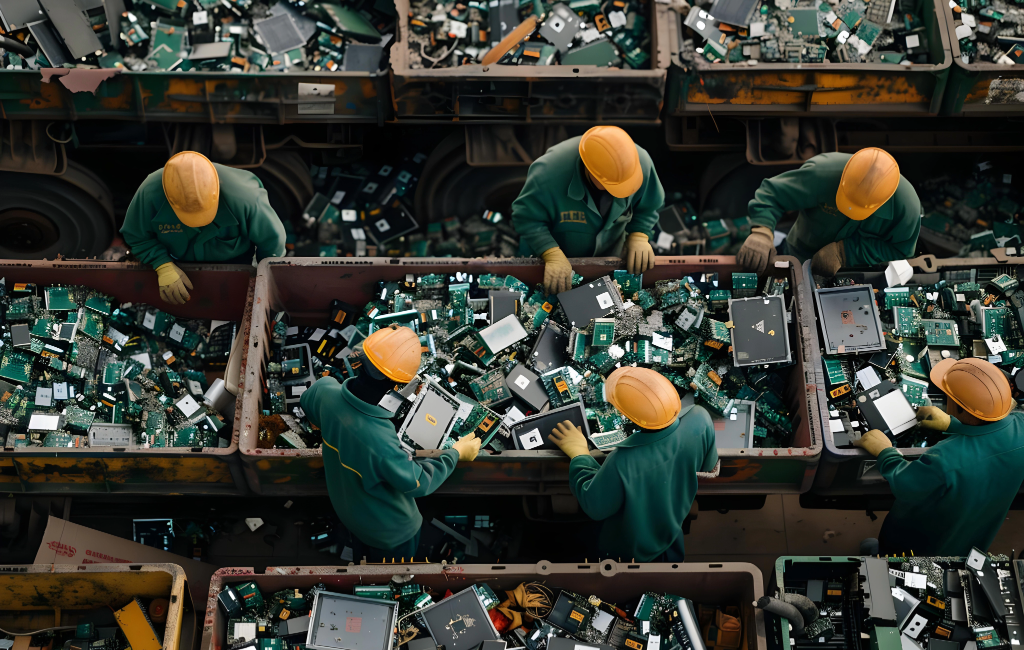
The United Nations painted a stark picture in a 2024 report. Over the past 12 years, the global e-waste pile has nearly doubled – rising from 34 billion to 62 billion kilograms. That’s the equivalent of 1.55 million fully loaded shipping trucks. If current trends continue, that number could hit 82 billion kilograms by 2030. But the recycling effort has not followed suit. Only 13.8 billion kilograms – roughly 20% of the total – is expected to be recycled, a figure that experts believe will hold steady.
In short, more electronics are being thrown out than ever before, and recycling efforts are failing to bridge the gap. Researchers at Virginia Tech have offered a glimmer of hope: a new material that could transform how we think about, and deal with, electronic waste.
Wired differently: chemistry meets engineering
In a cross-disciplinary collaboration, Associate Professor of Mechanical Engineering Michael Bartlett and Assistant Professor of Chemistry Josh Worch led their respective teams in creating a next-generation circuit material. Their research, published in Advanced Materials, introduced a material that didn’t just survive damage – it bounced back. With help from postdoctoral and graduate researchers, including Dong Hae Ho, Meng Jiang, and Ravi Tutika, the group developed circuits that were recyclable, conductive, reconfigurable, and even self-healing – all while maintaining the durability found in conventional circuit board plastics.
The innovation starts with a vitrimer – a dynamic polymer that allows reshaping and recycling. Into this polymer, they embedded droplets of liquid metal. These droplets take on the role traditionally held by rigid metallic wiring, enabling electrical flow while allowing flexibility and repairability.
This blend stands apart from previous attempts at flexible or recyclable electronics. By marrying adaptability with conductivity, the new circuits stood up to bending, stress, and damage without losing their function.
Bartlett explained: “Our material is unlike conventional electronic composites. The circuit boards are remarkably resilient and functional. Even under mechanical deformation or damage, they still work.”
Breaking the circuit breaker
Recycling today’s standard circuit boards is no simple matter. It involves energy-heavy processes and still leads to high volumes of unusable waste. Often, valuable components are lost along the way, resulting in a costly, inefficient cycle.
Virginia Tech’s circuit boards, by contrast, are designed to be recycled – simply and effectively.
Worch outlined the difference: “Traditional circuit boards are made from permanent thermosets that are incredibly difficult to recycle.
“Here, our dynamic composite material can be healed or reshaped if damaged by applying heat, and the electrical performance will not suffer. Modern circuit boards simply cannot do this.”
A smarter afterlife for electronics
While the global appetite for electronic devices is unlikely to slow down, this breakthrough signals a practical step toward reducing the environmental footprint of the digital age. Rather than continuing to funnel broken tech into landfills, solutions like this offered a pathway for reuse – not just of devices, but of their core materials.
It may not stop the tide of discarded electronics, but it suggested a better way forward: one circuit board at a time.