









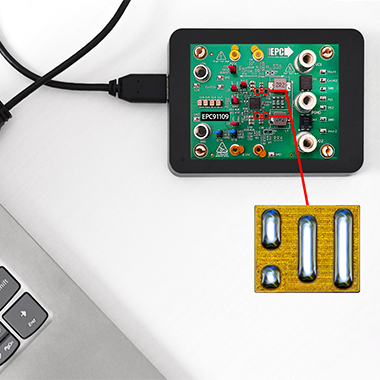
Targeting USB Power Delivery (USB-PD 3.1) applications up to 180W, the EPC91109 is optimised for space- and power-constrained designs such as laptops, portable devices, and battery-powered systems.
The EPC91109 combines four 50 V-rated EPC2057 GaN FETs with the Analog Devices LTC7890, a dual-phase buck controller, to deliver output voltages of 12V, 16V, or 20V from an input range of 20V to 36V. In two-phase interleaved mode, it supports output currents up to 14.3A – matching the full 180W USB-PD power envelope at 12V output from a 36V source.
“The EPC91109 shows GaN’s power density and efficiency for USB PD. It’s a compact, robust platform that needs no heatsink or airflow – even at full power,” said Alex Lidow, CEO of EPC.
Key features of the EPC91109 Evaluation Board:
- Configurable to operate in either two-phase or single phase, dual-output mode
- Up to 180W output (12V at 14.3A)
- Ultra-compact power stage: 24mm x 24mm
- Low-profile inductor of 3mm height
- No heatsink or forced air cooling required
- Configurable light-load modes and dead-time settings
- Peak efficiency >98% under standard operating conditions
The EPC91109 demonstrates how EPC’s latest generation GaN FETs and advanced controllers from Analog Devices can be combined to produce smaller, faster, cooler converters that outperform silicon-based alternatives.
Price and availability
- The EPC91109 reference design boards are priced at $317.09
- The EPC2057 is priced at $0.657/ea in 2.5Ku reels.