


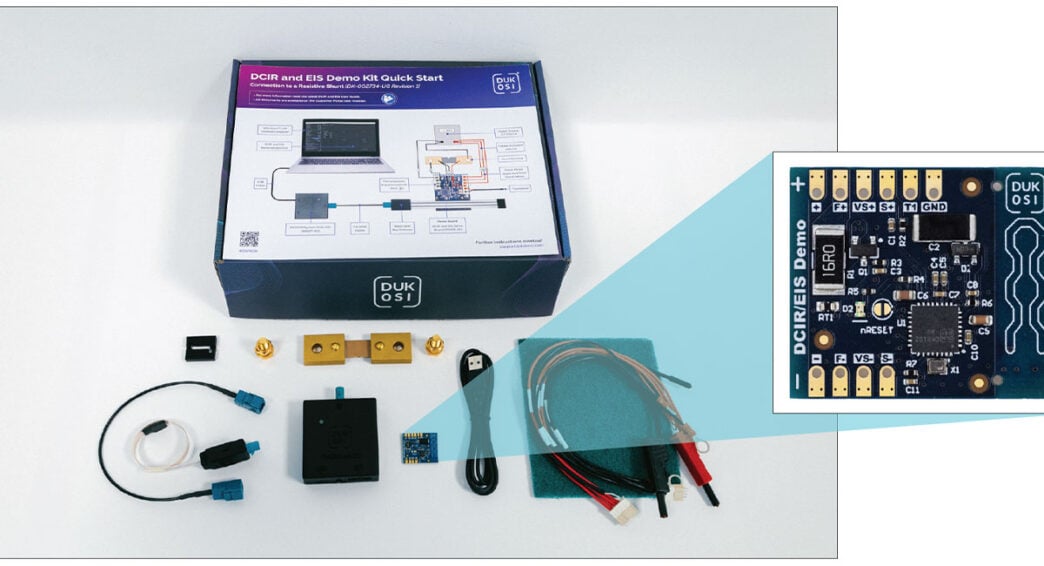
Edinburgh-based battery technology company Dukosi has launched an evaluation kit that it says lets developers take laboratory-quality health measurements from individual lithium-ion cells while they sit inside a working battery pack.
The DCIR and EIS Evaluation Kit, announced on 9 November, measures two indicators of a cell’s condition: DC internal resistance (DCIR) and electrochemical impedance spectroscopy (EIS). Both have traditionally needed specialist lab equipment. Dukosi says its kit takes the measurements directly on the cell, with no extra software or calibration required.
The kit is aimed at companies across the battery supply chain that want to evaluate Dukosi’s “chip-on-cell” technology before building it into their own packs. Target markets include electric vehicles, industrial and marine systems, robotics, and battery energy storage for grid-scale projects and AI data centres.
Most battery management systems track health at the level of the whole battery. Monitoring each cell individually lets operators spot faulty or weakening cells early, plan maintenance before problems occur and track cells through the supply chain. It could also make used cells more valuable for reuse in second-life applications.
According to Dukosi, its DCIR tests are considerably faster than rival systems, giving the battery management system a near-real-time view of conditions inside each cell. Combined with per-cell voltage and temperature readings, the company says this supports more accurate estimates of available power and more detailed thermal modelling, which is important for safety.
On EIS, Dukosi says customers who benchmarked its system against several competitors found it the most accurate, and 15 to 20 times faster. Developers can run a full frequency sweep from 0.1 Hz to 3.5 kHz, or target specific frequencies to cut test time. The company says the data can be used to improve State of Health estimates for each cell.
“Our DCIR and EIS measurements bring insights previously available only from high-end lab equipment directly into production-spec batteries,” said Joseph Notaro, President of Dukosi. “More accurate, consistent and detailed cell data helps developers design safer, more reliable systems with longer operating lives.”
The kit includes a Cell Monitor board, with one board needed for each cell, and a System Hub that can connect up to 216 boards, allowing developers to simulate a full battery pack. It also comes with cables for testing with either a power supply or live cells, plus a graphical interface that shows a “digital twin” of the setup and lets users switch between DCIR and EIS tests without rewiring. Dukosi is providing technical documentation and development support.
The kit uses Dukosi’s proprietary C-SynQ communication protocol, which the company says has already gained significant market adoption.
Dukosi will demonstrate the kit at electronica in Munich from 10 to 13 November, on the PGUB Future Mobility Pavilion (Hall B4, booth B4.421). It will also show its DK-NFLNK module demonstrator and a Battery Passport Ready Secure Solution developed with STMicroelectronics.