


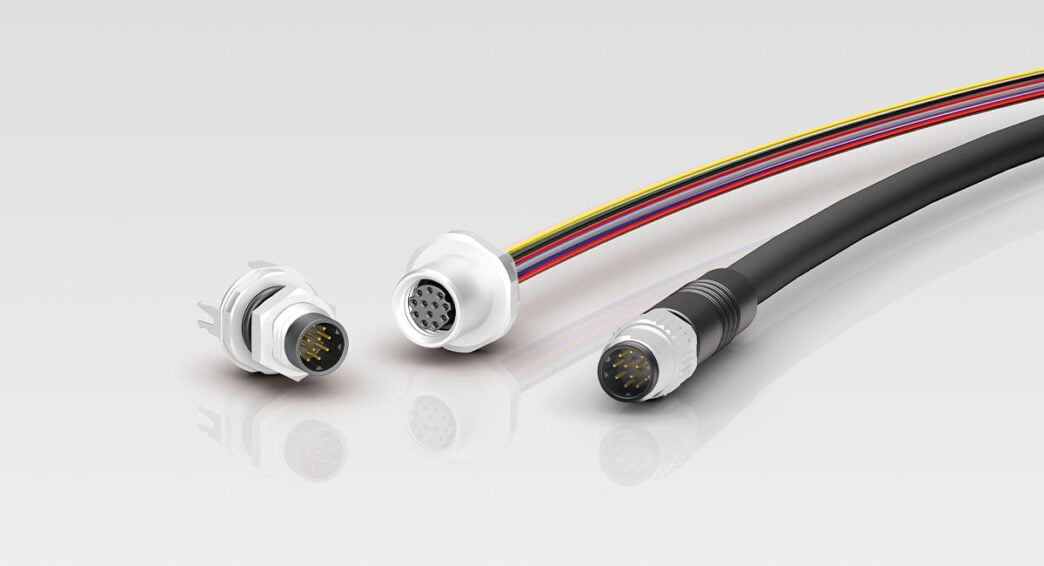
A 12-pin connector interface developed by binder has been formally recognised in the latest revision of the M8 circular connector standard, marking a step towards greater standardisation across the industrial connectivity market.
The revised DIN EN IEC 61076-2-104 (VDE 0687-76-2-104) specification now includes C-coding for the first time, documenting a 12-pin interface in the compact M8 connector format.
The design was originally introduced by binder in 2020 following a request from a manufacturer of length measuring systems. The customer needed more than eight signals for a new generation of equipment but could not increase the size of the M8 connectors already being used.
In response, binder developed a 12-pin mating face and initially introduced it as a proprietary coding. Since then, the design has been used in applications including length measuring systems, laboratory automation and industrial cameras.
Its inclusion in the revised standard means the mating face, coding and connection dimensions are now defined independently of any individual manufacturer. This is expected to give equipment designers greater confidence when specifying components and planning future systems.
Fitting 12 contacts into the small diameter of an M8 connector presented several engineering challenges.
The original design concept involved using a single, larger coding key, similar to those found in other M8 connector configurations. However, the symmetrical arrangement of the 12 contacts left insufficient space for this approach.
Binder instead developed a solution using five smaller coding keys, allowing the connector to be correctly aligned during mating while protecting the delicate contacts from damage.
The contacts measure just 0.5mm in diameter, making precise alignment particularly important to prevent bending during connection.
Manufacturing the connectors also requires careful assembly. The plastic bodies are fitted with the 12 contacts by hand, using magnification aids to ensure accuracy. For panel-mounted versions, 12 fine, individually coloured wires must be arranged in a specific sequence, with colour templates helping production staff position each wire correctly. The cable connectors are then moulded by machine.
The 12-pin M8-C interface has been used in industrial applications since 2020, including measurement equipment, laboratory systems and industrial cameras.
Its higher signal capacity allows manufacturers to transmit more information through a connector without moving to the larger M12 format.
Potential applications include conveyor and parcel sorting systems, where a single interface can carry four sensor signals, four actuator signals and four additional signals between a field device and decentralised input/output (I/O) systems.
Other applications include:
- Length and displacement measurement: Connecting more than eight signals without increasing connector size or moving to M12.
- Laboratory automation: Supporting environmental analysis equipment requiring higher signal density.
- Industrial cameras: Providing a compact connection for image, trigger and status signals.
- Conveyor and sorting systems: Combining multiple sensor and actuator signals through one interface.
- Robot grippers: Connecting sensors, gripping functions and diagnostic systems within restricted installation spaces.
The standardised C-coded connectors are available in male and female cable versions, as well as panel-mounted versions for rear installation. They use screw locking and provide IP67 protection when mated and secured.
Electrical specifications include a rated current of 1A, rated voltage of 30V or 32V depending on the version, and a rated impulse voltage of 500V. The connectors also feature gold-plated brass or bronze contacts and are available with PUR or PVC cable jackets.
Guido Werner, Product Manager at binder, said the revised standard would help establish compatibility across different connector manufacturers.
“With the revised standard, the foundation has been laid for consistent mating compatibility across the connector market,” he said.
“The future of automation lies, among other things, in miniaturisation, and with our portfolio of smaller sizes such as M5 and M8, we are already very well positioned for this.”
The inclusion of C-coding alongside established M8 A and D codings gives equipment manufacturers another option when designing compact connectivity solutions.
For binder, the revision represents the transition of a connector design developed in response to a specific customer requirement into a recognised industry standard, providing users with a 12-pin M8 interface that has already been established in industrial applications.