





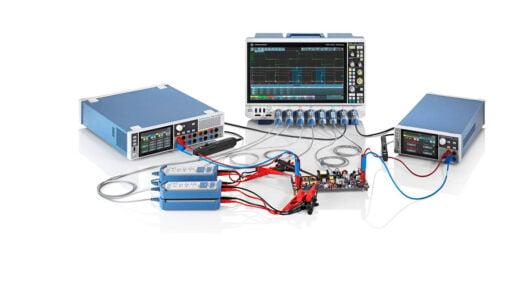
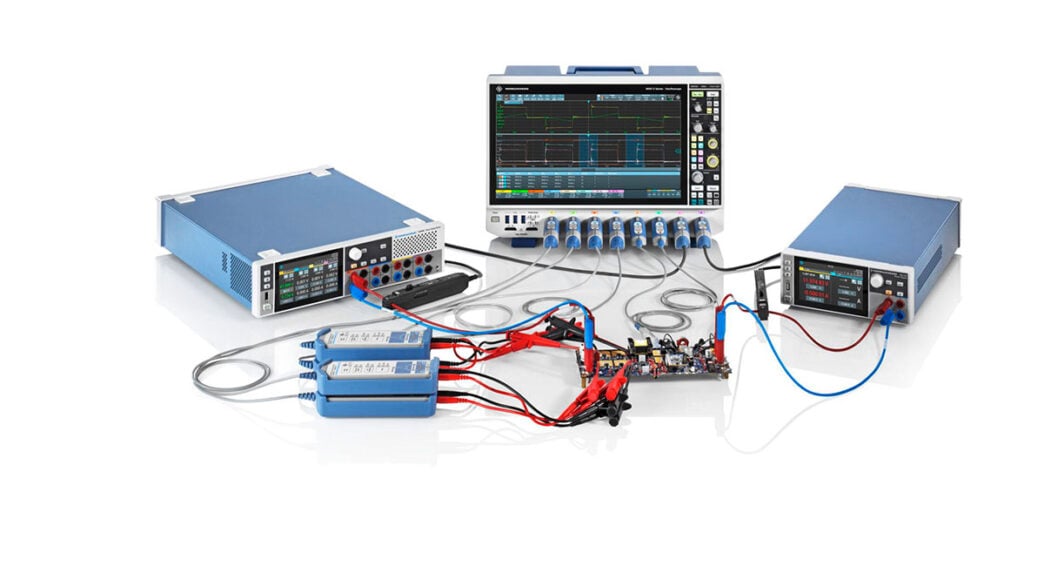
Modern circuits combine many components that operate at different supply levels, so a clean, stable power distribution network is essential. At low voltages, tolerances are expressed in percentages, making precise measurement difficult. Power up and power down timing determines whether parts receive the correct voltage at the right moment, and an oscilloscope is the ideal tool for observing these sequences. Conventional 4 channel oscilloscopes are not only limited by the number of signals that can be observed concurrently. They often struggle when performing measurements with tight (1-2 %) tolerances with noise from fast switching loads, especially in high frequency EMI environments. Additional probes and instruments further degrade the analysis confidence.
The MXO 5 and the more compact MXO 3 use the same next generation MXO technology from Rohde & Schwarz. Both series are available with up to eight analog and 16 logic channels, providing the channel count required for multi rail analysis and greatly simplifying power sequencing tests. Their memory depth of up to 500 Mpoints per channel captures millisecond scale up/down sequences while preserving signal detail. Reducing the acquisition bandwidth during ripple noise analysis lets the 12 bit ADC operate in an 18 bit HD mode, delivering higher effective resolution. With a vertical sensitivity of 1 mV/div on the MXO 5, engineers can view rails from –5 to +5 V (or ±3V offset on the MXO 3). The MXO architecture employs a sample based digital trigger with a sensitivity of < 0.0001 vertical divisions (Figure 1). This enhanced trigger sensitivity allows for the full utilisation of the 18-bit vertical resolution.
Power sequence measurement considerations
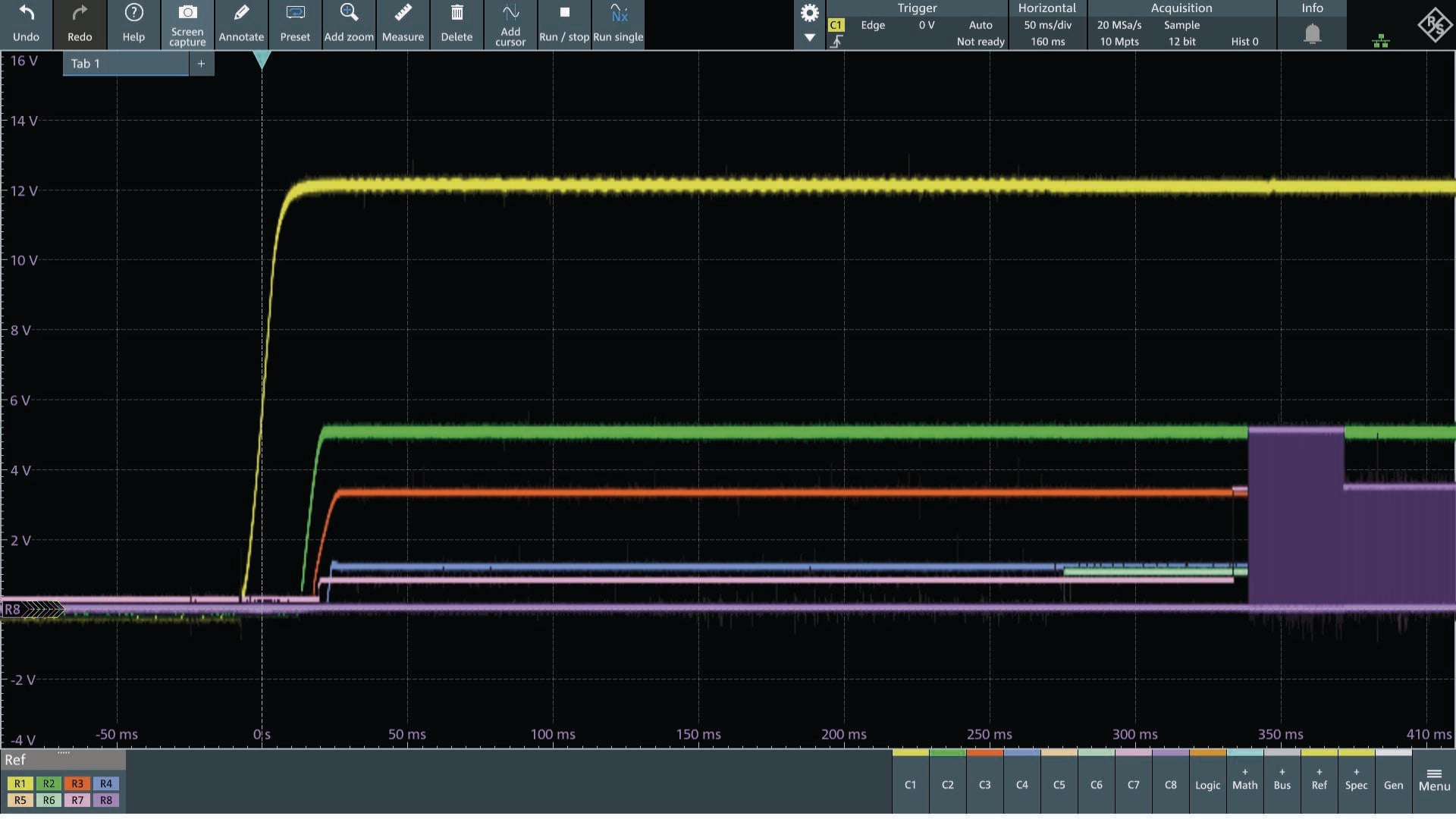
Accurate voltage levels and timing are critical for circuit function. Delays between rails ensure that each supply settles before the next circuit block is activated. Lower voltage DC rails are derived from higher supplies and need time to stabilise before regulation. Probing several rails simultaneously can be tedious; logic channels only indicate 1 or 0, whereas additional analog channels can capture the transition shape.
Long record lengths are often required – hundreds of milliseconds to several seconds for high power designs – to observe discharge periods and overall sequence dynamics. A balance between the acquisition time and the sample rate due to the available memory is critical to ensure enough resolution albeit the long captures, especially with even more channel traces.
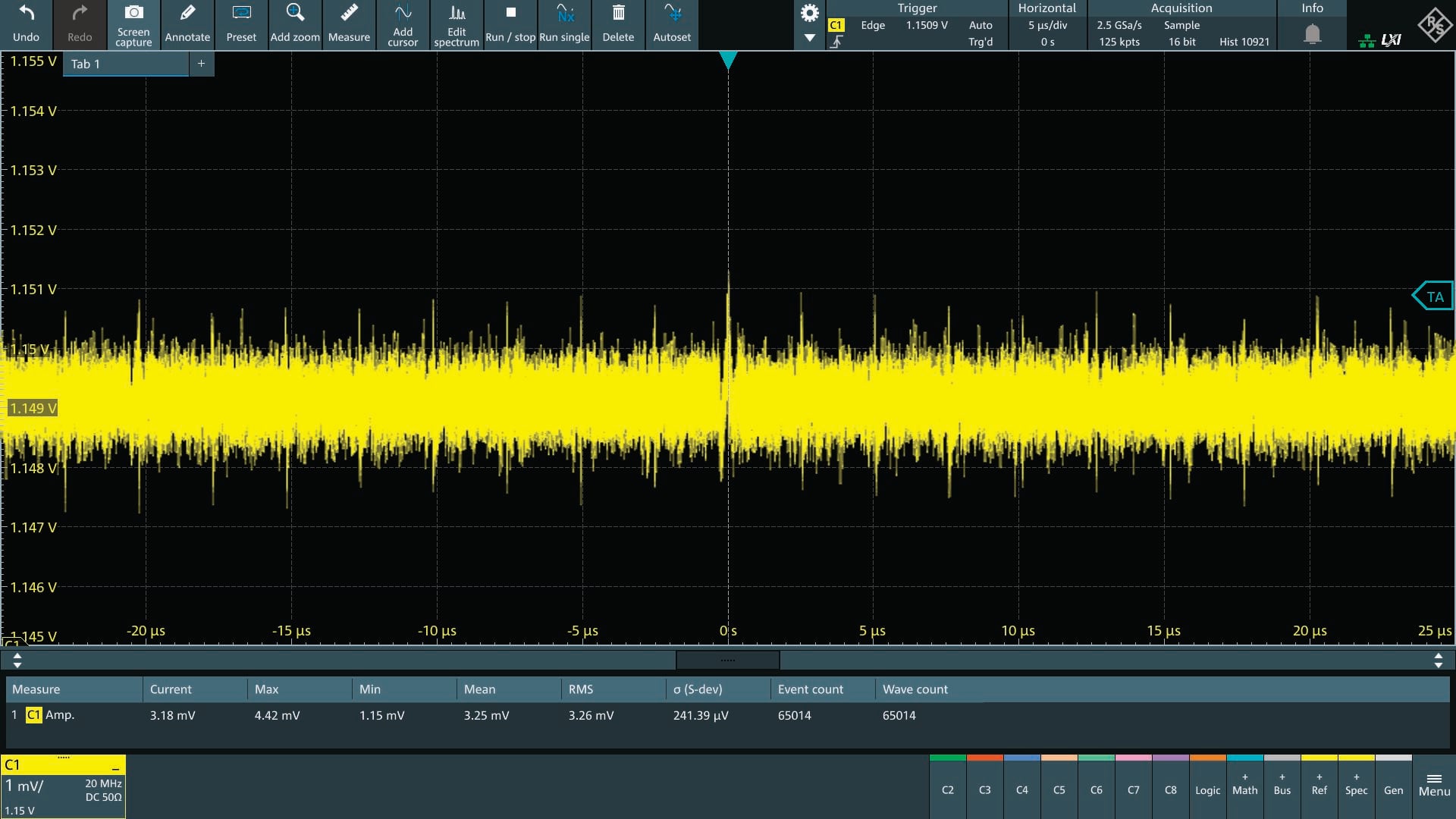
Ripple noise measurement considerations
Bandwidth selection directly affects measured noise. Higher bandwidth scopes record more noise, so the user must choose bandwidth that captures the frequencies of interest while rejecting unwanted components. Most power converters switch around 1MHz, making a 20MHz bandwidth sufficient for most analysis. Emerging interest in GHz range ripple, driven by fast load transients of wide bandgap devices, can be addressed with R&S RT ZPR power rail probes that offer up to 4GHz of analysis bandwidth. These probes come with short, direct connections and low inductance coaxial cables which reduce interference, minimising measurement induced noise.
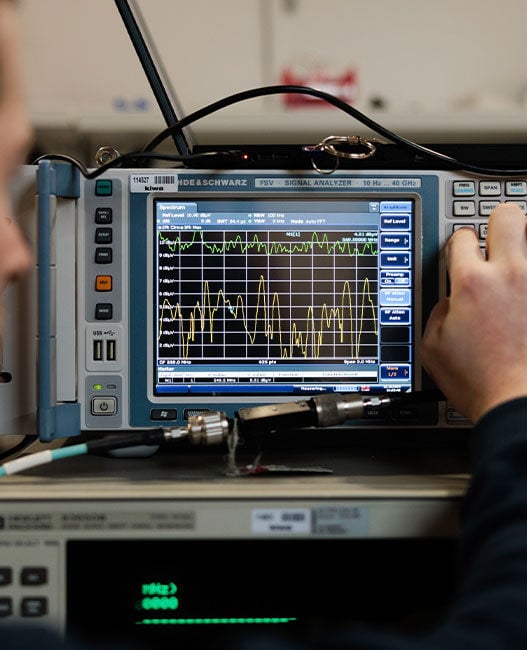
Spectral analysis (Figure 3) reveals the frequency content of ripples, helping to locate sources and design appropriate filters, MXO oscilloscopes provide rapid spectral updates (>45 000 FFT/s), delivering a responsive view of sporadic EMI events. Combined with near field probes and spectrum zone trigger, these enable precise identification and mitigation of noise sources.
Addressing power sequencing and ripple noise measurement with the MXO oscilloscopes
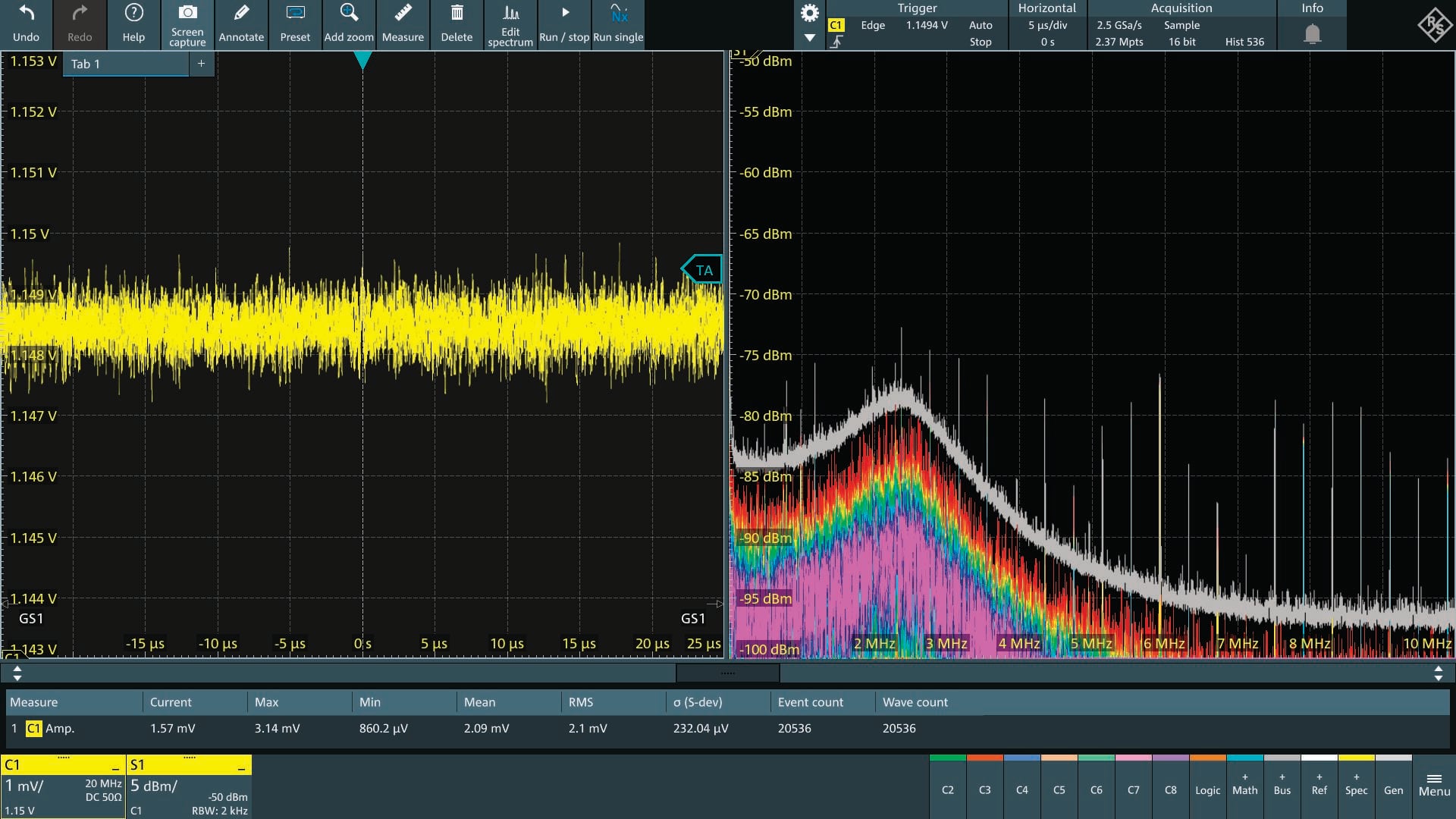
Power sequence and power rail analysis are fundamental measurements to ensure proper circuit behaviour. With eight channels, the MXO 3 and MXO 5 series are ideal for multiple rail analysis. With up to 500 Mpoints per channel retain high sampling resolution and the 12-bit ADC provides highest available precision for accurate measurements. Filtering and box car averaging allow the HD mode to provide up to 18-bit precision. The MXO series oscilloscopes also have a high input sensitivity of 500μV/div with ±5 V offset range for an easy passive probe setups in power rail measurements. The channel input can also apply selective filters or use HD mode filtering to generate the required measurement bandwidth. Functions such as spectrum analysis and frequency response analysis can also be useful when characterising power ripple behaviour.
This article originally appeared in the June’26 magazine issue of Electronic Specifier Design – see ES’s Magazine Archives for more featured publications.