





Sony has developed a sensor series called STARVIS, which uses a back-side-illuminated (BSI) architecture in which the wires are placed behind the photodiode, allowing more light to be captured. This BSI-type sensor has a higher quantum efficiency, allowing sensitivity in both the visible and near-infrared bands.
The STARVIS 2 platform is the next generation of STARVIS and uses a back-side-illuminated (BSI) architecture with deep trench isolation (DTI) technology, further improving sensitivity and dynamic range by optimising photodiode structures and charge conversion efficiency.
While the IMX415 and IMX715 belong to the STARVIS generation, the IMX678 is built on the
STARVIS 2 platform, delivering significantly enhanced imaging performance.
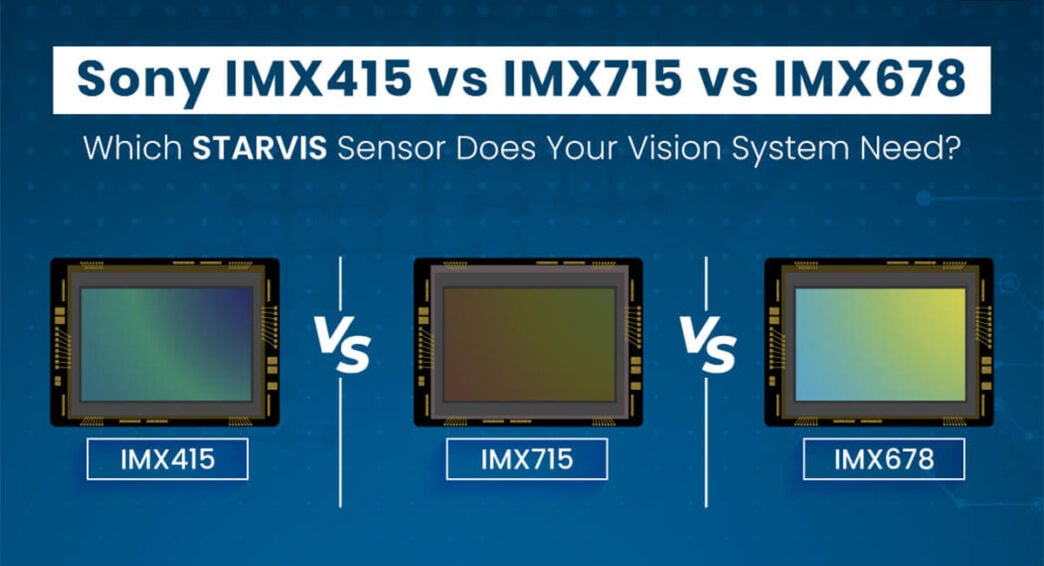
All three sensors output 4K UHD resolution (3840 × 2160) but differ in sensor size, pixel pitch, and photon-collection efficiency. Understanding the architectural differences among these sensors helps select the right imager for an industrial inspection system or patient monitoring system operating in low-light environments.
Understanding the Sony IMX415, IMX715, and IMX678 sensor generations
Sony IMX415
The IMX415 is Sony’s first-generation STARVIS sensor. It was Sony’s flagship 8MP 1/2.8″ BSI sensor targeting surveillance and industrial markets. Its 1.45µm pixel pitch enabled compact optical designs with small-format lenses. Our Sony STARVIS camera series is available in both colour and monochrome variants.
Explore our Sony IMX415 sensor-based cameras
Sony IMX715
The IMX715 also belongs to the STARVIS family, representing an incremental but significant evolution of the IMX415, retaining the identical 1/2.8″ format and 1.45µm pixel pitch while explicitly targeting improved sensitivity in the near-infrared (NIR) spectrum.
Explore our Sony IMX715 sensor-based cameras
Sony IMX678
The IMX678 is designed on the STARVIS 2 platform. It uses a larger 1/1.8″ sensor format with a 2.0 µm pixel pitch – nearly 90% larger pixel area compared to the 1.45µm sensors. STARVIS 2 additionally provides a wide dynamic range advantage exceeding 8 dB over STARVIS for the same pixel size in a single exposure.
Explore our Sony IMX678 sensor-based cameras
Full specification comparison: Sony IMX415 vs. IMX715 vs. IMX678 sensors
| SPECIFICATIONS | IMX415 | IMX715 | IMX678 |
| Sensor Technology | STARVIS BSI | STARVIS BSI (improved NIR) | STARVIS 2 BSI |
| Image Size (Type) | Type 1/2.8 (6.4mm) | Type 1/2.8 (6.4mm) | Type 1/1.8 (8.86mm) |
| Pixel Size | 1.45 µm × 1.45 µm | 1.45 µm × 1.45 µm | 2.0 µm × 2.0 µm |
| Effective Pixels | 3864×2192 (~8.46 MP) | 3864×2192 (~8.46 MP) | 3856×2180 (~8.40 MP) |
| Output Format | RAW10 / RAW12 | RAW10 / RAW12 | RAW10 / RAW12 |
| Max Frame Rate (10b) | 90.9 fps | 90.9 fps | 72 fps |
| Max Frame Rate (12b) | 60.3 fps | 60.3 fps | 60 fps |
| Output Interface | CSI-2 (2/4 Lane) | CSI-2 (2/4 Lane) | CSI-2 (2/4/8 Lane, 4L×2ch) |
| HDR (High Dynamic Range) Modes | Multi-exp + DOL | Multi-exp + DOL | DOL + Clear HDR |
| Window Cropping | Yes | Yes | Yes |
| 2×2 Binning | Yes | Yes | Yes |
| Sensor Type | Color and monochrome | Color | Color |
Key technical differences: IMX415 vs. IMX715 vs. IMX678 sensors
-
HDR architecture
HDR imaging is critical in security applications where scenes often contain both brightly lit windows and shadowed interiors simultaneously.
-
- Multiple exposure HDR: IMX415 and IMX715 sensors capture images with multiple exposures, which are merged in post-processing. Offers flexibility in exposure ratio control.
- Digital overlap HDR (DOL-HDR): Supported by all three sensors. Embeds long and short exposures, reducing motion artifacts compared to frame-sequential HDR.
- Clear HDR: The clear HDR is a new feature, available exclusively in the IMX678 (STARVIS 2). This is an advanced HDR mode that leverages STARVIS 2’s pixel architecture to extend dynamic range within a single exposure – reducing the ghosting and motion blur artifacts inherent in multi-exposure approaches.
An example of this capability can be seen in a 4K HDR GigE ONVIF-complaint camera powered by the Sony IMX678 sensor, where DOL-HDR and Clear HDR technologies enable reliable imaging performance in challenging lighting environments.
In the image below, the number plate is clearly visible without motion artifact in clear HDR, whereas in DOL HDR, motion artifact can be observed.
-
Optical format
Sony IMX415 and IMX715
Both sensors can be fitted with compact cameras due to their 6.4mm diagonal and 1/2.8″ optical format.
Sony IMX678
The IMX678 has a larger 8.86mm diagonal and requires a correspondingly larger image circle lens. It enables several key benefits:
-
- Distinguishes small details across its field of view (FOV).
- Maintains a good focus range despite low light conditions.
- Delivers cleaner, sharper images in near-infrared wavelengths, as the IMX678 sensor-based camera is less sensitive to chromatic aberration.
-
Near-infrared performance
The IMX715 improves NIR sensitivity over earlier generations, making it suitable for applications using infrared illumination (e.g., 850 or 940nm) in low-light environments. The improvement is achieved by refined BSI-pixel processing within the STARVIS architecture.
The latest-generation STARVIS 2 IMX678 enhances NIR performance through a deeper photodiode structure that reduces NIR absorption losses.
-
Maximum frame rate
Both 1/2.8″ IMX415 and IMX715 sensors achieve 90.9fps at 10-bit and 60.3fps at 12-bit in all-pixel scan mode. As the larger sensor format of IMX678 requires a higher pixel data bandwidth and supports the broader CSI-2 lane configurations, IMX678 produces 72fps (10-bit) and 60 fps (12-bit).
-
CSI-2 output interface
All three sensors support CSI-2 as the primary output, but the IMX678 offers greater flexibility.
-
- IMX415 and IMX715 support 2-lane and 4-lane CSI-2 configurations
- IMX678 supports 2-lane, 4-lane, 8-lane, and dual 4-lane × 2channel configurations.
-
Binning mode
All three sensors support a 2×2-pixel binning feature, which reduces the output to 1920×1080 while improving sensitivity and maintaining the same maximum frame rate (90.9 fps for IMX415/715, 72 fps for IMX678). Binning works by averaging neighbouring pixels into a single sample, thereby quadrupling the light-gathering area at the expense of resolution, which can be a worthwhile compromise in very dark scenes.
The 2×2 and 4×4-pixel-binned images are shown below.
Read blog: What is pixel binning? How It works and Its key advantages
Conclusion
Ultimately, the choice between IMX415, IMX715, and IMX678 will depend on system constraints, lighting conditions, and other optical requirements.
The IMX415 remains a cost-effective solution for standard surveillance applications where compact form factors are essential.
The IMX715 offers improved NIR sensitivity compared to previous STARVIS versions while retaining the same optical format. This improved NIR sensitivity, making it suitable for smart city applications and parking lot management.
The IMX678, however, provides the most significant performance advantage. Its larger pixel architecture and STARVIS 2 technology make it the preferred choice for low-light AI vision systems, traffic monitoring, robotics, and industrial automation, where superior sensitivity and dynamic range are required.
e-con systems offers world-class IMX678-based camera solutions
Since 2003, e-con Systems has been designing, developing, and manufacturing embedded vision solutions, from custom OEM cameras to complete ODM platforms. Our camera solutions have evolved alongside advancements in imaging technologies, including those from Sony, onsemi and OMNIVISION.
We have implemented IMX678’s STARVIS 2 capabilities into production-ready embedded camera modules to deliver superior low-light sensitivity, high dynamic range, and reliable imaging performance across demanding environments.
Explore our Sony STARVIS and STARVIS 2 sensor-based cameras to find the ideal solution for your application.
Visit our Camera Selector to quickly and easily identify the right camera for your vision needs.
To meet your specific vision requirements, please contact our camera experts at camerasolutions@e-consystems.com.