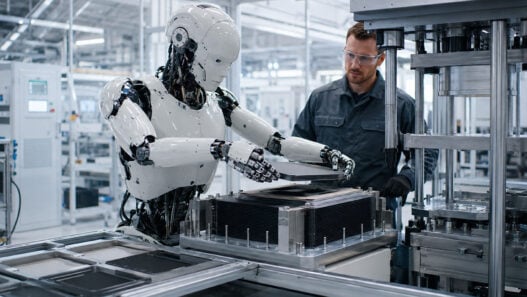




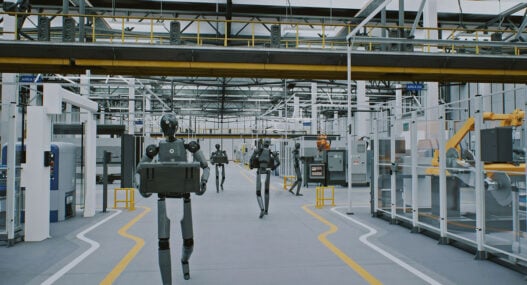
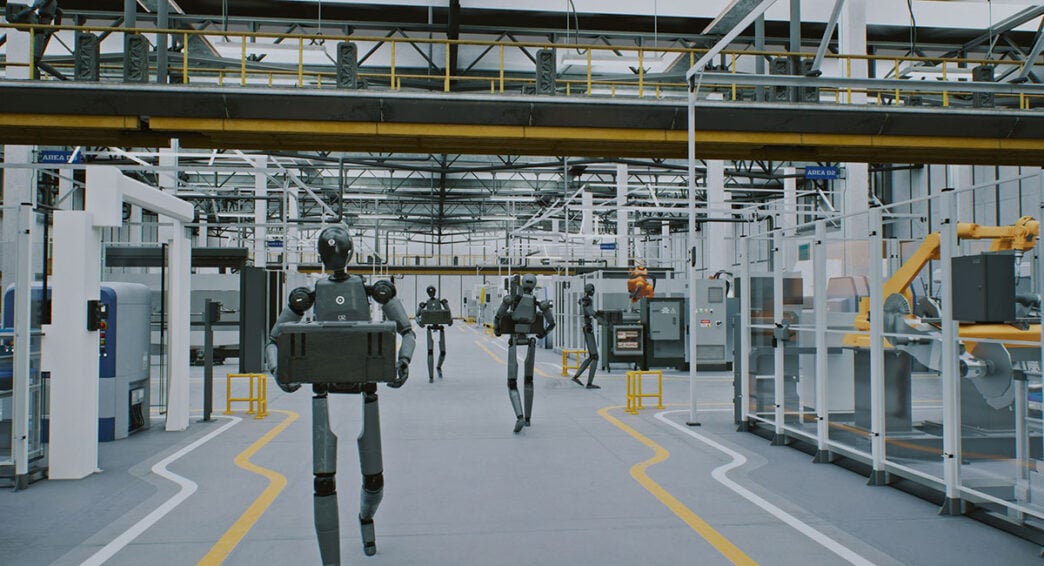
The BMW Group’s deployment of AI-enabled humanoid robots in automotive production highlights the shift towards physical AI in manufacturing environments. These systems are designed to support repetitive high-precision tasks within factory settings where adaptability and consistency are increasingly important.
Here Ross Turnbull, Director of Business Development at Swindon Silicon Systems, explains how humanoid robotics is evolving and why ASICs are critical to reliable real-world performance.
The global robotics industry continues to expand as automation increasingly becomes embedded across automotive, electronics, and logistics sectors. According to the International Federation of Robotics, ‘542,000 industrial robots were installed globally in 2024’, bringing the total number of operational units to 4.66 million, driven by demand for higher throughput, labour efficiency and flexible production systems across manufacturing environments.
Within this broader market, humanoid robotics remains an emerging segment, with Goldman Sachs projecting the sector to reach around $38 billion by 2035 as development moves from pilot systems towards industrial deployment.
From fixed automation to adaptive robotics
Humanoid robots are robotic systems designed with human-like form factors that allow operation in environments built for people. Unlike traditional industrial robots, which are fixed to specific tasks and locations, humanoids are designed for adaptability in dynamic environments where workflows are not fully structured.
In manufacturing settings, these systems are used for repetitive assembly, material handling, inspection and support tasks. Deployments in automotive production demonstrate this shift, with humanoid platforms operating alongside human workers to support precision-driven tasks while improving production flexibility without major changes to existing infrastructure.
Physical AI and system integration limits
Physical AI combines digital intelligence with physical systems that perceive, decide and act within real-world environments. Performance depends on how effectively computational output is translated into physical execution.
Humanoid robots process large volumes of sensor data in real time while maintaining precise motion control. This introduces constraints including signal noise, latency, mechanical variation and environmental interference. Even small reductions in signal integrity directly impact stability and accuracy in repetitive operations.
Operational constraints in industrial environments
AI defines decision making, but execution depends on the quality of underlying electronics. Industrial environments introduce vibration, electrical noise and temperature variation, which affect signal quality and system response.
As humanoid systems move from pilot deployment to continuous operation, these constraints significantly increase. Performance must remain consistent across thousands of cycles under variable conditions without degradation in precision or control stability.
Signal chain and control dependence
Humanoid operation depends on the interaction between sensing, processing and actuation. Sensors capture environmental data, processing systems interpret it and control systems execute movement. Any disruption across this chain introduces cumulative error in timing and motion accuracy.
Signal conditioning and real-time processing therefore define system stability. Latency and noise become direct limiting factors in whether performance can be sustained at scale.
ASICs as the integration layer
Application specific integrated circuits (ASICs) integrate sensing, processing and control functions into silicon designed for specific applications. Unlike general purpose components, ASICs are optimised for efficiency, consistency and deterministic operation.
In humanoid robotics, this enables signal conditioning and processing at hardware level, reducing the distance between data capture and execution. This improves responsiveness, stabilises motion control and increases accuracy in repetitive tasks where consistency is critical.
ASIC integration reduces system complexity by consolidating functions into a single device. This lowers component count and reduces potential failure points while simplifying overall system architecture in continuous industrial operation.
Performance and system level impact
ASICs deliver improved signal integrity, reduced noise sensitivity, lower latency and higher energy efficiency compared with general purpose solutions. These characteristics support continuous operation in variable industrial environments where stability is required.
System-level integration reduces design complexity and improves long-term reliability by limiting dependency on multiple discrete components subject to supply variation or obsolescence. In industrial applications where lifecycles extend beyond 15 to 20 years, this stability becomes a critical factor.
Scalable deployment of humanoid systems
Scalability depends on consistent performance across diverse operational environments. Tightly integrated electronic systems are therefore required to maintain predictable behaviour under real-world constraints.
ASIC-based architectures provide a foundation for scalable deployment by enabling consistent performance across systems while reducing integration overhead. This allows humanoid robotics to be introduced into manufacturing environments without compromising reliability or requiring major system redesign.
Humanoid robotics represents a significant development in industrial automation, but its effectiveness depends on more than advances in AI. Physical AI systems must operate reliably within complex and variable environments where precision and stability determine performance.
ASIC technology enables accurate signal processing, stable control and efficient system integration, allowing humanoid robotic systems to perform predictably. In manufacturing environments, this precision becomes the condition that determines whether physical AI can operate reliably at scale.