









A multi-institution research team has published details of a brain-computer interface that abandons the conventional approach of bulky, multi-component electronics in favour of a single integrated circuit chip.
The platform, called the Biological Interface System to Cortex (BISC), was described in Nature Electronics on 8th December 2025. It was developed by researchers at Columbia University, NewYork-Presbyterian Hospital, Stanford University, and the University of Pennsylvania, under DARPA’s Neural Engineering System Design programme.
The architecture problem it solves
Today’s state-of-the-art clinical BCIs are assembled from discrete microelectronic components – amplifiers, data converters, radio transmitters, power management circuits – housed in a large canister that must be surgically implanted either by removing a portion of the skull or by placing the unit elsewhere in the body and running wires to the brain.
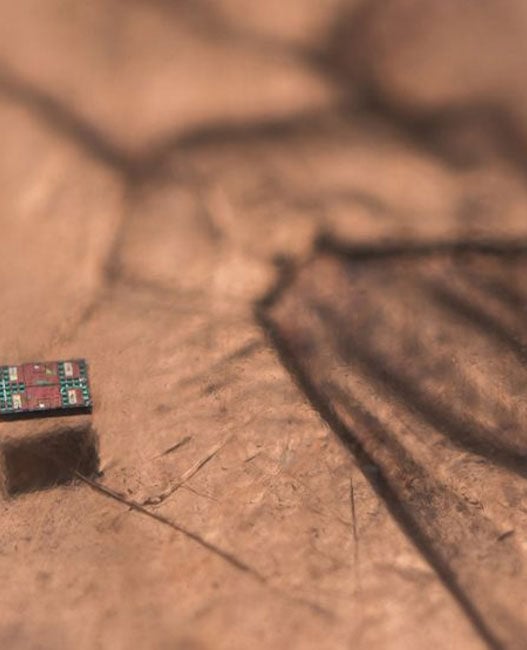
BISC takes a different approach entirely. The entire implant occupies less than 1/1000th the volume of a conventional device. It is a single CMOS integrated circuit thinned to just 50μm – thin enough to slide into the subdural space and conform to the cortical surface.
Ken Shepard, Lau Family Professor of Electrical Engineering at Columbia, described it as resting on the brain “like a piece of wet tissue paper.”
The spec sheet
Within that 3mm³ total volume, the chip integrates 65,536 electrodes, 1,024 simultaneous recording channels, and 16,384 stimulation channels. The single die also incorporates a radio transceiver, wireless powering circuitry, digital control logic, power management, data conversion, and the full analog front-end for recording and stimulation.
On the wireless side, a battery-powered wearable relay station communicates with the implant over a custom ultrawideband radio link achieving 100Mbps – at least 100 times higher throughput than any competing wireless BCI device. The relay station is itself an 802.11 Wi-Fi node, effectively forming a relayed network path from any computer directly to the brain.
Manufacturing and process technology
The chip was fabricated using TSMC‘s 0.13-μm Bipolar-CMOS-DMOS (BCD) process. This process integrates three distinct device families onto a single die to create mixed-signal ICs: CMOS for digital logic, bipolar, and DMOS transistors for high-current and high-voltage analog functions, and DMOS power devices.
The choice of BCD is significant – it allows the neural recording front-end, stimulation drivers, and digital processing to coexist on a single substrate without the signal integrity compromises that come with multi-chip approaches.
Neural decoding and AI integration
BISC has its own instruction set, backed by an extensive software stack, constituting a computing architecture purpose-built for BCIs. The high-bandwidth recording feeds directly into machine-learning and deep-learning frameworks for decoding complex intentions, perceptions, and states.
Andreas Tolias, co-corresponding author and professor at Stanford’s Byers Eye Institute, trained AI models on large-scale neural datasets recorded using BISC. He describes BISC as turning the cortical surface into “an effective portal, delivering high-bandwidth, minimally invasive read–write communication with AI and external devices,” and says its single-chip scalability opens the door to adaptive neuroprosthetics and brain-AI interfaces for treating neuropsychiatric disorders including epilepsy.
Clinical pathway
The team has refined surgical implantation methods in a preclinical model, and short-term intraoperative recordings in human patients are already underway. The implant is inserted through a minimally invasive skull incision and slid directly onto the cortical surface. The paper-thin form factor and the absence of brain-penetrating electrodes or tethering wires are designed to minimise tissue reactivity and long-term signal degradation.
Youngerman and Shepard have also been awarded an NIH grant to apply BISC to the management of drug-resistant epilepsy.
Commercialisation
To accelerate clinical translation, the Columbia and Stanford teams have spun out Kampto Neurotech, founded by Columbia electrical engineering alumnus Dr. Nanyu Zeng. The company is developing commercial chip versions for preclinical research and raising funds to advance the system toward broader human use.
Zeng said: “This is a fundamentally different way of building BCI devices. BISC has technological capabilities that exceed those of competing devices by many orders of magnitude.”
Shepard drew a pointed analogy for where the field is heading: “Semiconductor technology allowed the computing power of room-sized computers to fit in your pocket. We are now doing the same for medical implantables.”