




Humans are back at the Moon. On 1st April 2026, NASA’s Artemis II blasted off from Kennedy Space Center and sent four astronauts further from Earth than any person has ever been.
But behind the jaw-dropping moments is some seriously impressive hardware. We’re talking laser beams bouncing 4K video off the Moon, a European-built engine module with 33 thrusters and 11 kilometres of wiring, and a spacesuit that could keep you alive for six days in the vacuum of space.
Here’s a breakdown of the coolest technology aboard Artemis II:
O2O Laser Communications System
Artemis II is historic not only for renewing human exploration beyond Earth, but also for being the first crewed lunar flight to demonstrate lasercom technologies, which are poised to revolutionise how spacecraft communicate.
Developed at MIT Lincoln Laboratory in collaboration with NASA Goddard Space Flight Center, the Orion Artemis II Optical Communications System (O2O) is a laser-based system capable of sending data back to Earth at up to 260 megabits per second – far beyond what traditional radio links could achieve.
“The Orion spacecraft collects a huge amount of data during the first day of a mission, and typically these data sit on the spacecraft until it splashes down and can take months to be offloaded,” said lead systems engineer Farzana Khatri, a senior staff member in the laboratory’s Optical and Quantum Communications Group. “With an optical link running at the highest rate, we should be able to get all the data down to Earth within a few hours for immediate analysis. Furthermore, astronauts will be able to communicate in real-time over the optical link to stay in touch with Earth during their journey, inspiring the public and the next generation of deep-space explorers, much like the Apollo 11 astronauts who first landed on the moon 57 years ago.”
At the heart of O2O is the laboratory-developed Modular, Agile, Scalable Optical Terminal (MAScOT). About the size of a house cat, MAScOT features a 4-inch telescope mounted on a two-axis pivoted support (gimbal) with fixed backend optics. The gimbal precisely points the telescope and tracks the laser beam through which communications signals are emitted and received in the direction of the desired data recipient or sender. Underneath the gimbal, in a separate assembly, are the backend optics, which contain light-focusing lenses, tracking sensors, fast-steering mirrors, and other components to finely point the laser beam.
MAScOT made its debut in space as part of the laboratory’s Integrated Laser Communications Relay Demonstration (LCRD) LEO User Modem and Amplifier Terminal (ILLUMA-T), which launched to the International Space Station in November 2023. Over the following six months, the laboratory team performed experiments to test and characterise the system’s basic functionality, performance, and utility for human crews and user applications. Initially, the team checked whether the ILLUMA-T-to-LCRD optical link was operating at the intended data rates in both directions: 622Mbps down and 51Mbps up. In fact, even higher data rates were achieved: 1.2Gbps down and 155Mbps up.
32 cameras
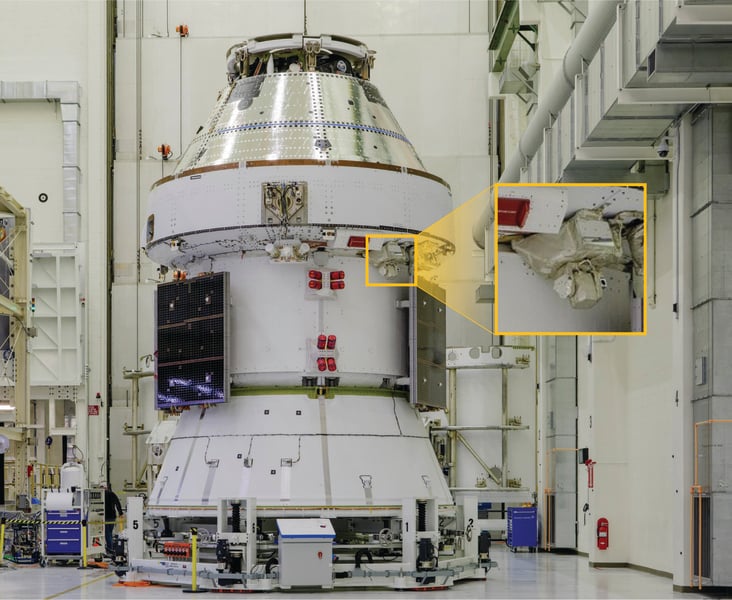
Orion is carrying 32 cameras and devices, including any instrument with a lens capable of capturing photos or video, inside or on the exterior of the vehicle.
The systems support engineering, navigation, crew monitoring, and a range of lunar science and outreach activities.
Fifteen cameras are mounted directly to the spacecraft, and 17 are handheld cameras operated by the crew.
European Service Module (ESM)
The European Service Module is ESA’s contribution to NASA’s Orion spacecraft. It provides electricity, water, oxygen and nitrogen as well as keeping the spacecraft at the right temperature and on course.
The ESM carries three types of engines. A single main engine delivers the large velocity changes needed to send Orion toward the Moon. Eight auxiliary engines handle orbital corrections and can back up the main engine if needed. And 24 smaller reaction control system engines, arranged in six pods, handle precise rotation and orientation of the spacecraft.
The main engine itself has a long heritage – a variant of the same AJ10 design was used on the Apollo service module, dating back to 1957.
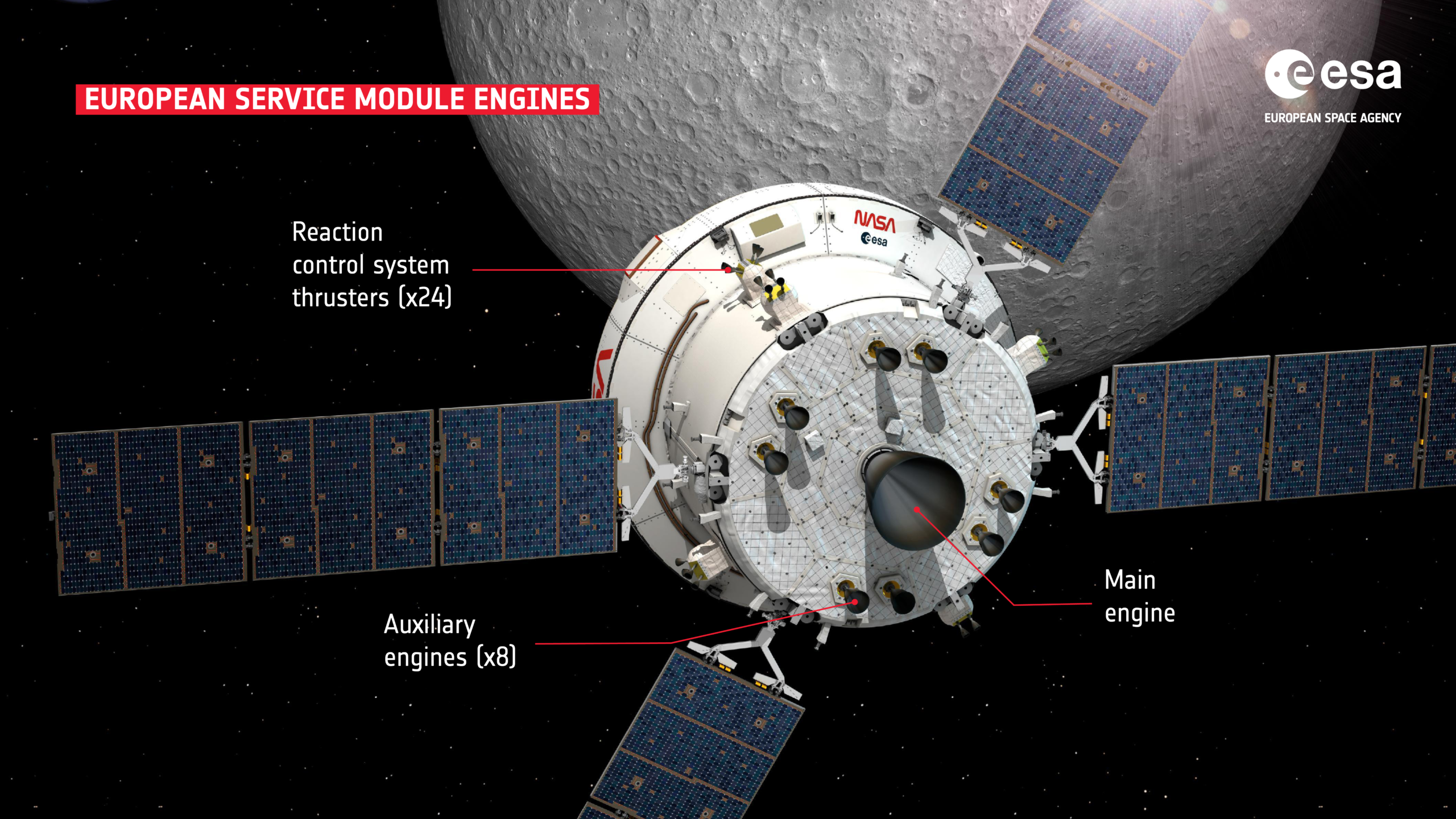
Four large solar array wings contain 15,000 high-efficiency solar cells and generate roughly 11.2kW of electricity – enough to power two average European households. These moveable wings continuously track the Sun but can also be folded back to protect them from physical stress.
The system carries 90kg of oxygen and 240kg of drinking water, supplied to the crew module to sustain the astronauts, while its thermal control system regulates cabin conditions amid extreme temperature variations in deep space.
Inside the module there are 11km of electrical wiring, four propellant tanks, and two pressure tanks, all working together with no room for error.
AVATAR Organ-on-a-Chip Experiment
Artemis II AVATAR is a small experiment flying aboard Artemis II that could lead to big impacts in healthcare, both for astronauts in space and citizens on Earth.
It will use organ-on-a-chip devices, or organ chips, to study the effects of increased radiation and microgravity on human health, studying how different space stressors affect tissue before sending the first humans to Mars. It could provide valuable information for developing measures to protect astronaut health on their journeys, such as personalised medical kits.
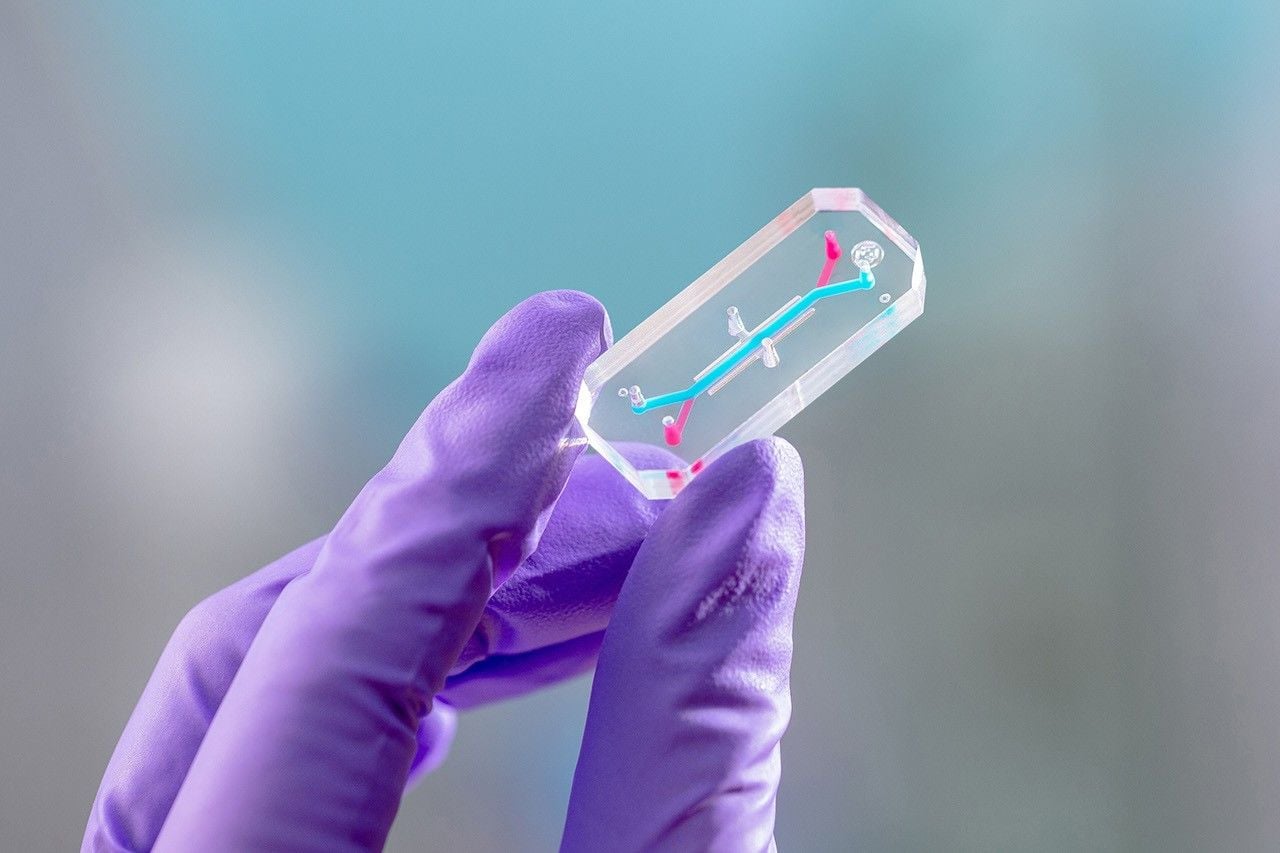
“For NASA, organ chips could provide vital data for protecting astronaut health on deep space missions,” said Lisa Carnell, NASA’s Biological and Physical Sciences Division.
AVATAR is a collaboration between NASA, multiple government agencies, and industry partners that seeks to gain a deeper understanding of human biology and disease, preventative measures, and personalised therapeutic treatments.
International CubeSats
The mission carries several small satellites, including the ATENEA satellite from Argentina to study radiation shielding and test long-distance communications, and the K-RadCube from South Korea, which studies a dosimeter material designed to mimic human tissue to measure the effects of space radiation.
Orion Crew Survival System Suit (OCSS)
The Orion Crew Survival System (OCSS) is the bright orange spacesuit worn by astronauts inside the Orion spacecraft during the highest-risk phases of a mission – launch, re-entry, and any emergencies in between. The orange colour is deliberate: it makes crew members easy to spot in the ocean if they ever need to exit the spacecraft without recovery personnel on hand. Unlike the shuttle-era suits that came in standard off-the-shelf sizes, the OCSS is custom-fitted for each astronaut and designed to minimise the pressure points that made older suits uncomfortable during long wear.
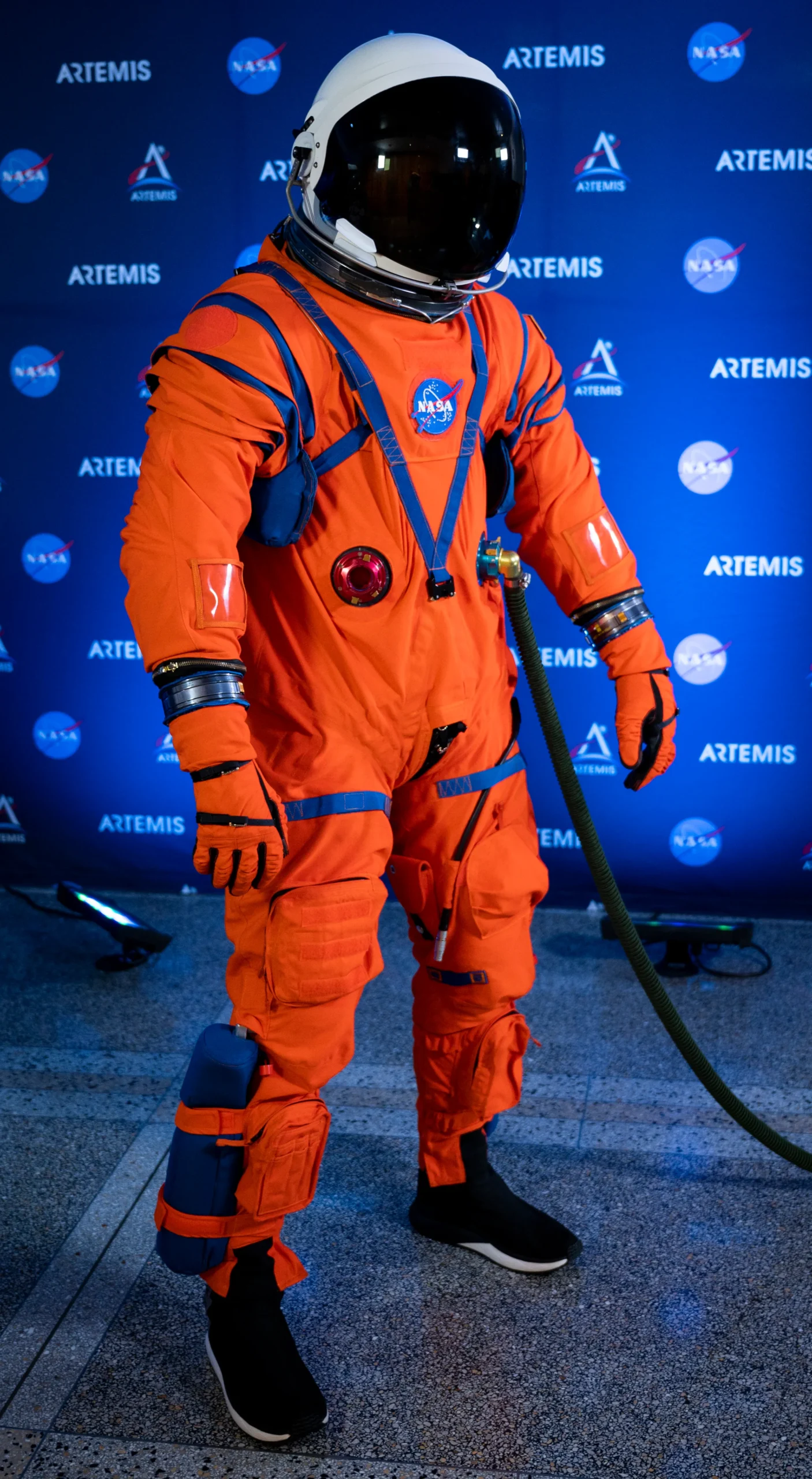
The suit is packed with engineering improvements from helmet to boot. The helmet is lighter, stronger, and better at reducing noise. The gloves are more durable and touchscreen compatible. The boots offer better fire protection and mobility. A redesigned zipper makes it faster to put on, and a liquid cooling garment worn underneath keeps astronauts cool and dry during extended use.
Beyond comfort, it’s a serious survival system. If Orion were to lose cabin pressure anywhere on the journey – including near the Moon – the suit could keep an astronaut alive for up to six days while they make their way back to Earth. Each suit also carries a personal survival kit including a life preserver, locator beacon, rescue knife, mirror, strobe light, whistle, and light sticks, in case the crew needs to exit the spacecraft after splashdown before help arrives.