


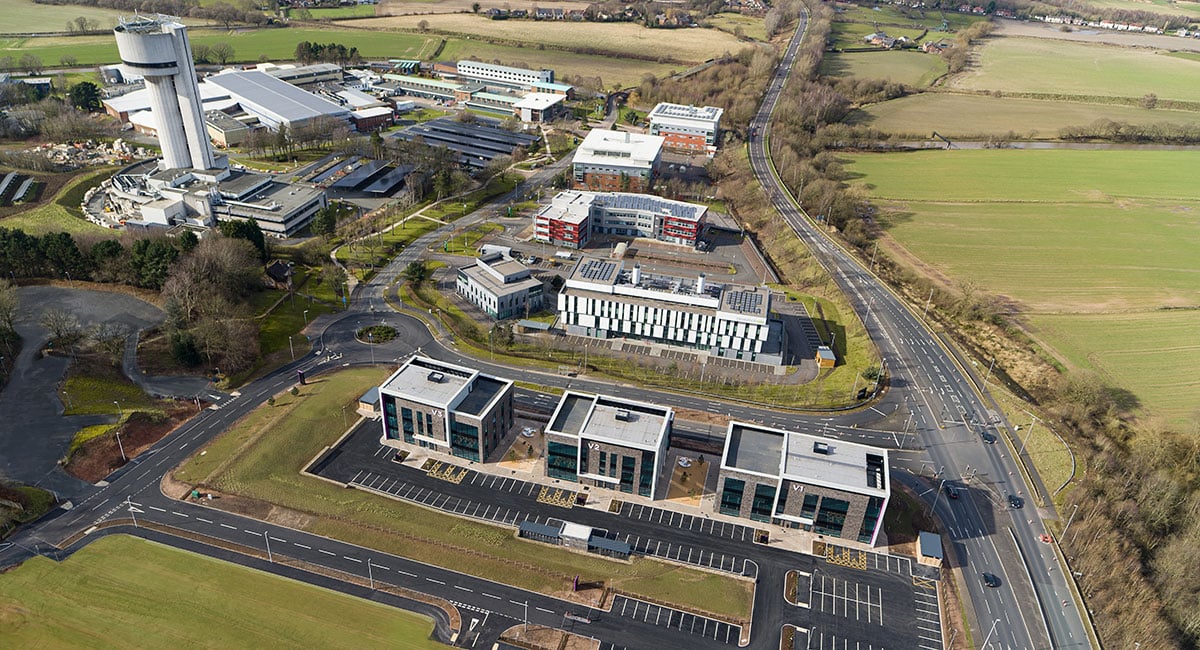
Tucked between the stretches of motorway that connect Liverpool and Manchester, Sci-Tech Daresbury is a gem of UK innovation. Home to over 160 high-tech companies and nearly 2,000 workers, the facility has become one of Europe’s most significant science and business campuses. Now, with the arrival of a £51 million National Cryogenic Facility (NCF), it is about to become a cross-sector innovation engine.
The facility, to be located within STFC’s Daresbury Laboratory, will be capable of operating at temperatures close to those found in deep space, which is fractions of a degree above absolute zero. And, according to those building it, it is a piece of national infrastructure that is as important to the UK’s industrial future as any motorway or power grid.
What is the National Cryogenic Facility?
To understand the NCF’s significance, it helps to understand what cryogenics enables. Quantum computers – the machines that many believe will define the next era of computing – cannot function at room temperature. They require an environment of extreme cold, close to absolute zero, to maintain the fragile quantum states on which their processing power depends. Achieving and sustaining those temperatures requires a cryoplant: a complex and expensive infrastructure that most companies and research institutions cannot afford to build and operate independently.
That is precisely the gap the NCF is designed to fill. “The role of NCF in boosting innovation is to offer access to a cryogenic environment as a service,” explains Massimo Noro, Director of Business Development at STFC. “This means that a company developing a prototype for a quantum computer doesn’t need to buy its own cryoplant – it can rely on the NCF as an open-access, UK-based facility.”
So, rather than focusing on enabling cutting-edge capability in the hands of a few well-capitalised organisations, the NCF is a democratic model that opens up cryogenic testing to the full spectrum of businesses – from early-stage start-ups to global industrial players – that are developing next-generation technologies but lack the resources to go it alone.
A proven approach, now scaled up
Daresbury is not starting from scratch. STFC already operates a smaller cryoplant on campus, and an initial shared-access arrangement has enabled companies to test and validate components across multiple sectors.
“The Sci-Tech Daresbury campus has become a magnet for industry,” says Noro, “and STFC is continuing to expand commercial space to meet rising demand.”
No other facility of this size and scale exists in Europe, and that absence is a commercial opportunity.
Businesses seeking to develop cryogenic technologies have, until now, had to decide whether they should build their own infrastructure at prohibitive cost, travel overseas to access facilities, or slow down their development timelines. The NCF removes all three barriers at once.
Beyond quantum: a cross-sector enabler
The NFC has breadth of potential impact because, as Noro points out, traditional science clusters tend to coalesce around a single sector – pharmaceuticals, or advanced materials, or digital technology. The NCF is a cross-sector platform whose applications span quantum computing, fusion energy, healthcare, and power transmission.
The potential impact on the energy transition alone could be transformational, says Noro. Investment in high-temperature superconductor (HTS) technologies is accelerating worldwide, driven by the rapid development of the fusion energy industry. Superconducting magnets – which require cryogenic cooling to function – could be transformational for the sector. According to Noro, the shift to superconducting magnets could unlock over £650 billion in market opportunities and potentially address 57% of global CO₂ emissions by enabling cleaner energy solutions.
Although the government has staked considerable political capital on making the UK a global AI superpower, Noro locates AI within a broader technological landscape. “AI is not the only digital technology that enables growth,” he notes. “Other computing architectures will play an important role too.” The real prize, in his view, lies in combining AI, quantum computing, and established high-performance computing in a hybrid approach – and the NCF, co-located with the Hartree Centre at Daresbury where hybrid software is already being developed, is positioned at the heart of that convergence.
Is it good for the economy?
Noro states that a report by Oxford Economics suggests that if commercially useful quantum computing is adopted by 2035, the productivity gains to the UK could be transformational: a 4.2x employment multiplier, a 7% uplift in national productivity by 2045, and additional gross value added of up to £212 billion by the same date. The NCF, by accelerating the development and adoption of quantum technologies, is a direct investment in capturing a share of those gains.
But more than purely economic advantages, the skills aspect is equally relevant. A UK Quantum Skills Taskforce report estimates that new jobs in the quantum computing sector globally will reach 250,000 by 2030 and 840,000 by 2035 – with a significant share flowing to leading quantum nations, including the UK. The NCF is designed not only to host cutting-edge research but to build the talent pipeline that will sustain it, through apprenticeship-level training in quantum and fusion-relevant technical skills, and through collaborations with existing centres for doctoral training.
Many of the companies that stand to benefit from the NCF have already acknowledged that, despite the critical importance of cryogenics to their plans, they do not yet have the appropriate in-house expertise. Access to the NCF’s knowledge base, alongside the facility itself, will allow them to develop the understanding they need – and, crucially, to de-risk the investment decisions that will take their technologies from prototype to scale.
An innovation campus reborn
From a national laboratory, through its reinvention as an enterprise zone, to its current status as a thriving campus of over 150 companies ranging from start-ups to global corporations, the NCF is a new chapter added to its history that stretches back more than fifty years. A strategically important chapter that changes the calculus for any business operating at the forefront of quantum, fusion, or advanced energy technology.
From deep-space temperatures to billion-pound market opportunities, the NCF is a reminder that some of the UK’s most important innovations are happening not in London’s tech clusters, but in a quiet corner of Cheshire, where the temperature drops close to absolute zero, and the ambitions run correspondingly high.