







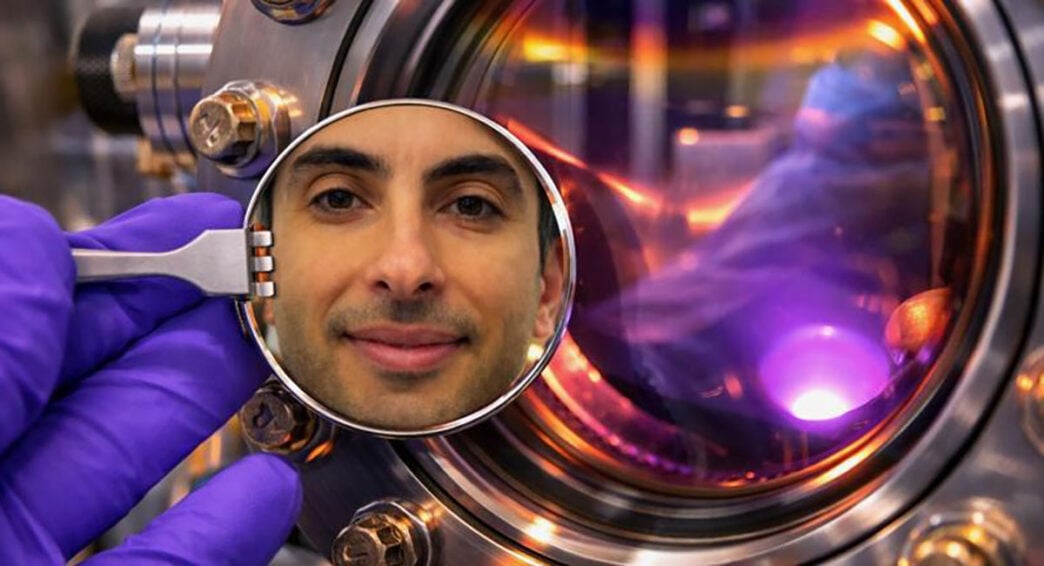
Research led by the University of Cambridge has discovered a new form of material that reduces the energy consumed by AI hardware by mimicking the human brain.
Achieving low energy in electronic devices is one of the most pressing challenges in modern electronics. Traditional methods of ferrying data back and forth aren’t up to snuff in the modern world. And now, artificial intelligence (AI) has gone from gently simmering in the background to rapidly boiling over into everyday life at an unprecedented rate. And with this influx comes both challenges and opportunities.
The challenges
AI systems currently rely on traditional computer chips to carry data between memory and processing units – a process that consumes a significant amount of energy. This demand has the knock-on effect of dramatically increasing electricity consumption in data centres, consuming vast amounts of water for cooling, and increasing the difficulty of powering these systems from renewable rather than fossil fuel sources.
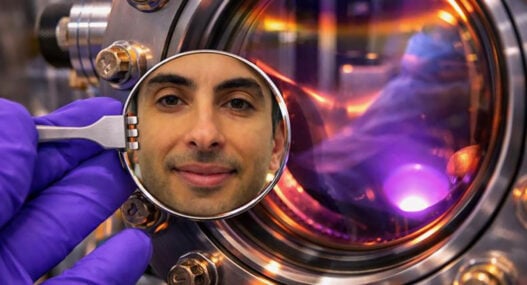
Overcoming this requires a fundamental rethink of how hardware is designed. “[Y]ou need devices with extremely low currents, excellent stability, outstanding uniformity across switching cycles and devices, and the ability to switch between many distinct states,” says Dr Babak Bakhit, from Cambridge’s Department of Materials Science and Metallurgy.
To address this, memristors are a promising opportunity. However, most existing versions rely on small conductive filaments inside metal oxide material that do not behave predictably and typically require high forming and operating voltages, limiting their practical use.
Neuromorphic computing
Neuromorphic computing is an alternative way to process information. It works by mimicking the human brain. Rather than shuttling data between separate memory and processing units as traditional chips do, it mimics the human brain’s ability to store and process information, and to adapt and learn. By pivoting to this approach, energy usage could be reduced by up to 70%.
A new nanoelectronic device
The Cambridge team developed a new kind of material – a form of hafnium oxide that acts as a memristor – that addresses the shortcomings of existing devices. By adding strontium and titanium and using a two-step growth process with oxygen, they created tiny electronic gates, known as p-n junctions, inside the oxide where the layers meet. This allows the device to smoothly change its resistance without the unpredictable filament behaviour that plagues conventional designs.
“Filamentary devices suffer from random behaviour,” said Bakhit. “But because our devices switch at the interface, they show outstanding uniformity from cycle to cycle and from device to device.”
The results show that switching currents are around a million times lower than those of some traditional oxide-based devices, and the memristors can produce hundreds of distinct, stable conductance levels – a key requirement for analogue in-memory computing. Tests confirmed the devices can endure tens of thousands of switching cycles, retain their programmed states for approximately 24 hours, and even replicate fundamental biological learning rules, such as spike-timing dependent plasticity: the mechanism by which neurons strengthen or weaken their connections depending on when signals arrive.
The road ahead
Despite these promising results, challenges remain. Current fabrication processes require temperatures of around 700°C, which is far higher than standard semiconductor manufacturing tolerances allow. Bakhit and his team are working to bring this down to make it “more compatible with standard industry processes,” and he is confident that with further development the technology could be integrated into chip-scale systems. “If we can reduce the temperature and put these devices onto a chip, it would be a major step forward,” he said.
Whilst it is still early days, Bakhit is optimistic that once the temperature issue is resolved, “this technology could be game-changing because the energy consumption is so much lower and at the same time, the device performance is highly promising.”