






As naval threats evolve and sea mines become increasingly sophisticated, the need for safer, more efficient countermeasures has driven a shift toward autonomous mine hunting.
By combining advanced robotics, high-resolution sensing technologies, and artificial intelligence, these systems are transforming how navies detect and neutralise underwater threats.
Rather than placing crews directly in harm’s way, autonomous mine hunters enable operations to be conducted remotely, offering a smarter, data-driven approach to safeguarding critical maritime routes.
The systems and components
Autonomous mine hunting systems are made up of a suite of modular, intelligent components designed to detect, identify, and neutralise mines while keeping personnel at a safe distance.
The physical architecture of an autonomous system typically involves various unmanned vehicles:
- Unmanned Surface Vehicles (USVs): these serve as the primary surface platform for navigation and deployment of other payloads. They are often used to tow advanced sonar systems or act as a communications link
- Autonomous Underwater Vehicles (AUVs) or Unmanned Underwater Vehicles (UUVs): these drones operate beneath the surface to conduct high-resolution seabed surveys
- Remotely Operated Vehicles (ROVs): used primarily for the visual inspection and neutralisation of identified mines. ROVs allow operators to identify a threat and deploy neutralisation charges from a safe distance
Each system relies on sophisticated sensors to locate objects on the seabed:
- Synthetic Aperture Sonar (SAS): this is a critical sensor for high-resolution imaging. Advanced versions, such as multi-aspect SAS, are highly efficient at reducing false positives by viewing objects from multiple angles
- Complementary sensors: while sonar is primary, systems may also incorporate LiDAR for detection in turbulent “bubble layers” near the surface, as well as electro-optical, thermal, and millimetre radar sensors. Future technologies may include quantum magnetometers to counter mines made of non-acoustic materials
The “intelligence” of the system is driven by complex software modules:
- Command and Control (C2) systems: these provide secure mission management and planning. Modern systems utilise Goal-Based Mission Planning, where an operator defines the objective and AI assigns the necessary assets
- Mission autonomy: this software manages navigation, payload deployment, and Adaptive Mission Autonomy, which allows drones to revisit difficult areas or compensate for underwater currents without human intervention
- Automatic Target Recognition (ATR): this uses statistics and Deep Learning (such as convolutional neural networks) to detect, classify, and localise mines within sonar imagery in real-time
How does it work?
An autonomous mine hunting operation typically follows a multi-stage process that removes human personnel from the danger zone while leveraging artificial intelligence and robotics.
The process begins with Goal-Based Mission Planning, where an operator at a safe standoff range (on a mother ship or coastal base) defines the mission objectives. An Unmanned Surface Vehicle (USV) is then deployed to the target area, often towing an advanced Synthetic Aperture Sonar (SAS).
As the USV or an Autonomous Underwater Vehicle (AUV) traverses the seabed, it collects high-resolution imagery. The system’s Automatic Target Recognition (ATR) software analyses these images in real-time. It specifically looks for a bright highlight and an adjacent shadow, which are characteristic of mine-like objects on the seabed. If the software identifies a suspect object but the data is inconclusive, Adaptive Mission Autonomy may command the drone to autonomously revisit the site from a different angle to improve classification.
Once a potential mine is detected and localised, the system transitions to the identification phase. A Remotely Operated Vehicle (ROV) or a specialised UUV is sent to the specific coordinates of the target. This vehicle provides a live CCTV feed and uses high-intensity searchlights to allow operators to visually confirm whether the object is a genuine threat or merely harmless seabed debris.
If the object is confirmed to be a mine, it can be neutralised through two primary autonomous methods:
- Expendable mine disposal: a combat drone is launched. Controlled via a fibre-optic cable, it approaches the mine and uses its built-in shaped charge warhead to detonate and destroy the target
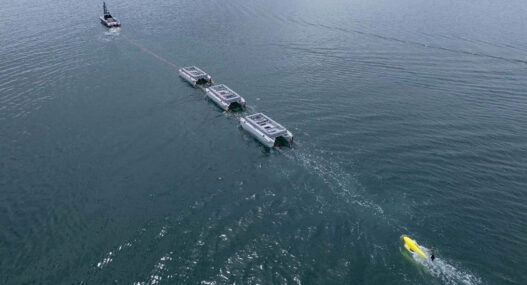
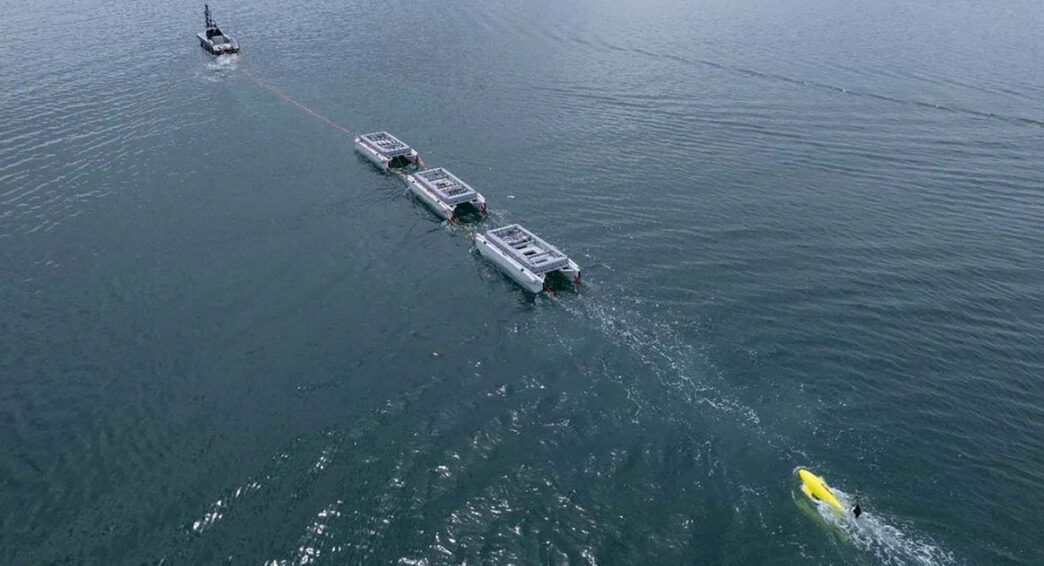
- Signature tricking (minesweeping): alternatively, systems like the UK’s SWEEP can be used. This uncrewed surface vessel replicates a ship’s magnetic or acoustic signature, “tricking” sophisticated digital mines into detonating safely as the drone passes
The UK’s autonomous mine hunting systems
Drones keep sailors safe by enabling a “stand-off” mine countermeasures doctrine, where personnel and crewed ships remain at a safe distance or entirely outside the active minefield while unmanned systems enter the threat area. This approach replaces traditional methods that required dedicated mine-hunting ships and crews of up to 40 people to physically navigate through dangerous waters.
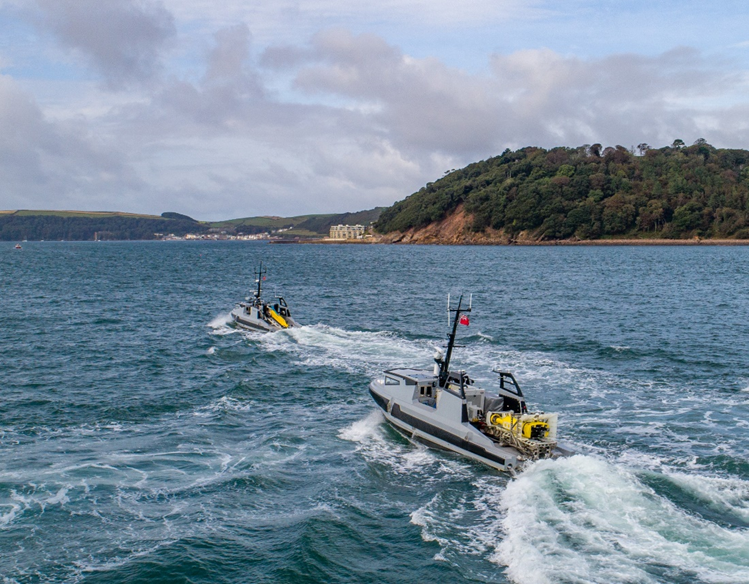
The Royal Navy has begun transitioning from conventional ship-based mine clearance to autonomous systems:
- MMCM system: delivered by Thales, this programme delivers mine hunting equipment to the Royal Navy and the Marine nationale, comprising of uncrewed surface vessels, mine hunting payloads, and remote command centres
- WILTON system: delivered by Atlas Electronik, the system contains crewed and uncrewed surface vessels, mine detection payloads, and remote command centres. WILTON is already being operated by the Royal Navy in the Clyde area and the Gulf
- SWEEP system: also delivered by Atlas Electronik, the system contains uncrewed surface vessels, coil auxiliary boats, and remote command centres. Each system can emit magnetic, electric, and acoustic signals to detonate a variety of sea mines. SWEEP is a complimentary system used to deal with mines that cannot be dealt with using other mine-hunting tactics
- SEACAT system: also delivered by Atlas Electronik, the SEACAT system will be used with crewed and uncrewed surface vessels for additional discreet/covert capability to search for underwater threats
Back in March 2025, Thales reached a historic milestone by delivering the first end-to-end autonomous maritime mine hunting system to the Royal Navy. The system drastically reduces the exposure risk for personnel on board ships while contributing to the safety of maritime routes, the backbone of the global economy.
Each system includes several integrated pieces of equipment and subsystems, enabling the accomplishment of highly complex missions: an Unmanned Surface Vehicle (USV), an advanced towed sonar (TSAM) with a multivision sonar (SAMDIS), a Remotely Operated Vehicle (ROV), and a lightweight operations centre (e-POC), all supported by a secure command and control system.
Thanks to its expertise in sensors, data analysis, and machine learning, Thales has developed a sonar analysis application, Mi-Map, which processes sonar data up to four times faster, allowing even more precise detection and classification of sea floor mines.
Deployed and operated from a mother ship and coastal bases, the platforms can handle vast volumes of data, enabling operators to expedite the process of identifying and neutralising mines.
Phil Siveter, CEO of Thales in the UK, stated: “We are extremely proud to deliver the world’s first end-to-end autonomous mine hunting system to the Royal Navy. With the introduction of AI and advanced sensor technology, this innovation marks a new era in naval defence and underlines our unwavering commitment to providing cutting-edge solutions that enhance the capabilities of our armed forces. The Royal Navy will now have a powerful tool to protect its national interests and maintain safety at sea.”
The Royal Navy also accepted SWEEP into active service in July 2025. An uncrewed surface vessel and sophisticated payloads make up the SWEEP system, which is controlled remotely on the surface to hunt and detonate mines quickly.
SWEEP’s “sense and avoid” capability works together with other similar autonomous systems, such as the Maritime Mine Counter Measures (MMCM) system and SeaCat Uncrewed Underwater Vehicles, for the common goals of sustaining freedom of manoeuvre for Royal Navy vessels and making international waters safer.
“The return of the ability to remotely counter sophisticated mines that are more difficult to detect by sonar, is a crucial milestone for the Royal Navy’s Mine Countermeasures capability,” said Commander Dan Herridge, Commanding Officer of the Royal Navy’s Mine & Threat Exploitation Group.
“To be able to do this remotely without putting people in harm’s way is a key tenet of the Mine Hunting Capability Programme.
“The acceptance of SWEEP is an exciting milestone ahead of the Royal Navy conducting training, operational evaluation, and assurance of the systems prior to deployment.”
Summary
Autonomous mine hunting represents a significant step forward in naval defence, replacing traditional, high-risk methods with intelligent, stand-off operations.
Through the integration of unmanned vehicles, advanced sonar, and AI-powered analysis, these systems can rapidly detect, classify, and neutralise threats with minimal human intervention.
As adoption grows – particularly within the Royal Navy – this technology is set to play a vital role in ensuring safer seas, protecting global trade, and redefining the future of mine countermeasure operations.