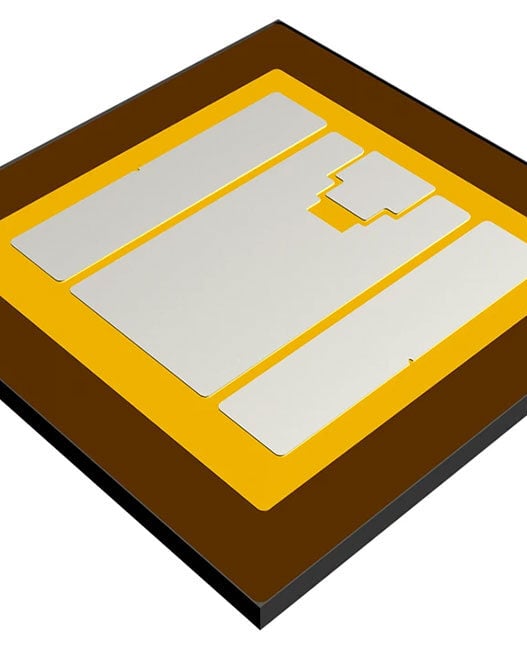






After four years of research and development, DIAMFAB and STMicroelectronics have successfully designed an innovative diamond-tritium beta-voltaic generator capable of producing continuous electrical energy over several decades.
A tritium-based beta-voltaic generator is a tiny nuclear battery that turns the natural decay of tritium, a radioactive form of hydrogen, into electricity using semiconductor material, similarly to how a solar cell turns light into power. Because tritium decays slowly and its weak radiation is easily blocked, these generators can provide small amounts of power, safely and continuously for many years without recharging or maintenance.
This pioneering technology, combining synthetic diamond and recycled tritium from the nuclear industry, offers a path towards a new generation of compact, chemically inert, and mechanically robust nuclear batteries. These power sources are ideally suited for applications demanding exceptional longevity and reliability, including remote sensors, microsatellites, and autonomous systems operating in harsh environments. This breakthrough unlocks transformative possibilities across diverse sectors such as healthcare, aerospace, industrial monitoring, civil engineering, and defence.
“We have developed unique technological know-how in diamond beta-voltaic cell manufacturing and generator design,” said Gauthier Chicot, CEO of DIAMFAB. “This collaboration has expanded our understanding and opened pathways to future innovations. We are actively working with ESA and ORANO to create more powerful generators that will o er sovereign solutions for space exploration.”
“STMicroelectronics is at the forefront of R&D on ultra-low power microcontroller innovation and energy-harvesting technologies. Tbatt-Diamond demonstrates exciting possibilities for long-lasting nuclear micro-batteries that could power autonomous, maintenance-free devices that meet the highest standards of efficiency and reliability for future self-powered IoT and New Space applications,” said Philippe Roche, Company Fellow High Reliability and Head of Technology Explorations and Ecosystems at STMicroelectronics.
The Tbatt-Diamond consortium has demonstrated diamond beta-voltaic cells with a conversion efficiency of 10.5%, achieving an energy density of 15nW/cm² when paired with a Beta source developed by CEA.
“A key milestone has been achieved with Tbatt when reaching 15nW.cm-2, as a best-in-class achievement ever published to date. However, another 1-2 decades of power improvement is still required to achieve industrial standards and full autonomy,” STMicroelectronics told Electronic Specifier. “New R&D programmes are already at play for bridging the gap between a very successful proof of concept (Tbatt) and its industrial usage (towards 1µW.cm-3).”
The consortium’s success lies in the unique synergy between synthetic diamond’s robustness and superior energy conversion efficiency, stable beta-emission from a light nuclear source. The resulting beta-voltaic generators deliver a constant, high energy density output for over 20 years, without environmental sensitivity or radiological hazards. Beyond powering devices in extreme or inaccessible environments, this technology also potentially contributes to improved radioactive waste utilisation by transforming tritium – a common nuclear byproduct – into a valuable energy resource.
Looking ahead, the team aims to push conversion efficiency and increase power density to 100µW/cm³ through scaling active surface areas, enhancing radioactive source intensity, and refining assembly architectures. Such advances will enable practical applications in autonomous sensors for industrial infrastructure, environmental monitoring, and other fields where long-lasting, maintenance-free power is critical.
“We are considering layering and stacking techniques to increase the power production, as well as switching to more energetic alpha &/or beta radionuclei,” STMicroelectronics told me.
There is historical precedent for the safe adoption of nuclear micro-batteries in regulated environments. Such technologies were already introduced for pacemakers in France in the early 1970s, demonstrating compliance with stringent medical requirements. This legacy, combined with ongoing advances in materials science and energy density, suggests that with continued innovation and regulatory clarity, nuclear micro-batteries could transition from niche applications to broader industrial and commercial use.