






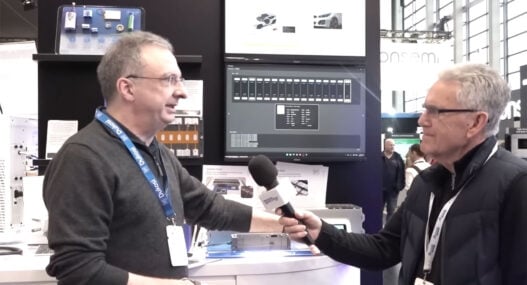

At embedded world 2026, Electronic Specifier’s Mick Elliott spoke with Joseph Notaro, Chief Revenue Officer from Dukosi, which introduced two new products aimed at improving battery traceability, security, and system design.
The first product emerged from a collaboration with STMicroelectronics, combining Dukosi’s chip-on-cell technology with secure microcontroller and authentication capabilities. The solution aims to establish a traceable and secure supply chain, extending from individual battery cells to the Cloud.
Notaro explained: “What we’re showcasing here is a cooperation we have with STMicroelectronics … how can we really create a secure and traceable supply chain from the cell all the way up to the Cloud.”
Each battery cell integrates a chip containing a unique identifier, linking that specific cell to its data throughout its lifecycle. This included manufacturing details such as chemistry, origin, and production timing, alongside operational data like exposure to over-temperature or overcharging conditions.
This persistent data record enables full lifecycle visibility. It also supports authentication at system level, allowing detection of unauthorised or counterfeit cells introduced into a battery pack. During the demonstration, the system identified an unrecognised cell, flagging it as an “unauthorised cell replacement.”
Beyond security, the approach also supports sustainability objectives. By maintaining a verified history of each cell, operators can make informed decisions about reuse and repurposing in second-life applications. Notaro noted that this enables “true second life,” with users able to “have trust in a cell in the quality of the cell” through cross-checking with Cloud-based records.
The second product addressed communication within battery systems, focusing on simplifying design and improving reliability. Dukosi’s approach relies on three pillars: data, accurate measurement, and communication. The latest development focused on the third pillar, introducing a near-field, contactless communication method.
This eliminates the need for wiring and connectors between battery modules, which are often sources of failure and complexity. Instead of traditional daisy-chain architectures, modules can communicate through a wireless protocol, enabling synchronised measurements at module level.
Notaro said the goal was to provide an upgrade path for existing systems without requiring fundamental redesign: “We’re not disrupting their architecture… all the algorithms remain the same but they could speed up and upgrade the existing systems to a more reliable, more secure, and better performing system.”
The concept extended the idea of a “cell passport” to a “module passport,” allowing data and traceability to be managed at multiple levels within a battery system.
Target applications included automotive, energy storage, and industrial transport sectors, particularly where large-scale battery systems are deployed. Notaro highlighted use cases across marine, airport ground service equipment, and future mining applications, indicating that deployments were already in production in several areas.
Both products were confirmed as commercially available, positioning Dukosi’s technology as a solution for manufacturers seeking improved traceability, security, and scalability in battery management systems.
Find out more in the interview below.