


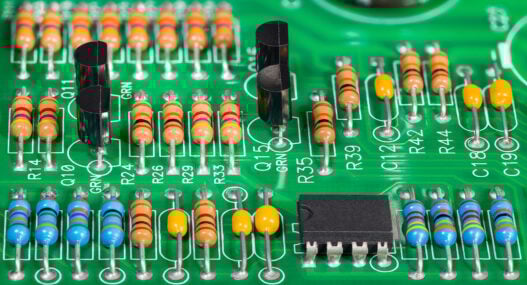
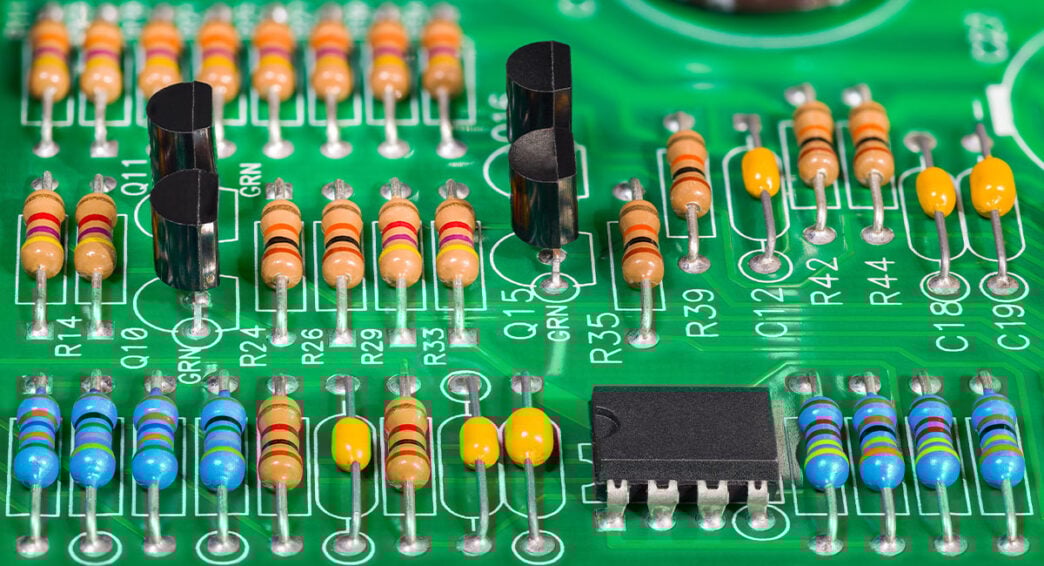
Resistors are fundamental components in electronic circuits. Despite their simplicity, they play a central role in ensuring circuits operate reliably, safely, and predictably. From basic current limiting to precision signal conditioning, resistors influence nearly every aspect of electronic behaviour.
Controlling the current
At their core, resistors limit the amount of current passing through a circuit. By introducing resistance, they prevent too much current from flowing, which could damage sensitive components such as LEDs or microcontrollers. The resistance is measured in ohms (Ω), and the value required depends on the voltage applied and the desired current, according to Ohm’s Law.
The relationship between voltage, current, and resistance is defined by Ohm’s Law: V = I × R
Where:
- V is voltage (volts)
- I is current (amps)
- R is resistance (ohms)
Voltage dividers
Resistors can also create voltage dividers, producing lower voltages from a higher source. This is useful for powering components that require a voltage lower than the main supply. By connecting two resistors in series, the voltage is divided proportionally according to their resistance values.
This technique is widely used in analogue sensing, biasing circuits, and analogue-to-digital conversion.
Voltage dividers are frequently used in:
- Sensor interfaces
- Battery monitoring circuits
- Biasing transistors
- Setting reference voltages
However, designers must consider loading effects. If the connected load draws significant current, it alters the expected output voltage. Buffering with an operational amplifier is often required in precision applications.
More uses
Resistors often act as safety devices, preventing current spikes that can burn out components. They are essential in circuits with LEDs, transistors, and integrated circuits, ensuring these devices operate within safe limits.
In more advanced applications, resistors influence how signals behave. Paired with capacitors or inductors, they form filters that control frequency response. This is crucial in audio circuits, communication systems, and signal processing.
Resistors are frequently used to define default logic levels on digital circuits. Pull-up resistors connect inputs to the positive supply, while pull-down resistors connect them to ground. These ensure inputs remain stable and avoid floating states that could lead to erratic behaviour.
Resistors convert electrical energy into heat, a process known as power dissipation. The amount of heat is determined by the current and the resistance, calculated as P = I² × R. This must be considered when selecting a resistor, particularly in high-power applications.
Why resistors remain essential
While simple in design, resistors are critical to controlling current, shaping voltages, and protecting components. Their versatility makes them indispensable in virtually every electronic circuit, from basic hobbyist projects to complex industrial systems. Understanding how to choose and use resistors is a key step for anyone working with electronics.
From managing microamp-level signals in sensor circuits to dissipating watts of power in industrial systems, resistors underpin the safe and stable operation of electronic devices.
Understanding their characteristics remains fundamental to effective circuit design.