




Ahead of International Day of Women and Girls in Science, high precision component supplier, Accu, decided to investigate which countries in Europe best support women in STEM and which fall behind.
Sweden is Europe’s best country for women in STEM
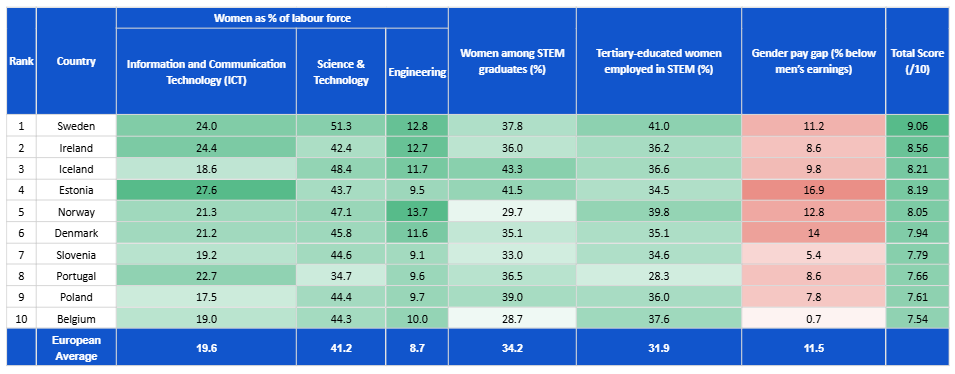
Sweden ranks first overall with a score of 9.06/10. In Sweden, women account for 24% of Information and Communication Technology (ICT) specialists and 51.3% of the science and technology workforce. Tertiary-educated women employed in STEM also exceed typical European levels with 41%, second only to Luxembourg. Sweden’s gender pay gap is on par with the European average at 11.2% below men’s earnings.
Ireland ranks second for women in STEM
Women account for 24.4% of ICT specialists, 42.4% of the science and technology workforce, and 12.8% of engineers in Ireland, exceeding the median for all three sectors. Tertiary-educated women make up 36% of those employed in STEM, while the gender pay gap stands at 8.6%, notably lower than the European average of 11.5%, contributing to Ireland’s high overall score of 8.56/10.
Iceland has the highest number of women graduating in STEM
In Iceland, women comprise 48.4% of the science and technology workforce and 43.3% of tertiary-educated employees in STEM, both of which are well above the respective averages. While women account for a lower 18.6% of ICT specialists, this is offset by a relatively small gender pay gap of 9.8%.
Hungary is Europe’s worst country for women in STEM
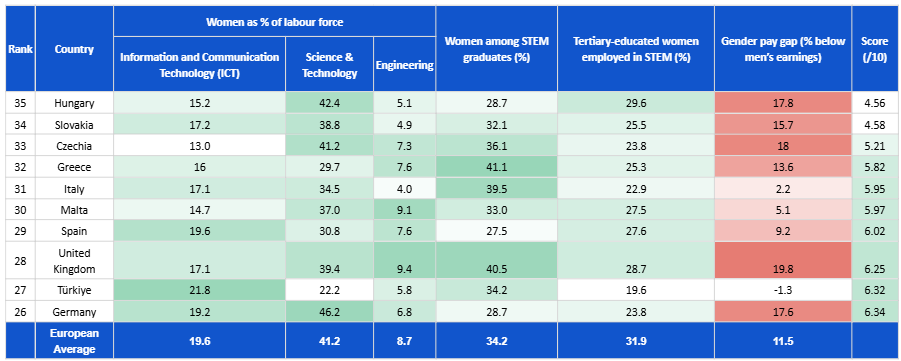
Hungary ranks last overall, reflecting weak outcomes across both participation and labour market indicators for women in STEM. Women account for 15.2% of ICT specialists and 5.1% of the engineering workforce, both below the European averages of 19.6% and 8.7%, respectively, indicating severe underrepresentation in key technical fields. Although women make up 42.4% of science and technology workers, only 29.6% of tertiary-educated women are employed in STEM roles, and the gender pay gap stands at 17.8%, over six percentage points worse than the European average, contributing to Hungary’s lowest overall score of 4.56/10.
Alastair Morris, UK Managing Director at Accu, comments on the findings: “When women face barriers entering or progressing in STEM roles, the risk is not just individual career loss but systemic skills shortages and weaker innovation outcomes. Engineering teams benefit greatly from women’s strengths in complex problem-solving and excellent communication skills, and organisations that fail to attract and retain women are effectively narrowing their own technical capability at a time when demand for STEM skills is growing.”