




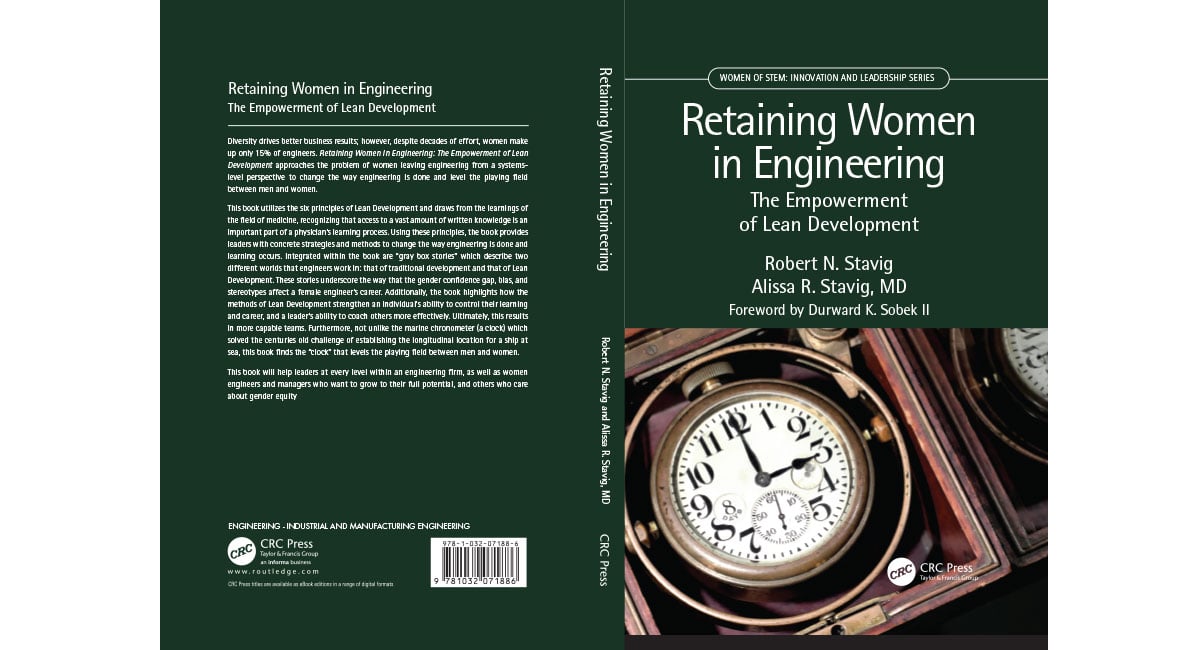
When talking about reaching gender parity in engineering, Bob Stavig, co-author of ‘Retaining Women in Engineering: The Empowerment of Lean Development (Women in STEM)’ alongside his daughter, Alissa Stavig, (a physician) is clear from the start: the problem isn’t the women. It’s the system.
Drawing from his decades-long career at Hewlett-Packard and the findings of the book, Stavig argues that engineering’s diversity issues stem not from a lack of talent or interest, but from the outdated way engineering work is structured, and knowledge is created and shared.
“Everything comes down to how the work is done. And in engineering, the system is set up to amplify bias.”
In sectors such as medicine, law, or pharmacy, knowledge is centralised and accessible. However, engineering still depends heavily on informal, peer-based information sharing. This creates a reliance on personal relationships and gatekeepers, which opens the door to bias and exclusion.
Recalling a conversation with his daughter, who was then a medical resident, he asked her how much of her professional knowledge came from universally accessible and centralised sources. She answered: about 80%. He posed the same question to early-career engineers, who replied: 20%.
“It’s not about technical content. It’s about basic workplace knowledge – vendor lists, project data, and where to find answers. In engineering, it’s all scattered. In medicine, it’s organised and accessible,” said Stavig.
Alissa explained that throughout her medical education and the early years of her career in medicine, she has benefited from learning from supervising physicians, peers, and her patients: “Importantly though, I was not solely reliant on other individuals for basic clinical knowledge – I had a wealth of resources at my disposal whether they were journal articles, textbooks, or centralised evidence-based online clinical resources. This allowed me to take ownership of my education and expand my knowledge base on my own terms regardless of who my supervisor was at the time. This also meant that the time I spent working with supervisors or discussing cases with peers could focus on developing skills that I couldn’t learn by reading – skills like clinical reasoning and effective communication. In engineering, there is a much higher reliance on learning from others as there aren’t easily accessible repositories of knowledge. The learning experience is therefore out of the control of the individual engineer and entirely dependent on how effective other individuals are at teaching and managing. This reliance on others for knowledge means that any biases, whether unconscious or conscious, have the potential to detrimentally impact women engineers and their careers. Access to knowledge allows for some levelling of the playing field.”
Stavig argues that this contrast alone helps explain why the US has seen near gender parity in medicine but still hovers at just 15% female representation in engineering – a figure growing at only 1% per decade.
A 350-year bottleneck to gender parity
If the 1% trend continues, Stavig believes that it will take 350 years to reach gender parity in US engineering. And despite interest in STEM from young girls, by the time they enter the profession, many are pushed away from technical roles and into relational ones – managing, note-taking, organising meetings – simply because they’re “good at it” or because it’s expected.
“Even at the highest technical levels, many women still get funnelled into relational work. That’s where the biggest divergence starts.”
This divergence, however, is part of much broader cultural conditioning. Citing research in two books in particular, ‘Disappearing Acts (Gender, Power, and Relational Practice at Work)’ by Joyce K. Fletcher, (1999) and ‘Why So Slow? The Advancement of Women’ by Virginia Valian, (1998) Stavig outlines how gendered expectations are internalised by age five, flatten slightly in university, but return with force once women enter the workplace.
The case for Lean Development in engineering
So how do we fix a system so entrenched?
Stavig believes the answer lies in Lean Development, specifically the principles pioneered by Toyota in its product development process. He emphasises that these are not vague ideals, but concrete, structured practices with decades of validation – including tools like the “A3 problem solving process,” a method for laying out problems and solutions in a single, logical document.
“Every one of my engineers used A3s. They’re faster, clearer, and they flatten hierarchies. Everyone can see the logic, regardless of personality or speaking style.”
He tells me about a case where an early to career female engineer used the A3 approach to cut $1 million in PCB manufacturing costs – and delivered the solution three months early. Her success, he argues, wasn’t about being assertive or charismatic. It was about structuring knowledge and discussion in a way that made outcomes objective.
What companies can – but often won’t – do
When asked what companies could do to improve gender equality in engineering, Stavig answers: “Most corporate engineering teams appear to have no desire to fix this. They say it’s important, but no one wants to change how the work is done.”
He believes that this resistance comes down to culture. Engineers pride themselves on autonomy and intelligence, and many feel they don’t need new processes or systems – even when existing methods clearly aren’t working.
That’s why his book isn’t filled with motivational slogans. It’s a textbook, designed to give engineers technical, step-by-step tools to change their workplace – without needing permission from management.
How individuals can drive change
So, if companies are slow to act, what then can individuals do? Stavig’s answer is to simply structure your problem-solving.
Using tools like the A3 document, engineers – especially women – can shift discussions from opinion-based to evidence-based. If you’re being talked over in meetings, he says, don’t raise your voice. Put your thinking on paper.
“Engineering school trains you to write things down. Use that. Stop relying on PowerPoints or hoping someone will listen. Document your logic, and the conversation changes.”
He also advocates pushing for web-based knowledge systems and flexible working, which remain rare in US engineering despite being widespread in medicine, law, and pharmacy – fields that have all achieved near or full gender parity.
What’s the real roadblock?
Perhaps the biggest takeaway from Stavig’s reflections is how little appetite there seems to be – even among affected individuals – for systemic change.
“I’m not a coach or a consultant. I just want to help solve the problem.”
He believes professional organisations like the Society of Women Engineers should play a greater role in educating graduates before they enter industry – not just about the culture, but about the technical tools that can help them navigate it.
Final message to engineers
“What we’re doing isn’t working. But we’re engineers. We solve problems. This is a problem that can be solved – if we’re willing to look at the system, not just the people.”
This article originally appeared in the December’25 magazine issue of Electronic Specifier Design – see ES’s Magazine Archives for more featured publications.