






Missions to the moon have been in full swing for years now. But unlike those first lunar landings, recent explorations are less about bringing back samples of astro rock, sticking a flag in the ground, and calling it a day, and more about how scientists, researchers, engineers, and everyone in between can find ways to sustain life in an atmosphere that is very different to our own.
Creating infrastructure on the moon is an astronomical feat – and an expensive one. According to Christian Dalsgaard, Senior Consultant at Danish Technological Institute: “Every time you want to send a kilo into space, you need 15 kilos of fuel to move it. So, there is an enormous advantage in being able to utilise local materials available on the Moon, for example, to repair critical parts.”
Of course, infrastructure would be nothing if the astronauts, who are expected to live and explore their new homestead, cannot generate space-based manufacturing capabilities. To this end, electronics such as sensors and circuits will become increasingly critical to unlocking the key to space-based longevity.
But what resources can a craterous moon offer?
Moon dust advancing electronics

In a project led by the Danish Technological Institute, researchers are exploring how the moon’s soil, also known as regolith, could be the key to unlocking in-space electronics.
The basic premise of electronic circuitry is to control the flow of electrons (electric current) to enable the processing of information, power management, or energy conversion. To make this work, the circuitry is built onto a printed circuit board (PCB). PCBs provide the physical structure and conductive pathways that interconnect components, allowing the electronic circuit to function.
With the aid of UK-based company Metalysis, the Institute is exploring the possibility of converting regolith into metal-rich compounds which can conduct electricity.
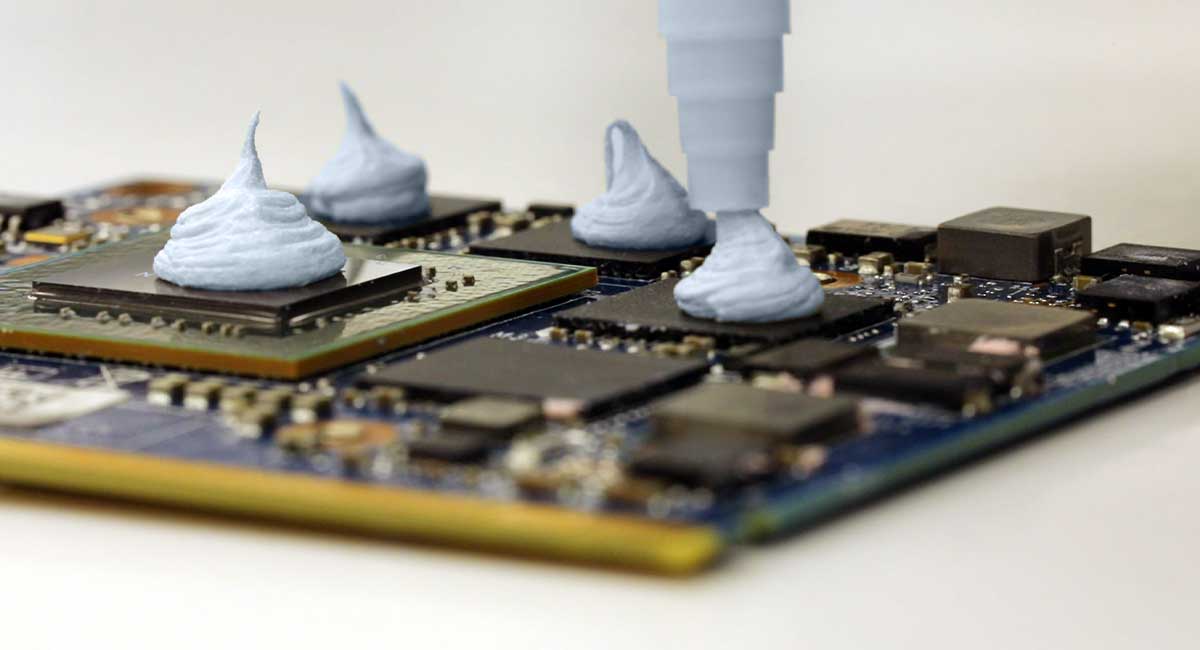
By forming an additive manufacturing process rather than a subtractive one – whereby the conductive ink prints traces directly onto the substrate rather than etching it on – it means that explorers can create intricate circuits with minimal waste and can create or repair where they are, rather than rely on payloads to arrive.
From dust to device: how it’s made
Regolith contains around 40–45% oxygen, which is chemically bound within it. Metalysis, using a patented process – molten salt electrolysis, whereby the calcium chloride electrolyte is heated to 800–1,000°C with a voltage applied between the electrodes – releases the oxygen from the ‘dust’.
Once the oxygen has been removed from the regolith, a mixture of metal alloys remains, which, it turns out, is conductive.
Beyond producing conductive inks, the project is also looking to convert the remaining alloys into powder, which could be used to 3D print larger components in-situ.
What this means for the future of space-based infrastructure
ESA is already looking into in-situ resource utilisation in space, and several other companies, including Blue Origin, are exploring ways to develop large-scale structures and solar power infrastructure beyond Earth, while others are focused on additive manufacture in-orbit.
The ability to create and repair electronics in-situ adds another dimension to what future life and long-term activity beyond our planet could look like.