





Taiwan Semiconductor Manufacturing Company (TSMC) is the dominant contract foundry for many of the largest technology companies. It is estimated to control close to 90% of the advanced processor market, while more than half of its revenue now comes from high-performance computing (HPC). As a result, TSMC’s revenue outlook is often viewed as a proxy for confidence in semiconductor demand across AI, HPC, Cloud, and mobile markets.
Because TSMC manufactures chips for a broad range of fabless designers, its revenue captures demand across multiple end markets, and not just the performance of a single product category. Because of this scope, changes in its quarterly performance are particularly relevant for businesses planning investments in silicon, infrastructure, and supply chains.
Foundry 2.0 and the widening revenue base
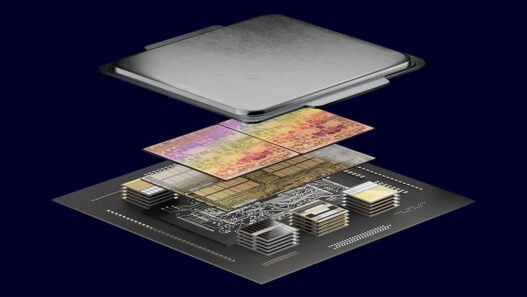
The semiconductor industry has formally entered what analysts describe as the ‘Foundry 2.0’ era. Rather than focusing solely on wafer fabrication, the foundry model now encompasses advanced packaging, specialised process technologies, and closer co-development with customers. This broader scope reflects how chip manufacturing has become more tightly integrated with system-level performance and power requirements.
In Q3 2025, global Foundry 2.0 revenue rose 17% year-on-year to $84.8 billion. Pure-play foundries accounted for a large share of this growth, with TSMC outperforming the wider market at 41% year-on-year revenue growth. For businesses, this shows how value is increasingly concentrated at the most advanced process nodes and packaging technologies, where barriers to entry are high.
Market shifts lead to greater gains
Founded in 1987, TSMC was initially closely aligned with the mobile market. However, it has repeatedly adapted to shifts in semiconductor demand. As AI and HPC workloads expanded through the 2000s and 2010s, the company scaled its advanced logic capabilities to support increasingly complex processors.
Today, around 60% of TSMC’s revenue comes from manufacturing its most advanced nodes, primarily serving customers developing leading-edge CPUs, GPUs, and AI accelerators. Many of these customers are headquartered in North America, tying TSMC’s revenue performance closely to hyperscaler investment cycles and data-centre expansion.
For businesses across the electronics ecosystem, this means spending trends among hyperscalers and fabless designers often appear first in TSMC’s revenue mix, particularly where advanced nodes and advanced packaging are concerned.
Key markers that set TSMC apart
In Q3 2025, the company reported revenue of approximately $33 billion, largely driven by sustained demand for HPC and AI processors. Chips manufactured at 3nm and 5nm nodes account for up to 60% of its sales, reflecting how quickly customers are adopting leading-edge technologies.
Looking ahead, TSMC plans to introduce 2nm process technology in 2026, a move that is expected to support further growth in performance-hungry applications while reinforcing its role at the top end of the foundry market.
AI infrastructure spending remains a key driver. Customers are increasingly requesting chips fabricated on TSMC’s most advanced nodes to meet power efficiency and performance targets. As a result, revenue growth at TSMC is often interpreted as an early indicator of AI deployment accelerating across multiple sectors.
In an industry that values predictability and long-term planning, TSMC’s revenue trends are widely used as a benchmark for global foundry demand. Its ability to outpace broader semiconductor industry averages means its financial performance offers businesses an early signal of where capital investment and technology adoption are heading next.