






In a post-show briefing following embedded world North America, I spoke with Chris Smerillo, Product Manager, nVent SCHROFF to recap what was on display at the event and to preview what’s coming in 2026.
Smerillo highlighted three central themes: integrated power distribution, open-standard embedded systems, and a rapidly expanding portfolio of thermal management solutions tailored to high‑demand markets such as big science, aerospace and defence, and test & measurement.
Power distribution with built‑in safety
The first major product area discussed was power distribution, anchored by the Rack Safety Plus solution. This is a rack‑mounted 3U power distribution unit with an integrated emergency stop (E‑stop) function. It is designed for test benches and lab environments where operator safety and equipment protection are equally essential.
Using an online configurator, customers can specify their own blend of main inputs, outputs, surge protection, and EMC filtering in just a few minutes. Behind the scenes, this corresponds to millions of possible configurations, but is presented to the user in a guided, accessible way. Importantly, even these configured variants retain UL certification, simplifying compliance for North American labs and engineering facilities.
Open-standard systems: from Gen 3 to Gen 5 PXIe
The second pillar of the discussion focused on embedded systems and nVent SCHROFF’s participation in open-standard ecosystems such as VITA, PXISA, and PICMG. The company supplies hardware across a wide range of platforms, including MicroTCA, PXIe, VME, CompactPCI, and VPX.
At embedded world North America, the company showcased its current PXIe Gen 3 chassis. A new MicroTCA chassis designed to the latest Rev. 3 specification, particularly relevant to big science facilities and low-level RF (LLRF) applications in areas like particle accelerators.
The most significant forward‑looking announcement was the development of what Smerillo described as the “very first Gen 5 PXIe chassis”, set for launch in Q1 2026. While the industry might expect a stepwise progression to Gen 4, nVent SCHROFF is skipping straight to Gen 5, aiming to unlock substantially higher bandwidths.
Because PXIe remains backwards compatible, the new chassis will support Gen 4, Gen 3, and earlier PCIe modules, allowing customers to achieve immediate performance gains by moving existing modules into the new platform. Smerillo emphasised that this is not simply a speed bump: the chassis introduces enhanced EMC shielding, improved cooling, and layout optimisations that yield double‑digit improvements in cooling capacity. The product is planned to be competitively priced, lowering the barrier for customers to adopt next‑generation performance levels.
The Gen 5 PXIe chassis is expected to be a flagship attraction at embedded world 2026.
Thermal management: from card to rack
Perhaps the most strategically important theme of the conversation was thermal management. While nVent SCHROFF is widely associated with racks and enclosures, Smerillo stressed that the company increasingly wants to be recognised for its cooling expertise.
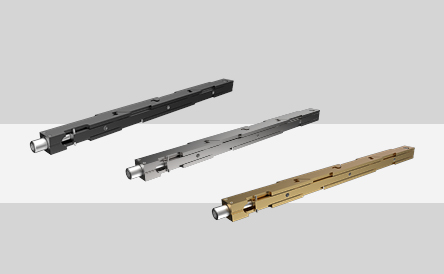
It is building a portfolio that spans:
• Board‑level thermal components
• Module‑level solutions, including liquid flow‑through designs
• Rack‑level cooling systems for large, complex installations
At board level, nVent SCHROFF highlighted its card locks/wedge locks, including a new Positive Retraction Card-Lok. Traditional card locks can suffer from a failure mode known as stiction, where the wedges remain stuck to the slot walls even after the screw is reversed, risking board damage during removal. The positive retraction design applies an active pulling force when the screw is reversed, cleanly retracting the wedges and eliminating this failure mode – a crucial advantage in mission‑critical aerospace and defence environments.
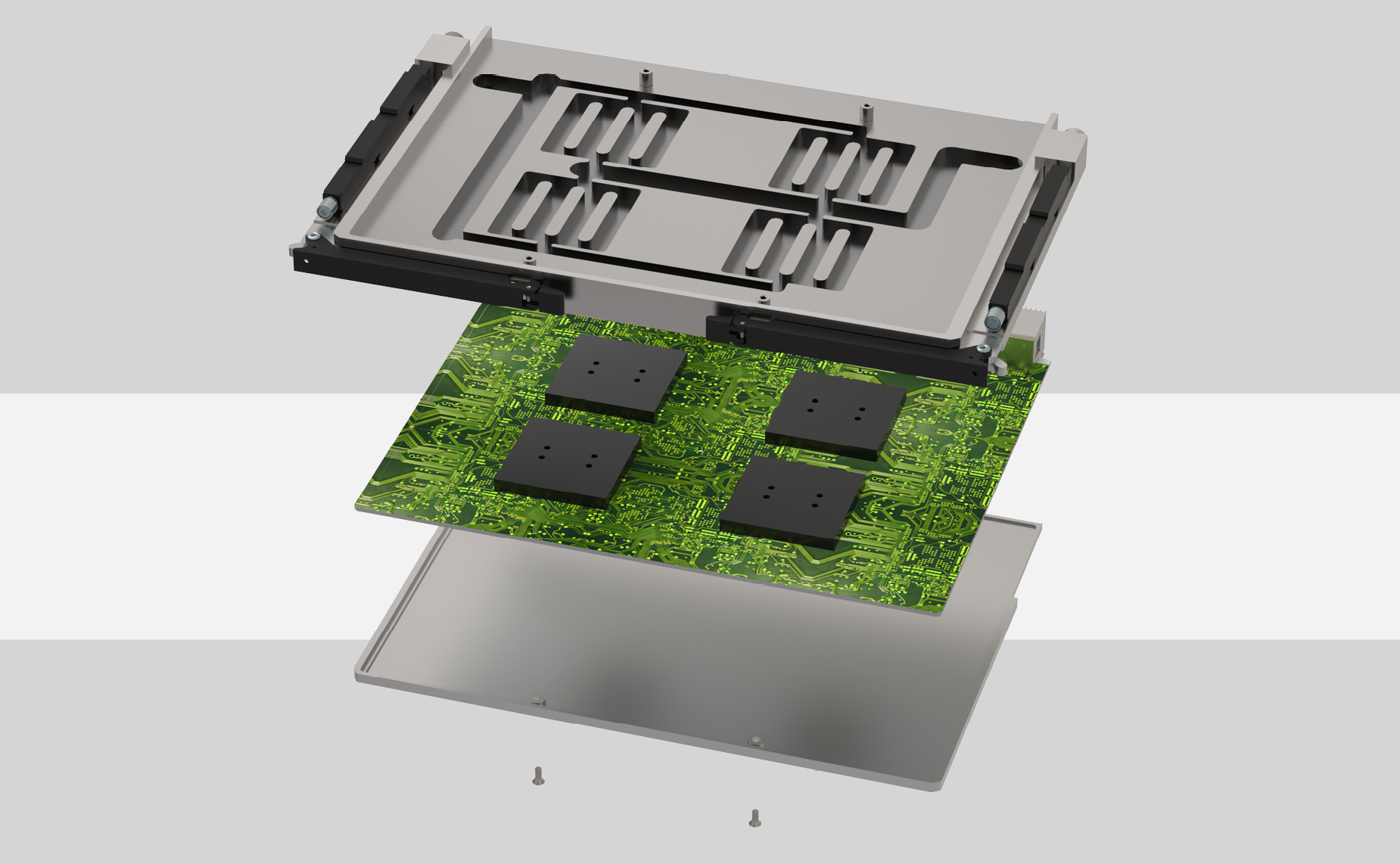
Moving up a level, the company is investing in liquid flow‑through modules that comply with the VITA 48.4 standard. These modules are designed for high‑power, high‑density electronics in harsh conditions, where traditional air or conduction cooling is no longer sufficient. Historically, defence projects were wary of placing liquids near electronics, particularly under extreme G‑forces, but the new VITA standard and nVent SCHROFF’s implementation aim to address these concerns. The modules are supplied as complete kits – including casing, card locks, inserters, extractors, and gaskets – simplified into a single part number for easier sourcing and integration.
At the rack level, nVent SCHROFF showcased its LHX Air/Liquid Heat Exchangers. The units demonstrated include 5 and 10kW variants, designed as in‑rack cooling solutions for environments such as big science laboratories and quantum computing control systems. Beyond removing large amounts of heat, these systems provide extremely precise temperature control, maintaining conditions within half a degree. This level of stability is crucial where even slight thermal drift could compromise experimental results.
Looking to 2026, Smerillo hinted that thermal management will be a major narrative, with expanded offerings at board, chassis, and rack level to match the specific location and intensity of customers’ thermal challenges.
Looking ahead to embedded world 2026
When asked what he is personally most excited to showcase at embedded world next year, Smerillo pointed to two areas: the Gen 5 PXIe chassis, in which he has been deeply involved, and the new cooling solutions that will broaden nVent SCHROFF’s thermal management story.