




When Rebecca, a pupil from Kelvinside Academy in Scotland, was asked what she would do if she were an engineer, she decided that she wanted to help people sleeping rough to stay warm. Her idea – a solar-powered heated blanket – has since been recognised by Time Magazine, which named her ‘Girl of the Year’, and by The Primary Engineer MacRobert Medal, where she took home both a Silver Medal and a first-of-its-kind Commendation Medal voted for by the public, showing that real solutions to real-world problems can come from the youngest minds.
Seeing problems differently
According to Shelter Scotland, a household becomes homeless every fifteen minutes. Between 2024 and 2025 alone more than 40,000 applications for homelessness assistance were recorded, with over 31,000 open cases by March 2025. These statistics often stem from complex logistics. But to Rebecca, who noticed a homelessness problem in her community, the crisis led her to wonder: what can I do to help keep people a little warmer at night?
Her heated blanket idea, part of her entry into The Primary Engineer Leaders Award – an annual UK-wide competition inviting children aged from three to 19 to identify a problem in their community and propose a creative engineering solution – is designed to give warmth to people without access to power after The Primary Engineer Competition posed the question to pupils: ‘If you were an engineer, what would you do?’ At its heart, the competition encourages children to look at the world around them, identify what could be improved, and think like engineers. Each participant is guided through interviewing professional engineers, visualising their ideas with annotated drawings, and writing a formal letter to professional engineers on the judging panel explaining their solution.
For Rebecca, that process began with observation. She recognised the problem of cold nights for people without shelter and started exploring how to deliver heat without relying on conventional power sources. Her thinking led her to sketch the idea of a heated blanket using flexible solar panels as a heat source.
From idea to innovation
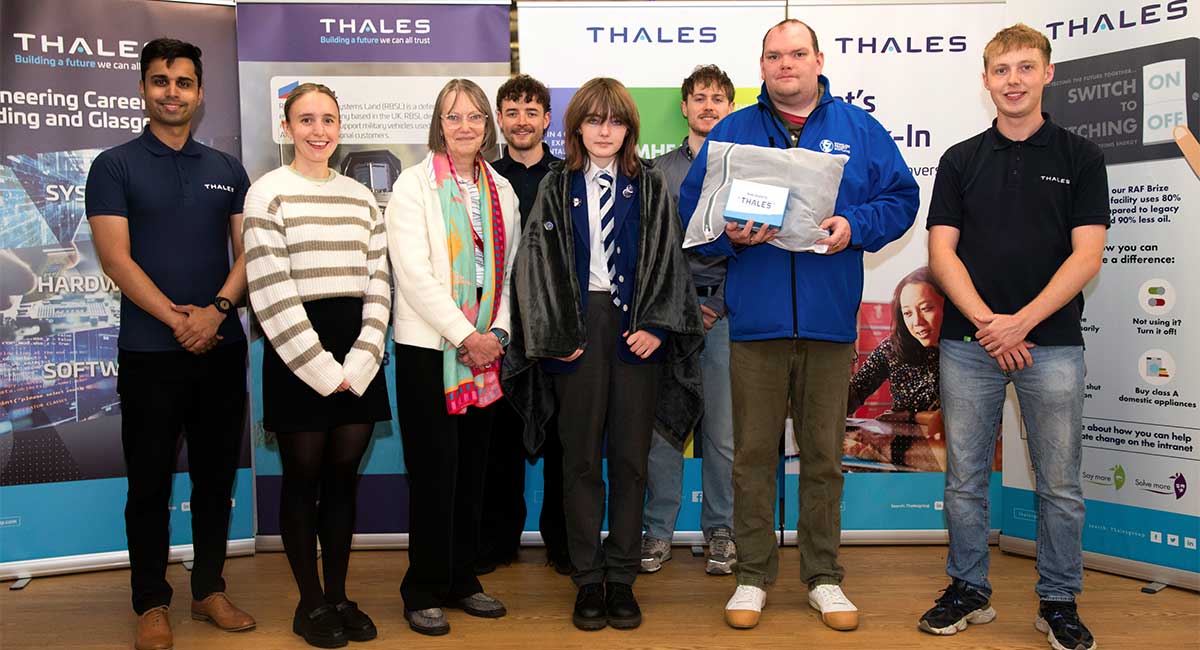
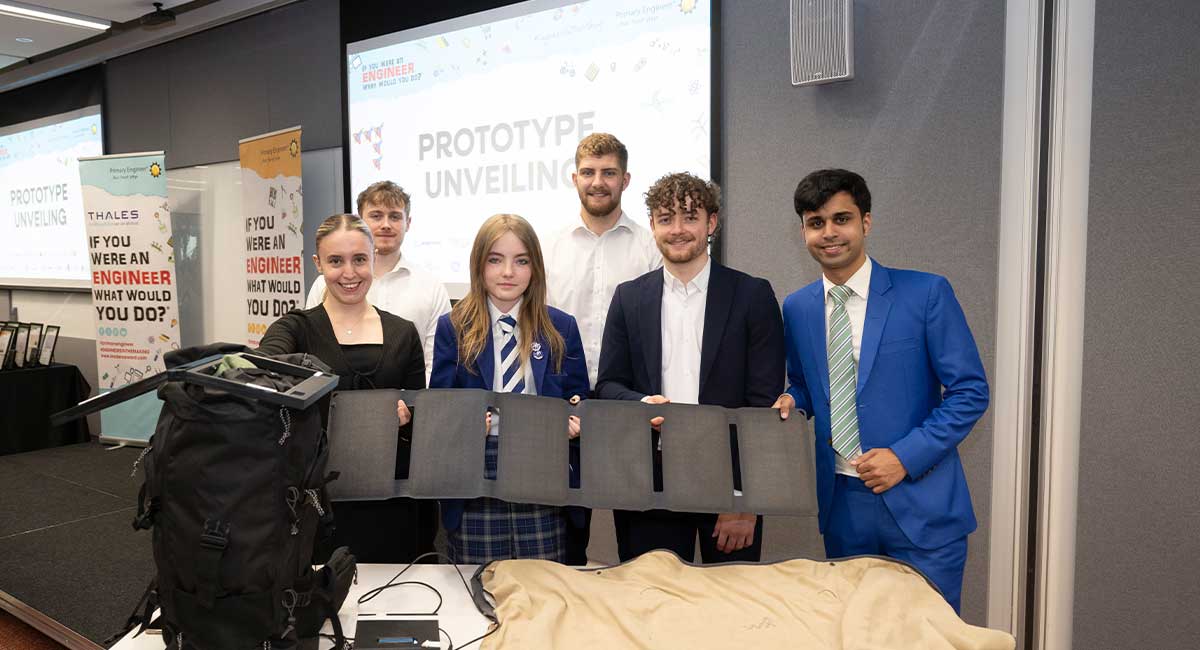
Rebecca’s design caught the attention of Thales UK, which selected six pupil ideas from across the country to prototype at its engineering sites. Over the following year, her concept evolved from a drawing into a working product, shaped by collaboration between Thales engineers and guided by Rebecca’s own feedback.
The resulting design was practical and thoughtful. The blanket evolved to become a sleeping bag that is lightweight and foldable which allows it to be folded into a backpack for easy transport. It is powered by a compact solar panel and battery pack, each roughly the size of a smartphone. The design includes adjustable heat settings, and it prioritises user safety – a critical consideration for any device in direct contact with the body. Thales’ prototype team began by breaking down the system into three core components – the heated blanket/sleeping bag, the solar panels, and the battery pack – and based their calculations on an average eight-hour sleep cycle. They then developed a control circuit capable of automatically switching between on and off states, based on temperature readings, to conserve power and extend the battery’s life.
The team also created a custom outer frame using CAD software, which holds the solar panels securely while doubling as additional storage space. Once assembled, every element was tested for durability, performance, and safety – from breadboard trials of the control circuitry to full system-level tests of the completed prototype.
The power of a young person’s perspective
Rebecca’s success reflects the innate curiosity of children in that they will approach engineering like natural system thinkers – they are curious about how things connect, yet they don’t carry the same burden of bureaucracy or complex thinking that can come from industry.
While adults might approach homelessness as a social policy challenge or a logistics problem, Rebecca’s response was human and immediate: people are cold; they need warmth. From there, she worked backwards to design a technical solution. It’s this clarity of purpose, rooted in empathy, that often distinguishes young inventors. By encouraging children to apply creativity to real-world issues, The Primary Engineer has helped to create an engineering culture that values social impact as much as technical skill. And this is something engineers at any stage of their careers can take from it. In an industry that is constantly shaped by efficiency, cost reduction, and risk mitigation, the ability to reimagine a problem from first principles is a valuable skill.
Engineering a better future
In June 2025, Thales announced that it would produce and donate 150 of Rebecca’s solar-powered blankets to six homeless charities across the Glasgow region. The first 35 have already gone to Homeless Project Scotland, supporting 31 temporary accommodation beds.
For Rebecca, it’s a remarkable achievement. But for the wider engineering community, it’s also a case study in how the profession can nurture fresh thinking.
For the engineers who helped her bring it to life – and for those inspired by her story – it just goes to show that sometimes, the most original engineering thinking starts long before the job title ‘engineer’ is ever earned. And that engineering is so much more than wearing a hardhat.
This article originally appeared in the November’25 magazine issue of Electronic Specifier Design – see ES’s Magazine Archives for more featured publications.