







Molex predicts that artificial intelligence (AI) will continue to transform every major industry sector over the next 12 to 18 months, driving exponential demand for computational resources while causing major bottlenecks in both compute power and connectivity.
AI-driven data proliferation and processing are creating new opportunities and obstacles for design engineers across fast-growth sectors, including automotive, aerospace and defence, consumer electronics, data centres, industrial automation, and medtech.
“AI models in every industry – from autonomous vehicle sensors and high-resolution medical imaging to vital defence systems and real-time control systems on factory floors – generate massive amounts of data while requiring high-speed connectivity, advanced power delivery and efficient thermal management,” said Aldo Lopez, SVP and President, Datacom and Specialty Solutions, Molex. “In 2026, we will remain steadfast in helping remove critical bottlenecks in compute power and connectivity while working with customers, suppliers and partners worldwide to develop future-ready, AI-driven infrastructures.”
Top 10 predictions for 2026
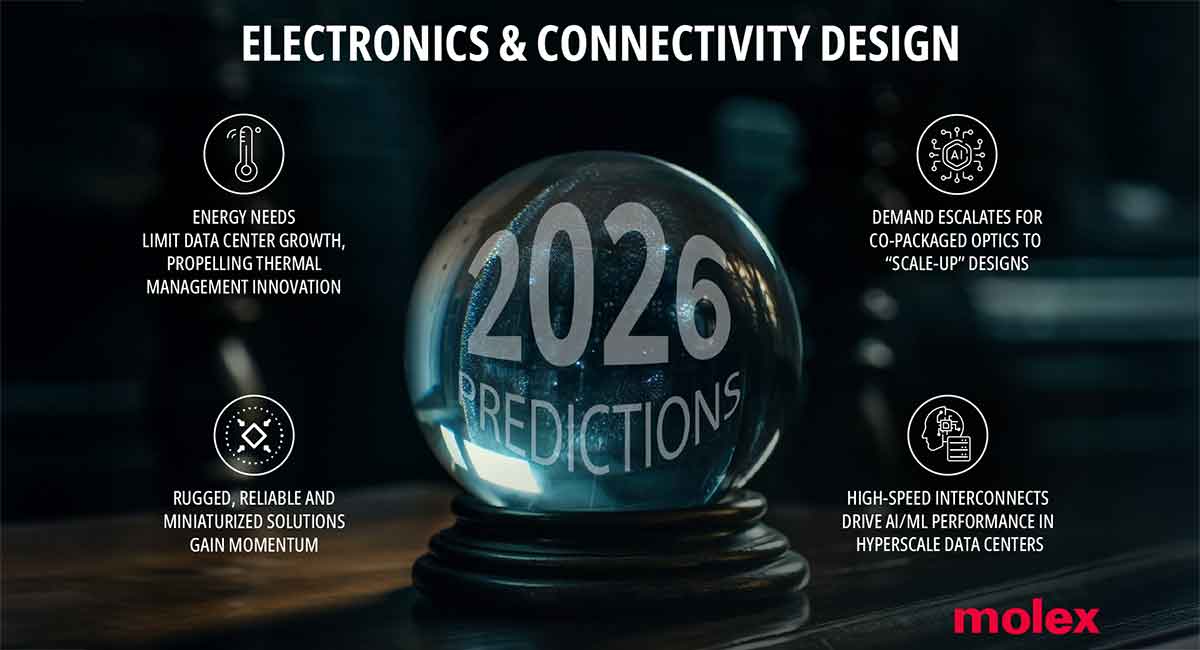
1. High-speed interconnects remain essential to delivering the speed and density to enable AI/machine learning workloads in modern hyperscale data centres
Communication between major compute elements, like GPUs and AI accelerators within a data centre server or chassis, necessitates a mix of high-speed backplane and board-to-board solutions designed for 224Gbps PAM-4 speed, along with high-speed pluggable I/O connectors that support aggregate speeds up to 400/800Gbps while providing a path to 1.6T.
2. Energy consumption hampers data centre scaling, propelling advancements in thermal management
The heat generated by high-performance servers and systems needed to scale generative AI applications while supporting the transition to 224Gbps PAM-4 has exceeded traditional solutions relying on air-cooling technology. Developments in liquid cooling, including direct-to-chip cooling, immersion cooling and passive components that enhance active cooling, will continue to gain traction and exploration over the next 12 to 18 months.
3. Demand escalates for Co-Packaged Optics to support ‘scale up’ architectures
Co-Packaged Optics (CPO) is considered essential for handling GPU-to-GPU interconnectivity in AI-driven architecture. Designed to deliver ultra-high bandwidth density directly at the chip Edge, CPO enables much higher interconnect density while reducing power consumption and electrical signal loss. The focus on CPO is expected to intensify in the coming year, as it has been developed specifically to address the massive power and bandwidth demands of hyperscale data centres and AI/ML clusters.
4. Specialty fibre optics accelerate medtech and aerospace and defence innovations
Specialty fibre optics offer high-precision links with immunity to Electromagnetic Interference (EMI). No wider than human hair, optical fibre increasingly powers high-resolution imaging equipment, like MRI and CT scanners, while delivering concentrated laser energy for non-invasive therapeutic treatments. Fibre optics also address engineering challenges in satellite and space systems to transmit vast volumes of data over long distances with minimal signal degradation.
5. Rugged, reliable, and miniaturised solutions gain momentum across every major sector
The use of compact, durable connectors that thrive in harsh environments has long dominated automotive as well as aerospace and defence applications. Pushing boundaries for greater reliability in very small form factors has now permeated consumer electronics (e.g., fitness trackers, smartwatches and smart home devices); industrial automation (e.g., warehouse robots, touchscreens and sensors); as well as medical devices (e.g., endoscopes, insulin pumps and wearable health monitors).
6. Electrification continues to accelerate, driving demand for high-speed, high-power connectivity
Electrification trends in military land systems are gaining ground, with growth in electric vertical take-off and landing (eVTOL) systems, which need lightweight, miniaturised and rugged MIL-SPEC connectors and cables. An early proponent of zonal architecture for next-gen electrified vehicles, Molex connects multiple sensors, cameras, radar, LiDAR, and other technologies while prioritising the role of hybrid or mixed connectors needed to handle power and high-speed signals associated with in-vehicle networks.
7. Mandates for modular solutions and open standards grow across most industry sectors
An active participant in the Open Compute Project (OCP), Molex is developing next-generation data centre cooling technologies and modular hardware specifications to enhance hyperscale system performance, efficiency and modularity. Close alignment with industry standards groups in aerospace and defence also empowers Molex to focus on reducing size, weight, power, and cost (SWaP-C).
8. 48V architecture gains traction as universal standard for power efficiency
48V architecture is rapidly becoming the universal standard for power efficiency in AI-driven data centres and next-gen vehicles. A power architecture enabler, Molex drives innovation in 48V technology to solve thermal density challenges and reduce cabling weight in automobiles while addressing power spikes caused by generative AI workloads in data centres in support of the OCP Open Rack v3 (ORV3) standard.
9. Personalisation continues to shift, thanks to emergence of agentic AI
Agentic AI adapts readily to changing conditions, aiding real-time decision making and personalisation. In automotive, this translates to advances in autonomous driving and in-cabin experiences that function more like a third living space. In consumer electronics and medtech wearables, greater personalisation optimises product usage while real-time diagnostics improve wellbeing. On factory floors, real-time access to data and adaptive human-machine interfaces improve productivity and operational efficiency.
10. Demands for supply optionality and regional manufacturing grow amid global trade volatility
Investments in AI-driven data ecosystems will propel digital supply chain intelligence to support demands for new, regional supply networks and localised manufacturing amid shifting trade policies. The result requires increased supply chain resilience amid growing demands for increased predictive procurement intelligence.
Dive deeper into these 2026 predictions and hear from Molex industry experts as they explore how engineering ingenuity and emerging technologies are shaping the future. Watch the videos to discover what’s in store across key industries in the coming year.