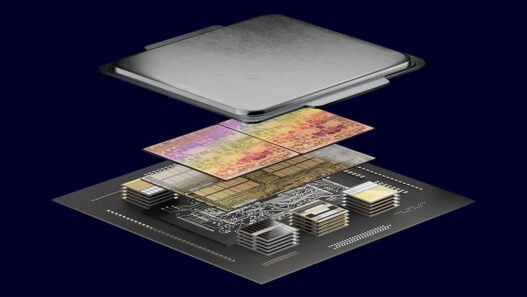











Neuromorphic supercomputers are entering a period of accelerated growth as researchers bring them closer to the structure and function of the human brain. Instead of relying on fixed instruction cycles, these systems operate through networks of artificial neurons that communicate with one another using short electrical spikes.
This design allows them to process information in parallel and adjust dynamically to incoming data. Some operations happen instantly. Others build across thousands or millions of interconnected nodes.
Achieving energy efficiency and scalable performance
One of the strongest arguments for expanding neuromorphic systems is their ability to deliver high performance while using a fraction of the energy required by conventional supercomputers.
Traditional machines must constantly move data between memory and processors.
Neuromorphic hardware stores and processes information in the same location, which eliminates unnecessary data transfers. Because neurons activate only when triggered, the machine performs work only when needed. As these systems grow in size, they maintain efficiency rather than collapsing under their own power demands.
Transforming artificial intelligence
The rise of neuromorphic supercomputers is reshaping artificial intelligence. They excel at tasks that require fast interpretation of sensory data. These tasks include visual perception, motion tracking, speech processing and real-time prediction. They can operate in unpredictable environments without relying on cloud servers, which makes them ideal for next-generation robots, drones and autonomous vehicles.
Many neuromorphic platforms also support continuous learning. Instead of training on massive datasets all at once, they update their behaviour as new information arrives, creating a more flexible and adaptive form of machine intelligence.
Advancing scientific research
Expanding neuromorphic systems are changing how scientists study complex natural processes. Their architecture allows them to stimulate neural activity, biological networks and ecological systems in ways that align more closely with how these systems behave in reality.
This capability can be especially beneficial in neuroscience. Hospitals in the United Kingdom admit around 40,000 people with signs of a traumatic brain injury each year. At least 2.5 million people in the United States sustain brain injuries annually. Researchers continue to search for better methods to understand how damaged neural circuits reorganise and attempt to heal. Neuromorphic machines can help by modelling firing patterns, disruptions and compensatory changes that occur after injury.
These simulations run faster, offer more nuance and allow scientists to explore scenarios that would be difficult or impossible to test through traditional experiments. As a result, the technology may contribute to more accurate diagnostics, improved rehabilitation strategies and deeper insights into how the brain recovers from trauma.
Rethinking computer architecture
The growth of neuromorphic hardware challenges long-standing assumptions in computer engineering. The traditional model separates memory from computation, forcing data to move constantly between different components. Neuromorphic systems erase this line. Memory and processing occur together, and the architecture scales through dense webs of connections rather than through faster clocks or wider instruction sets. This shift encourages new approaches to algorithm design, new programming frameworks and entirely new hardware layouts.
Implications for everyday technology
As neuromorphic supercomputers continue to expand, their influence is beginning to shape everyday technology. Developers are creating low-power chips inspired by neuromorphic principles for mobile devices, wearables and home sensors. These chips can perform real-time analysis without draining a battery or relying on Cloud processing. In health care, neuromorphic systems may enable more responsive prosthetics or early detection tools that listen for subtle biological signals. In environmental monitoring, they can interpret complex patterns in weather and climate data with greater accuracy.
The path ahead
The path forward for neuromorphic computing is both promising and complex. Researchers are working to build larger systems with billions of artificial neurons, but scaling the hardware requires new fabrication techniques and better materials for synaptic components. Software will also need to evolve. Programming neuromorphic machines is not yet as straightforward as writing code for traditional computers, and the field still needs standardised tools that make the technology more accessible.
Collaboration between neuroscientists, engineers and computer scientists is strengthening, which should accelerate progress. As funding grows and early commercial uses emerge, neuromorphic computing is likely to move from a specialised research area to a core part of future computing infrastructure.
A new era for intelligent computing
Neuromorphic supercomputers are redefining what advanced computing can achieve. Their ability to process information efficiently, learn continuously and reflect the structure of living systems gives them unique potential across AI, science, healthcare, and everyday technology.
As these machines continue to expand, they’ll open new possibilities for understanding the brain, improving intelligent systems and designing hardware that works in harmony with the natural world. The momentum behind neuromorphic computing is strong, and its influence is set to grow even more in the years ahead.