







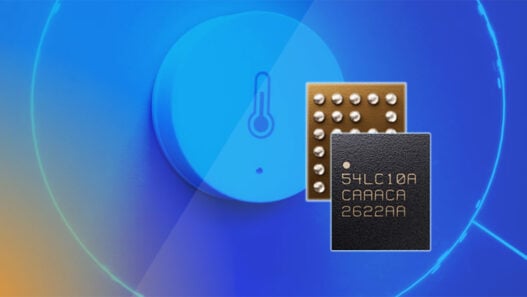

Belgian semiconductor supplier Melexis has unveiled an automotive-grade variant of its MLX90382 magnetic encoder, aiming to support the next generation of electric and digitally controlled vehicles.
The device, which offers up to 16-bit resolution and zero-latency performance, is designed for applications where safety is paramount, including electric steering, power braking, and active suspension systems. Its stray-field immunity (SFI) ensures reliable operation in the demanding electromagnetic environments typical of electric vehicles.
As automakers move away from mechanical and analogue feedback systems towards fully electronic control architectures, demand is rising for encoders that combine accuracy, safety, and robust diagnostics. High-speed digital feedback is critical for steer-by-wire, brake-by-wire, and active suspension systems, where replacing analogue interfaces with digital protocols can reduce wiring complexity, weight, and improve on-board diagnostics.
The MLX90382 integrates a Hall effect magnetic front end, analogue-to-digital conversion, and on-chip digital signal processing. Using Melexis’ Triaxis technology, it tracks the three components of magnetic flux density to measure absolute angle position and speed with precision, reaching speeds of up to 200,000 e-rpm and a 360° SFI of up to 4 kA/m. The device is compatible with multiple interfaces, including ABI, UVW, PWM, SPI, and SSI, and can be mounted on- or off-axis for flexible integration, including hollow-shaft applications.
Available in QFN24 and TSSOP16 packages, the MLX90382 supports 3.3V and 5V systems, operates across -40°C to 150°C, and is qualified to AEC-Q100 Grade 0 standards. Its dual-die variant is certified for ISO 26262:2018 functional safety compliance, supporting ASIL D system integration.
“Automotive manufacturers are rapidly transitioning to fully digital feedback systems to enable x-by-wire architectures and meet rising safety and availability demands,” said Klaus Wilczek, Global Marketing Director at Melexis. “This latest variant brings those benefits to steering, braking, and suspension systems — delivering robust, safe digital protocols and improved diagnostics, with further innovations to follow.”