




Resistors in parallel. Current divider circuit and equation

Two or more resistors are said to be in parallel, if identical voltage is across all the resistors.
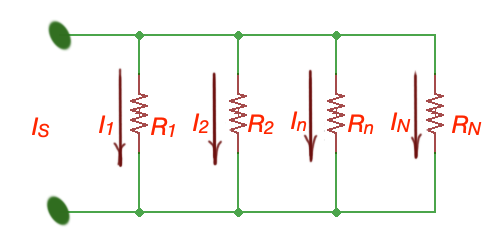
Resistor in parallel

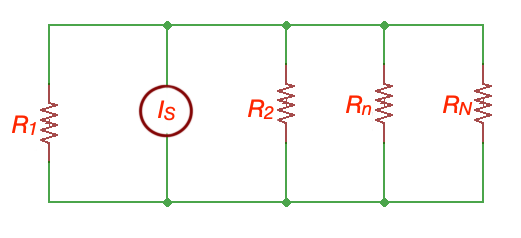
In accordance to Kirhhoff’s Law the current IS=I1+I2+...+IN, and V1=V2=...=VN=V.

Here I1=VR1, I2=VR2, ...IN=VRN. So IS=V(1R1+1R2+...1RN)=VReq.

Here parallel resistors can be replaced by the equivalent resistance 1Req=1R1+1R2+...1RN, and Req=11R1+1R2+...1RN.

Resistors in parallel and current divider

Then current through a resistor in parallel circuit is In=1Rn1R1+1R2+...1RNIS. This equation is called current divider. Current divider is a linear circuit, producing output current equal to a fraction of the input current.

For example, if R1=1Ohm, R2=2 Ohm, R3=4 Ohm, R4=2Ohm and Is=4A, then I3=49A.


Keep Up to Date with the Most Important News

By pressing the Subscribe button, you confirm that you have read and are agreeing to our Privacy Policy and Terms of Use
Previous Post

Qualcomm receives authorisation for NXP Semiconductors acquisition

Next Post

Resistors in series. Voltage divider circuit and equation