



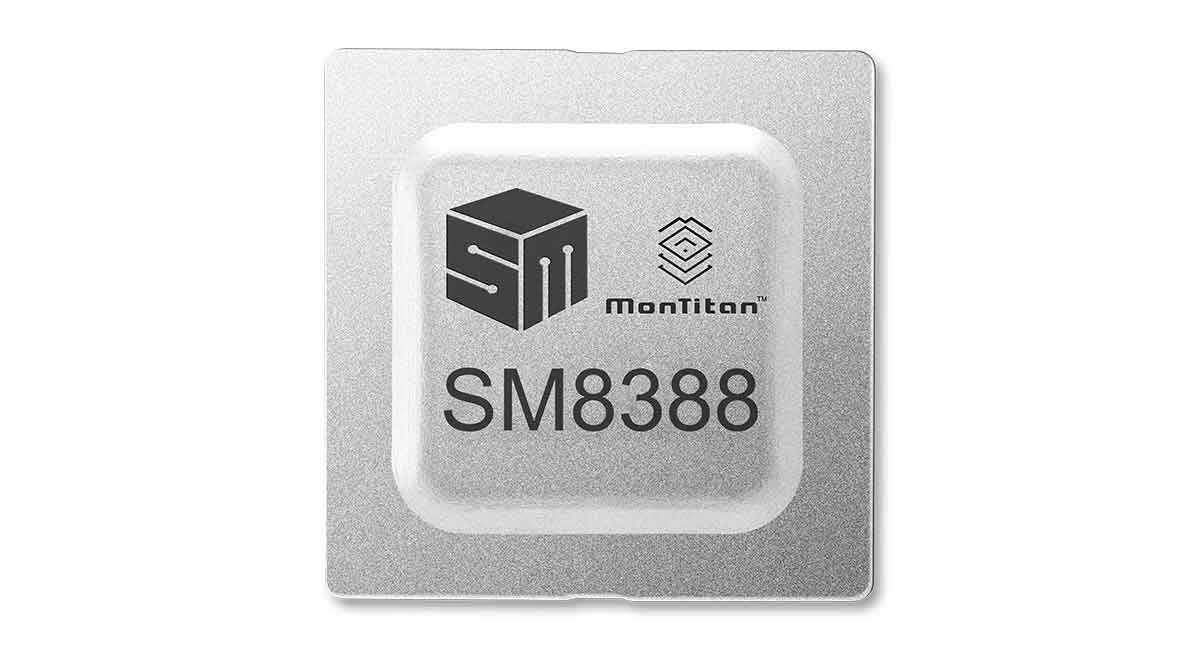
Silicon Motion Technology Corporation has announced its SM8388, a power-efficient 8-channel PCIe Gen5 enterprise SSD controller, designed for high performance, low power, lower cost, and high-capacity QLC enterprise SSDs – enabling Nearline SSDs. It sets a new benchmark by combining ultra-high performance and QLC NAND support with enterprise-grade security features and exceptional energy efficiency, addressing the growing demand for scalable, high-capacity warm data storage in AI and Cloud environments.
“The SM8388 extends our proven MonTitan SSD development platform that was first introduced with our successful high-performance, 16-channel PCIe Gen5 SM8366 controller,” said Alex Chou, Senior Vice President of Enterprise Storage & Display Interface Solution Business at Silicon Motion. “Building on the same robust architecture that has been adopted by leading enterprise SSD makers, the SM8388 is purpose-built for Nearline SSDs that serve AI-driven databases and data-centric infrastructures, combining exceptional throughput with industry-leading power efficiency.”
Featuring an 8-channel architecture supporting up to 3200MT/s per channel, the SM8388 delivers up to 14.4GB/s sequential read throughput and up to 3.5 million IOPS random read performance and supports SSD capacities of up to 128TB. Fully compliant with NVMe 2.6, the SM8388 supports multiple AI data centre form factors, including EDSFF (E1.S/E3.S) and U.2/U.3, enabling flexible configurations for high-density Nearline deployments. The SM8388 also incorporates enterprise-grade security features, including attestation, secure boot, key wrapping, AES-256 encryption, TCG Opel, and a hardware root of trust, ensuring data integrity, and protection across AI and Cloud storage environments.
With a typical active power consumption under 5W, the SM8388 achieves outstanding power efficiency without compromising performance. Its unique hardware-based channel speed accelerator, based on Separate Command Address (SCA), maximises channel-level parallelism to fully unleash the performance potential of PCIe Gen5, delivering superior read performance and responsiveness. These attributes make the SM8388 particularly effective for AI-driven nearline storage, where high read throughput is critical for managing warm data and its unparalleled power efficiency delivers lower operating cost and total cost of ownership.
The MonTitan enterprise SSD development platform provides a highly scalable, customisable foundation for building PCIe Gen5 and future-generation SSD solutions. It combines Silicon Motion’s advanced controller architecture, firmware stack, and reference design to accelerate time-to-market for partners developing enterprise and data centre SSDs. Leveraging MonTitan’s proven ecosystem and robust validation framework, the SM8388 enables seamless adoption of next-generation NAND technologies – including QLC – while delivering optimal performance and power efficiency for AI and Nearline storage applications.
“AIC is pleased to collaborate with Silicon Motion on next-generation AI server platforms designed for high-performance, power-efficient storage,” said Michael Liang, President and CEO of AIC. “By integrating SSDs powered by Silicon Motion’s MonTitan development platform into our AI server systems, we enable highly efficient, high-capacity storage that meets the evolving demands of AI data centres – from training to inference and warm data management.”